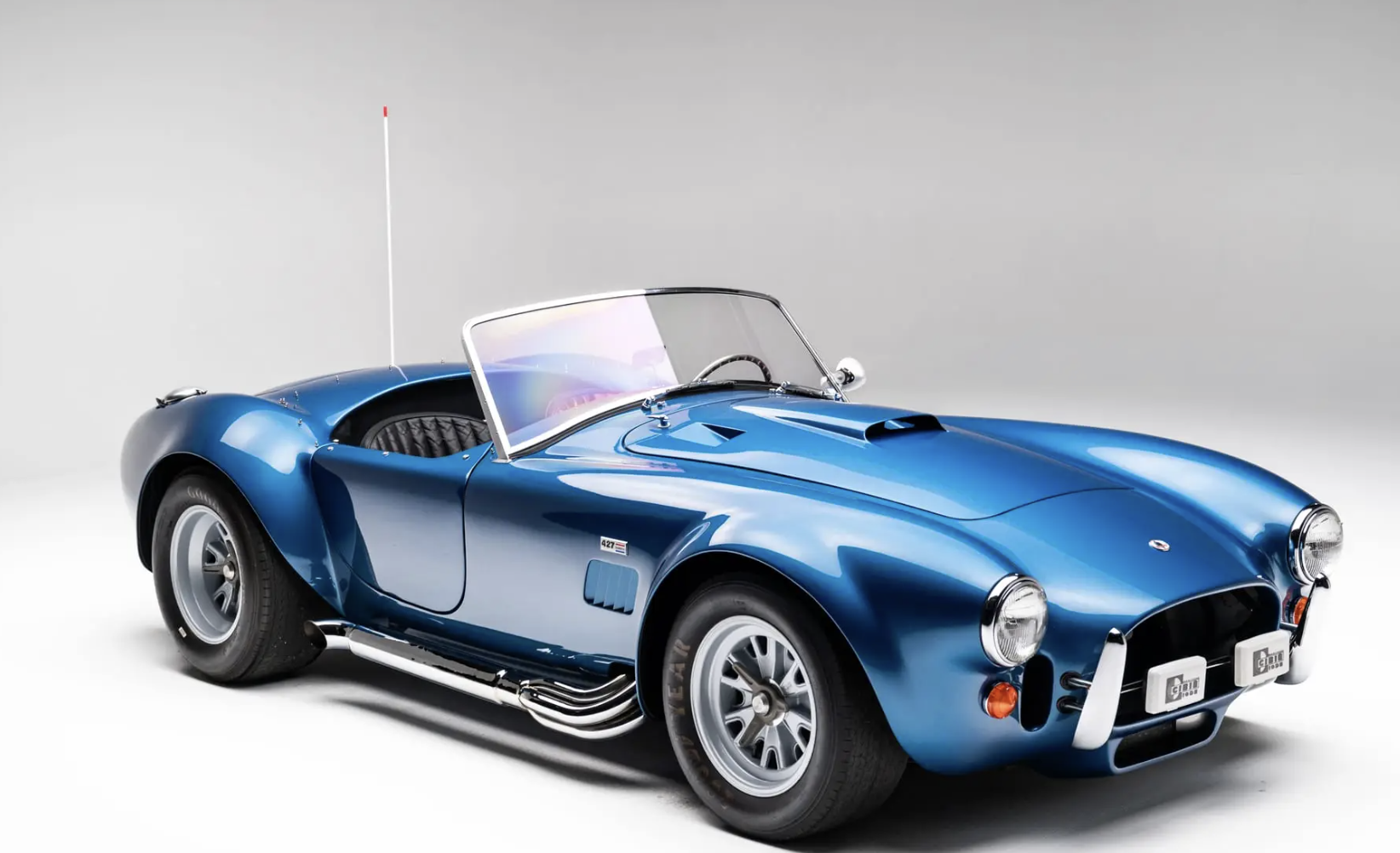
The 427 Cobra has been the loudest thing in any parking lot for sixty years, but only one of them got to bully a Ferrari Daytona down the concrete trench of the Los Angeles River while a nation of teenagers sat in a theater deciding what they wanted to be when they grew up. That car is CSX3243, and it’s currently live on Bring a Trailer with bidding closing August 26, consigned by Lincolnshire, Illinois dealer Blackdog Performance.
The timing is not an accident. The Gumball Rally hit theaters in August 1976, which makes this a fiftieth-anniversary consignment, and the seller has spent the past several years walking the car backward into its screen specification rather than forward into concours polish. That’s a defensible choice, and also a commercially calculated one.
What you’re actually buying, mechanically
A lot of people say “427 Cobra” without knowing what changed between the small-block cars and this thing. The Mark III wasn’t a 289 with a bigger engine crammed in — it was a substantially different car sharing a silhouette. AC built a new steel ladder frame with main tubes stepped up to four inches, ditched the transverse leaf springs for coil-over suspension at all four corners, widened the track, and flared the aluminum bodywork to cover it, all on the same 90-inch wheelbase. The result is a chassis that’s roughly twice as stiff in torsion as the 289 car and needs to be, because the Ford FE big block hanging over the front axle line is a genuinely heavy lump of iron.
Related Articles
- Stellantis Is Already Building the Next Jeep Cherokee, and This One Barely Has Floor Mats Yet
- Rivian’s E-Bike Spinout Just Raised $150 Million to Chase Driverless Delivery
That engine deserves its own footnote. The 427 side-oiler earns its name from a redesigned oil galley that runs down the left side of the block and feeds the main bearings before the top end — the opposite priority to a standard FE, and the reason side-oilers survive sustained high-rpm abuse that grenades ordinary 427s. It’s also worth knowing that a meaningful share of cars badged “427 Cobra” left Shelby American with 428 Police Interceptors instead: same external dimensions, cheaper to build, softer bottom end, considerably less exotic. Anyone shopping big-block Cobras should treat engine identification as step one, not a detail.
CSX3243’s specific wrinkle is that it isn’t running its original engine. After the car emerged from more than three decades of storage in 2010, McCluskey Ltd. and Maeco Motorsports handled the mechanical recommissioning, and a prior sales listing documented that the numbers-matching motor was pulled and set aside for safekeeping while a Maeco-built 427 side-oiler went in. Purists twitch at that. They shouldn’t. Preserving an irreplaceable original block in a crate while a fresh unit takes the thermal cycling and vibration is exactly what you do with a car you intend to drive — and this one has been driven, including at the Coronado Speed Festival and the Monterey Historics. The original engine goes with the car.
The other thing to understand is the “S/C” appearance. Genuine factory S/C Cobras were unsold competition cars converted for road use, and they trade at a fierce premium over street Mark IIIs. This car got its semi-competition modifications from an owner — collector Les Lindley — in the 1970s, which is precisely why Warner Bros. wanted it. It looked meaner than a stock street car on 35mm film. Buyers need to price it as what it is: a street 427 with period owner modifications and a movie résumé, not a factory S/C.
Provenance is a document problem, not a story problem
Movie-car value lives and dies on paperwork, and this is where the auction actually gets interesting. The AFI production record notes it took 61 days to move the cast and cars from Manhattan to Long Beach, with writer-director Chuck Bail putting stunt driver John Morton in charge of a drivers’ clinic to teach the actors how not to kill themselves at speed. Morton’s signature is on this Cobra’s glovebox door. The car carries 1975 Warner Bros. lease documentation.
That chain — studio contract naming a chassis number, plus continuous ownership history — is the difference between a seven-figure car and a nice 427 with a good anecdote. Screen-used claims without paper are the most common fraud in the collector market, and the Cobra world is especially exposed because so many replicas exist that a persuasive story plus blue paint gets you most of the way to a con. The Shelby American Automobile Club’s World Registry remains the arbiter here; if a CSX number’s history doesn’t reconcile with the registry, walk.
The ownership reality nobody puts in the listing
A 427 Cobra is an aluminum body riveted and bolted to a steel frame, which means galvanic corrosion at every dissimilar-metal interface is not a possibility, it’s a schedule. Body mounts, fastener locations, and the underside of the sills are where these cars quietly eat themselves, especially after long storage in humid conditions. Any pre-purchase inspection worth paying for includes lifting the car and looking hard at those junctions rather than admiring the paint.
Related Articles
- Polestar Hand-Built 34 Prototypes Just to Learn How to Build One Car
- FLEX Automotive Will Now Ship a Genuine JDM Land Cruiser Straight to Your Driveway
Add to that: a cooling system with essentially zero thermal reserve in traffic, side pipes that will brand your calf if you exit carelessly, Girling discs that were adequate in 1966 and are merely acceptable now, and pin-drive knock-off wheels that require regular re-torquing and directional discipline. Aluminum bodywork repair on an AC shell is not a job for a general collision shop; there are maybe a handful of people in the country who do it correctly, and their calendars are full.
On the insurance side, an agreed-value collector policy is mandatory, and the appraisal needs to specifically account for the provenance premium — a standard valuation on a street 427 Cobra will leave a substantial uninsured gap on a car whose value derives partly from a film credit. Bring the Warner Bros. documentation to the underwriter, not just the SAAC registry entry. Registration is its own adventure depending on the state, since these cars carry chassis serials rather than anything a modern DMV computer recognizes as a VIN.
What it’s likely to teach us
The broader signal here is about how the top of the collector market has migrated online. A car of this stature would have anchored a Scottsdale or Monterey stage a decade ago, with the theater and the auctioneer’s cadence doing real work on the final number. Running it on a public comment-thread platform instead is a bet that a fifty-year-old comedy has built a deeper, more distributed bench of emotionally invested bidders than a room full of consignors ever could. Given how many people can still hear that side-pipe soundtrack from memory, it’s probably a good bet.
Images Via: Bring a Trailer
About the Author