Honda just opened its own race car archive for business, and the fine print is the interesting part
Factory heritage departments usually sell you a repaint and a certificate. Honda Racing Corporation USA has decided to sell the cars themselves — and, more importantly, the institutional memory required to keep them running.
The HRC Heritage Racing Program went live during Monterey Car Week, covering restoration, sales, service and trackside support for historic Honda and Acura competition machinery. HRC US president David Salters framed it around custodianship of the original intellectual property, and that’s not marketing puffery — it’s the entire commercial premise. Anybody can repaint a prototype. Almost nobody outside Santa Clarita has the drawings, the homologation paperwork, or the engineers who signed off on the thing when it was new.
The headline car is not what the headline implies
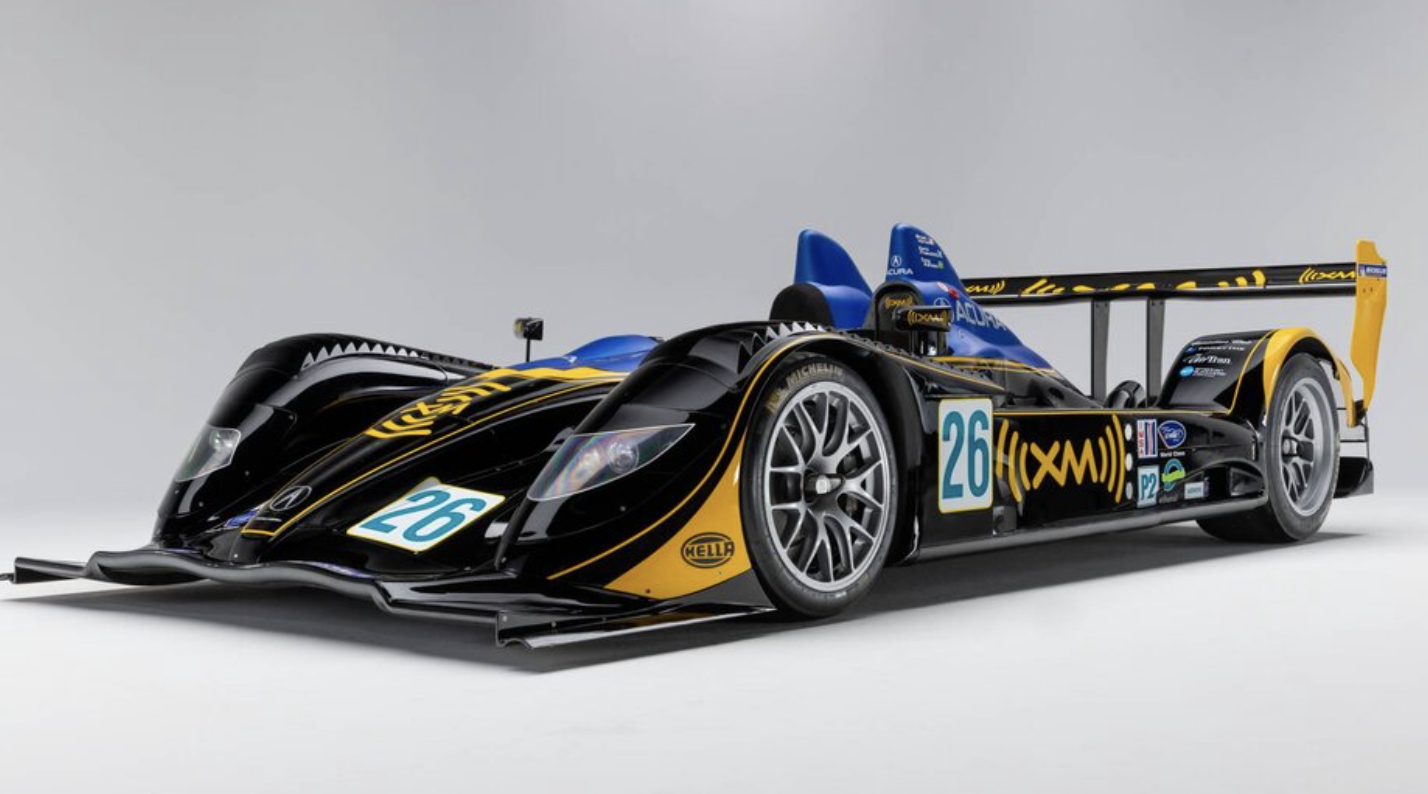
The launch vehicle is the #26 XM Satellite Radio Acura ARX-01a that Dario Franchitti, Bryan Herta and Tony Kanaan drove to an LMP2 class win at the 2007 Sebring 12 Hours — its debut race. HRC’s own listing describes the car as unrestored and original, which is a meaningfully different proposition from the restoration program surrounding it.
Related Articles
- Chevrolet’s Impala Sneaker Deal With Devin Booker and Nike, and What Impala Buyers Should Know
- How California’s New 100 MPH License Rule Changes Monterey Car Week for Drivers
That’s a genuine fork in the road for whoever buys it. Preservation-class cars carry a premium precisely because originality is a one-way door — you can restore an original car, but you can’t un-restore it. A prototype that raced hard for a season carries scuffs, repairs and period-correct wear that a full teardown erases forever. The upside of handing it to HRC is that you get a car you can actually race. The downside is that you’ve spent the provenance.
There’s also a nice bit of history buried in the listing: the XM car began life on a Courage LC75 chassis, and the modifications were extensive enough that it was homologated as its own model. The engine underneath is the AL7R — a 3.4-liter naturally aspirated 90-degree V8 rated at roughly 480 bhp, spinning to a 10,500 rpm limit, mated to a six-speed sequential. HRC says it shares architecture with the Indy Racing League V8 of the era, but that none of the parts interchange.
Sit with that last detail, because it explains the whole program. A 2007-spec prototype V8 with no parts commonality to anything else on earth has a supply chain of exactly one company, and that company is the one now offering to rebuild it.
Race engines are consumables, and that’s the real running cost
HRC’s engine services page is more revealing than the press release. It describes rebuilds against mileage limits, plus an inspection menu that includes borescope work, a water system pressure test, a nut-and-bolt check, documentation verification and dyno testing on certain engines.
If you’ve never owned a purpose-built racing engine, here’s the part that surprises people: these things are designed to a duty cycle, not to a lifespan. Valve springs, rod bolts, bearings and pistons in a 10,500 rpm V8 are engineered to survive a defined number of hours under load and then be thrown away. Ignoring the interval doesn’t get you a rough idle as a warning — it gets you a window in the block. HRC also notes that it makes changes where modern usage differs from period demands, which is the polite way of saying a car that ran a 12-hour endurance race on a professional maintenance schedule now gets driven twenty minutes at a time by an amateur, and the build spec should reflect that.
Note also the fuel listed for both the ARX-01a and the NSX GT3: MS100 unleaded. That’s a controlled racing fuel, not something you buy at a truck stop, and it’s another line item in a budget that most first-time buyers underestimate.
Electronics are why these cars die
HRC says electronics get modernized during restoration, and commercial manager John Whiteman singled out electronics specifically when describing what gets updated. This is the single most important sentence in the announcement.
Historic racing has a hard cutoff problem. Cars from the 1960s can be maintained by any competent fabricator with a lathe. Cars from 2007 cannot, because they depend on proprietary ECUs, dash loggers, CAN networks and calibration software that were obsolete within a decade. The laptop that talks to the car is often the rarest part of the car. Once the vendor stops supporting the software — or the one guy who understood the wiring loom retires — the machine becomes a very expensive coffee table. A manufacturer that still employs the engineers and holds the original data is the only credible solution to that, and it’s why factory-backed heritage programs are expanding across the industry rather than shrinking.
Eligibility is the gate nobody thinks about
The consultancy service quietly does the most useful work. HRC says it can research parts, setups and vehicle history, and can approach a specific series or event to help support acceptance.
Related Articles
- Gordon Murray’s New Special Vehicles Supercar: Reading the Teaser Before Friday’s Quail Reveal
- 2027 Suzuki GSX-R600 and GSX-R750: Prices, Specs, and the Missing ABS
That matters because owning a historic race car and being allowed to race it are separate achievements. Vintage and historic series run on logbooks, period-correct specification and organizer discretion, and a car that’s been modernized in the wrong places can be rejected from the grid it was bought to run on. The NSX GT3 listing shows how fine that line is: HRC states chassis 005 was restored to 2017 specifications with the exception of the 2020 Evo handling updates, adopted to improve drivability. Sensible engineering. Also, technically, a deviation from period spec — exactly the kind of thing a scrutineer asks about, and exactly why having the manufacturer’s homologation documents in your file is worth real money.
Which one would I actually buy?
If the goal is to drive rather than to display, the GT3 is the adult choice. Its JNC1 3.5-liter twin-turbo V6 revs to 7,500 rpm and was built on the production NSX’s design specifications at the same Ohio engine plant, in a car HRC lists at 2,780 pounds. Lower revs, production-derived architecture and a Balance of Performance-restricted output between roughly 500 and 557 bhp add up to dramatically cheaper hours than a bespoke 10,500 rpm prototype V8. Chassis 005 also happens to be the winningest NSX GT3 ever built, with 22 wins and three championships between 2017 and 2022, and HRC bought it in 2025 and sent it to JAS in Italy for a full restoration completed this past April.
Two practical warnings for anyone drafting a wire transfer. First, purpose-built race cars have no VIN and no title — the transaction is a bill of sale against a chassis number, which makes documented provenance the entire asset, and makes a factory-verified history worth paying for. Second, your regular collector-car policy almost certainly excludes competition. On-track coverage is a specialty product, agreed value is mandatory, and most policies still won’t pay for damage incurred while racing. Budget accordingly, or accept that a mistake at Turn 11 is entirely your problem.
No prices have been published for any of it, which in this corner of the market is the answer.
Images Via: Honda
About the Author