If your Car Week plan involves a spirited run up Highway 1 or a blast over the Santa Ynez hills on the way north, the enforcement math changed last winter and almost nobody driving to Monterey has noticed.
The old mental model went like this: get clocked, take the citation, hire a lawyer, show up in court, maybe get it knocked to a non-point violation, pay the fine, go home. Annoying, expensive, survivable.
That model is obsolete for one specific number.
FAST: the part that doesn’t care what the judge says
In December 2025, the California DMV and CHP launched a joint pilot called Forwarded Actions for Speeding Tickets, or FAST. Every citation written for driving more than 100 mph automatically kicks a referral to the DMV’s Driver Safety Branch. Driver Safety then reviews the incident and your record to decide whether to suspend or revoke your license.
Read the DMV’s own description carefully, because this is the whole story: the decision is independent of any judicial action tied to the citation, and it does not depend on a conviction. The review fires even if you have zero prior negligent operator points.
Related Articles
- Trent Williams Is Being Sued Over a Porsche 911 Lease—And the Car Is Reportedly Missing
- O’Reilly’s $18.8 Million Text Settlement Has a Ceiling, and Your $22 Check Has an Asterisk
So the guy who beats the ticket in Monterey County Superior Court in February can still be looking at a suspension letter that has nothing to do with that outcome. Two separate agencies, two separate proceedings, one traffic stop.
This is not theoretical anymore. Per CHP’s most recent enforcement release, the agency submitted more than 3,200 FAST referrals between January and May 2026. The DMV responded with over 3,000 suspension and re-examination actions — and 94.3 percent of those held up after administrative review and hearings.
That last figure deserves a moment. Roughly nineteen out of twenty people who fought the administrative action lost.
The cars you won’t see coming
The other half of the equation is what CHP is driving.
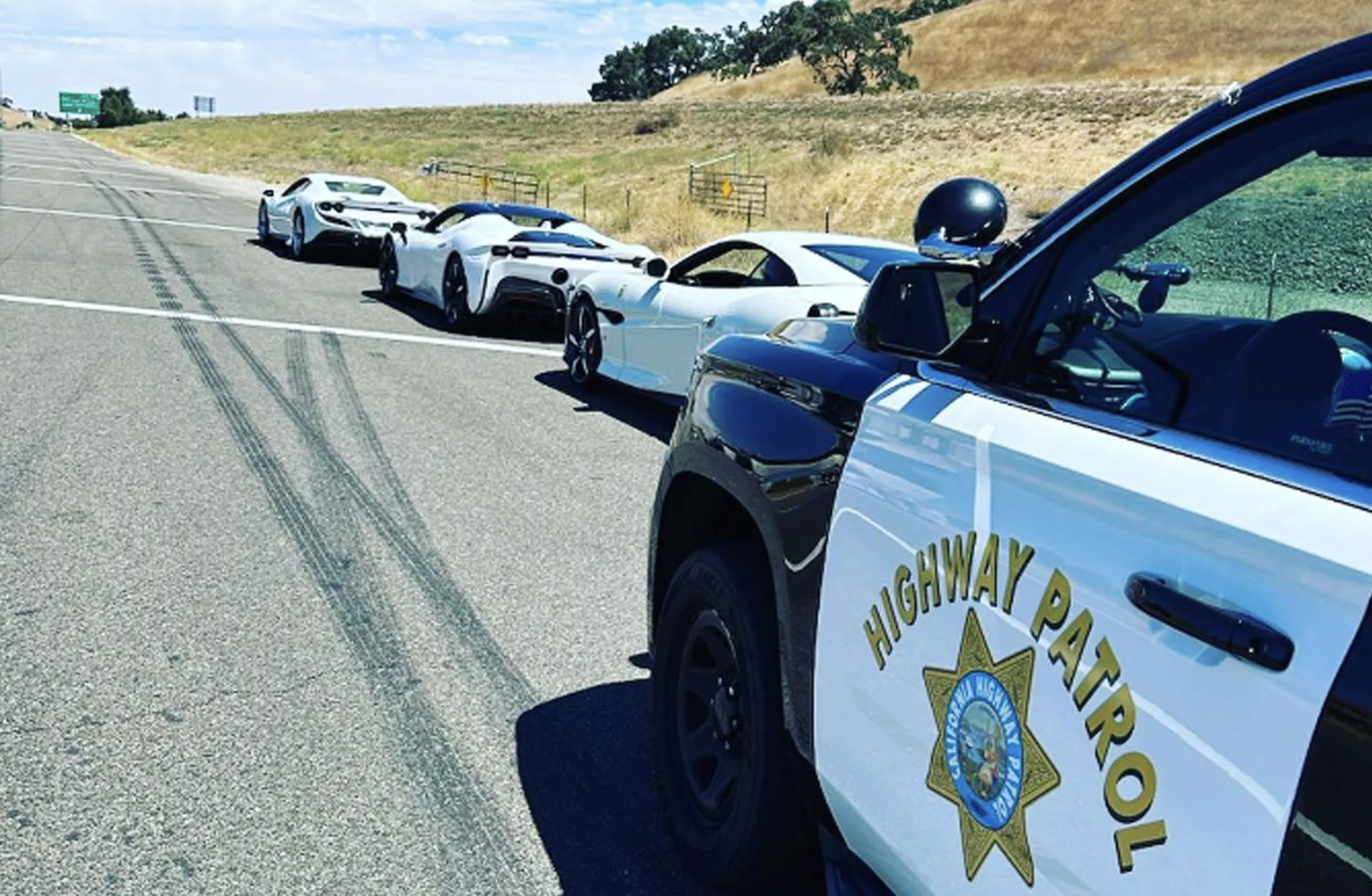
In May 2025, the agency put 100 low-profile, specially marked patrol vehicles into service statewide. These aren’t unmarked — they carry markings, just subdued ones — and the operational point is that they sit in traffic long enough to watch behavior before anything lights up.
The numbers tell you how well that works. In their first six months, officers in those cars wrote nearly 33,000 speed-related citations, of which more than 1,100 were for triple digits. By this summer, CHP put the cumulative total at more than 59,000 speed citations from that fleet alone.
Statewide, CHP writes roughly 1,600 citations a month to drivers doing 100 mph or better. In 2024 the total topped 18,000.
Then there’s the part enthusiasts consistently underestimate. CHP’s Coastal Division — which owns a 325-mile stretch of Central Coast through eleven Area offices — runs its own Air Operations unit, and airborne traffic enforcement is explicitly part of its job description. A radar detector is a useless object when the observation is happening from 1,500 feet and the stop is being made by a car three miles ahead of you.
What the statutes actually say
Worth knowing exactly which lines you’re standing near. California’s speed laws live in Division 11, Chapter 7 of the Vehicle Code, and three sections matter this week.
Section 22349 sets the general maximum at 65 mph — and, critically for the roads people actually want to drive, caps two-lane undivided highways at 55 mph unless posted higher on the basis of an engineering and traffic survey. That covers an enormous amount of the scenic mileage around Carmel Valley and the coast. The “everyone does 75 here” defense has no statutory footing.
Section 22350 is the basic speed law, which prohibits driving faster than is reasonable and prudent given weather, visibility, traffic, and road surface and width. This is the section that catches you when you’re doing the posted limit on a fog-bound stretch of Highway 1 in August, which is a very real condition on the Monterey Peninsula.
Section 22348(b) is the 100 mph provision: an infraction, but one carrying a fine up to $500 on a first conviction plus a license suspension of up to 30 days, escalating for repeat offenses within three and five years. And now, separately, the FAST referral.
Where this collides with your DMV record
The DMV’s Negligent Operator Treatment System runs on a published ladder, and the thresholds are tighter than most drivers assume. Two points in 12 months earns a warning letter. Three points in 12 months brings a notice of intent to suspend. Four points in 12 months triggers an order of probation and suspension — one year of probation including a six-month suspension, effective 34 days after the order is mailed.
Stack that against the FAST pathway and the exposure compounds fast. A single bad decision on Highway 101 can produce a court case, a DMV administrative action, and a record entry that follows you into every insurance renewal for years.
The insurance consequence people forget
Everyone braces for a premium increase. Fewer people think about what a suspension does to coverage.
A suspended license is not merely a scheduling problem. It’s a rating and eligibility problem at renewal, it’s a question on every application you’ll fill out for years, and if you drive on it and something goes wrong, you’re arguing with a claims adjuster about whether you were a permitted operator. For anyone traveling with a high-value collector or exotic on a specialty policy — the exact demographic this week attracts — a driving-record event of that severity can force a rewrite on terms you won’t enjoy.
And if the car isn’t yours, or it’s rented, or it’s an owner’s vehicle you were asked to move between events, you’ve now created a problem that lands on someone else’s paperwork too.
Practical takeaways for anyone driving to Monterey
Speeding-related crashes account for roughly a third of California traffic deaths over the past decade, per the DMV, and CHP’s own Statewide Integrated Traffic Records System puts speed behind more than 115,000 collisions and about 600 deaths annually. The enforcement posture isn’t arbitrary.
Related Articles
- A Popular Dealer-Installed Car Alarm Turned Out to Be a Universal Remote for Thieves
- Bugatti’s New One-Off Destrier Strips a Bolide of Every Wing and Vent That Made It Fast
Three things worth internalizing before you point the nose north:
One hundred is a cliff, not a slope. Ninety-nine mph and 101 mph are radically different legal events now. One is an expensive infraction. The other is an expensive infraction plus an automatic administrative proceeding that runs on its own track and doesn’t wait for a courtroom.
The two-lane roads are the trap, not the freeway. Highway 101 north of Santa Barbara feels open. The 55 mph default on undivided two-lane highways means you can be 40 over on a road that feels like a 70 without ever seeing a triple-digit number on the dash.
Assume you’re being observed before you’re being clocked. Low-profile patrol cars and aircraft both work the same way: they watch the behavior — the pass over a double yellow, the two cars playing with each other, the brake-check into a corner — and hand it off. By the time you notice anything, the observation is already documented.
None of this is an argument against enjoying the drive. The Central Coast in August with a good car is one of the genuine pleasures available to an enthusiast. It’s an argument for keeping the sub-eight-second-to-100 stuff on the correct side of a paddock gate, of which there are several open this week within a few miles of Laguna Seca.
Bring the car. Just don’t hand the DMV a reason to introduce itself.
Images Via: California Highway Patrol
About the Author