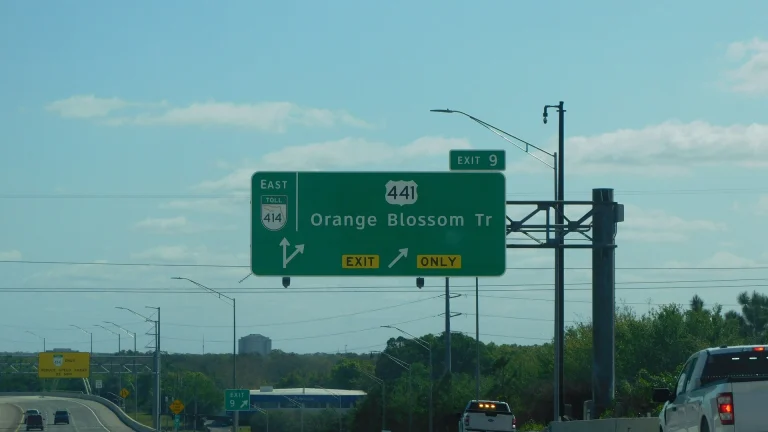
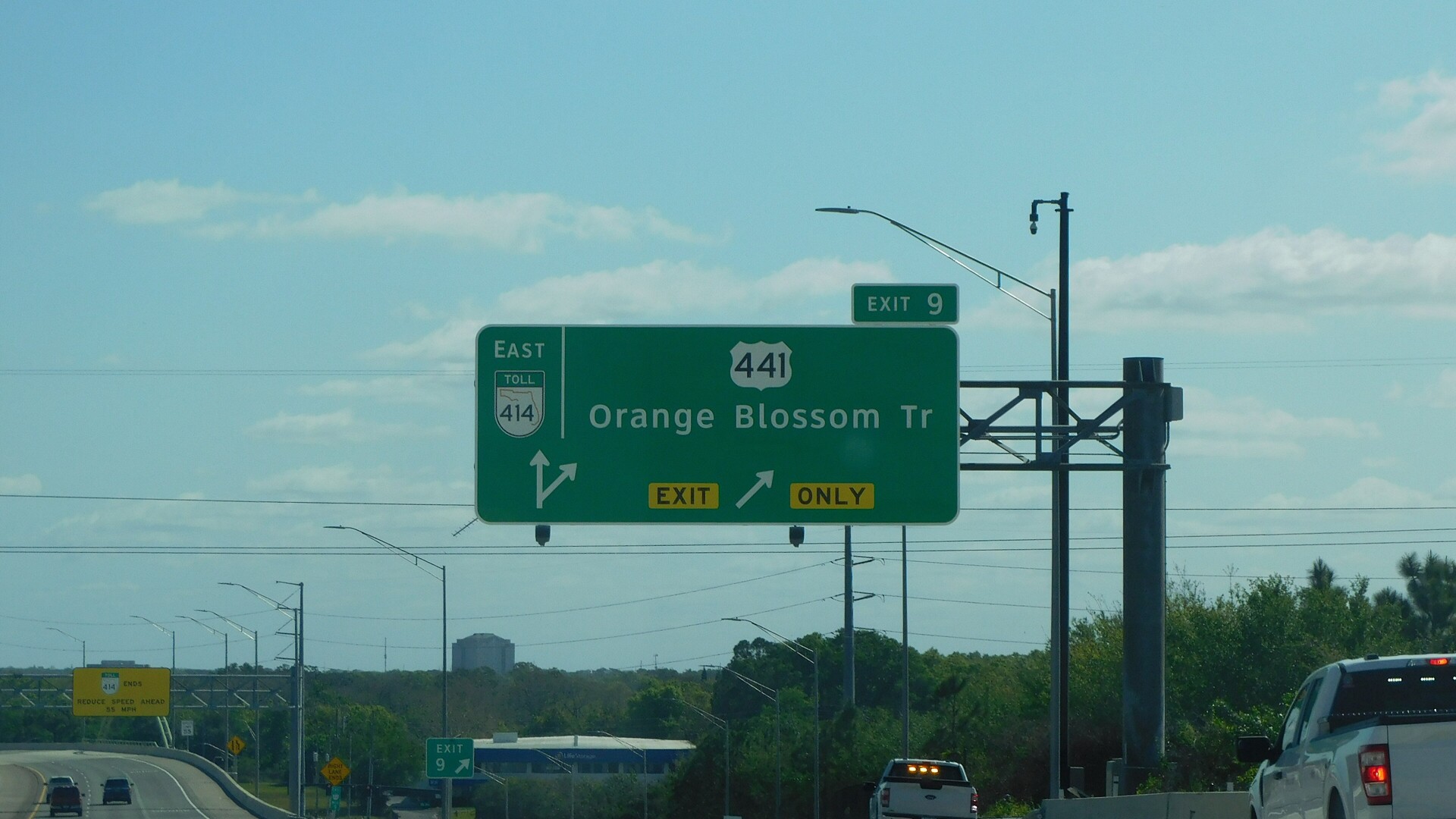
Eastbound State Road 414 at the US 441 (Orange Blossom Trail) exit, near where FHP says the chase ended. Photo: Markkos1992 via Wikimedia Commons, CC BY-SA 4.0
A Florida Highway Patrol trooper wrote that he hit 147 mph chasing a motorcycle on State Road 414 north of Orlando on Sunday, Nov. 15, and was still losing ground. The rider now faces a felony fleeing charge alongside a count under Florida’s Super Speeder law, and the felony is the one with lasting consequences.
The rider, a 27-year-old man, stopped only when traffic thickened near Rose Avenue, close to Orange Blossom Trail, WKMG-TV reported from the arrest report. The station listed the charges as fleeing and eluding at high speed, reckless driving, operating over 100 mph in a threatening manner and resisting without violence. Citing court records, WKMG reported that he has hired a lawyer and pleaded not guilty. The charges are accusations, and the arrest report is the trooper’s account.
The chase ran from SR 429 to a left-turn lane
The pursuit began around 5:30 p.m. The trooper was on State Road 429 when a blue motorcycle accelerated onto State Road 414, according to the report as described by Fox 35 Orlando. The trooper wrote that the rider was weaving through traffic and kept going with the patrol car’s lights and siren on, “taking evasive action to avoid capture.”
At 147 mph, a vehicle covers about 216 feet every second (Backfire News’s math: 147 times 5,280 feet, divided by 3,600 seconds), and the trooper wrote the motorcycle was pulling away from him at that speed. Neither published account gives a top speed for the motorcycle.
Traffic ended it. As intersections stacked up near Rose Avenue, the report says, the motorcycle “finally pulled into the left-turn lane and stopped.” The trooper wrote that he drew his gun, that the rider didn’t get on the ground at first and later pulled his hand away during handcuffing, and that he and a plainclothes officer then got the rider down and cuffed him, according to WKMG. That’s the basis for the resisting count.
The Super Speeder count is the lighter one
The Super Speeder statute, section 316.1922, created by House Bill 351 in 2025, covers driving 50 mph or more over the limit, or 100 mph or more in a way that threatens people or property or interferes with other vehicles. A first conviction carries up to 30 days in jail, a $500 fine, or both. Its license revocation of 180 days to a year applies only to a second or later conviction within five years. WKMG found one earlier case for the rider in Orange County records, a 2017 motorcycle speeding ticket from when he was 18, which predates the statute.
The fleeing law, section 316.1935, works on a different scale. Willfully fleeing a marked patrol car with lights and siren on is a third-degree felony. Add high speed or wanton disregard for safety and subsection (3)(a) makes it a second-degree felony, punishable by up to 15 years in prison and a $10,000 fine. Those are ceilings; the sentencing scoresheet, plea talks and the defendant’s record decide where a real sentence lands.
Two subsections do most of the work. Subsection (5) requires the court to revoke the license of anyone convicted under the fleeing law for at least one year and up to five, with no repeat-offense trigger. Subsection (6) says no court may “suspend, defer, or withhold adjudication of guilt or imposition of sentence” for any violation of the section. In many Florida felony cases, a judge can withhold adjudication for a defendant on probation, keeping a formal conviction off the record. A fleeing case doesn’t get that option once there’s a guilty or no-contest plea or verdict, though prosecutors can still reduce or drop counts in a plea deal.
Florida law also governs the trooper’s 147 mph
Florida’s emergency-vehicle rule, section 316.072(5), lets an officer chasing a suspected lawbreaker exceed the speed limit “so long as the driver does not endanger life or property,” and keeps the duty to “drive with due regard for the safety of all persons.” WKMG reported that FHP’s pursuit policy leaves the decision to the trooper but requires that the speed and extent of a pursuit be “objectively reasonable.” FHP declined an on-camera interview and said in a statement that troopers are trained on pursuits and supervisors monitor patrol activity every shift. A man who was nearby told the station a patrol car at triple digits concerned him even more than the motorcycle.
By the trooper’s own account, he was losing ground at 147 mph on a busy expressway at dinnertime on a Sunday. Neither published account says whether a supervisor weighed in on continuing.
Super Speeder cases have ended without a conviction more often than with one
FHP data shared with WKMG counted 967 trooper arrests for dangerous excessive speeding statewide from July 1, 2025, through June 15, 2026, a figure that excludes sheriffs’ deputies and city police. Action News Jax, analyzing state motor-vehicle agency data, reported nearly 1,800 Super Speeder citations statewide, with more than 400 drivers found guilty, more than 700 cases ending in an alternative disposition instead of a conviction, and about 160 pending. On those numbers, the Super Speeder law alone isn’t what makes a 147 mph case expensive. In this one, the heavier statute is already on the charging list.
The case is in Orange County court with a not-guilty plea entered, according to WKMG, and no next hearing date was reported. Under section 316.1935(1), a driver who knows an officer has ordered a stop and willfully keeps going commits a third-degree felony, and speed only raises the degree. A conviction takes the license for at least a year no matter what the speedometer read. A first Super Speeder conviction leaves the license alone.
The trooper was losing ground at 147 mph on a Sunday-evening expressway, and what finally stopped the rider was a left-turn lane. At what speed should a trooper let the bike go and wait for traffic to do the job?
About the Author