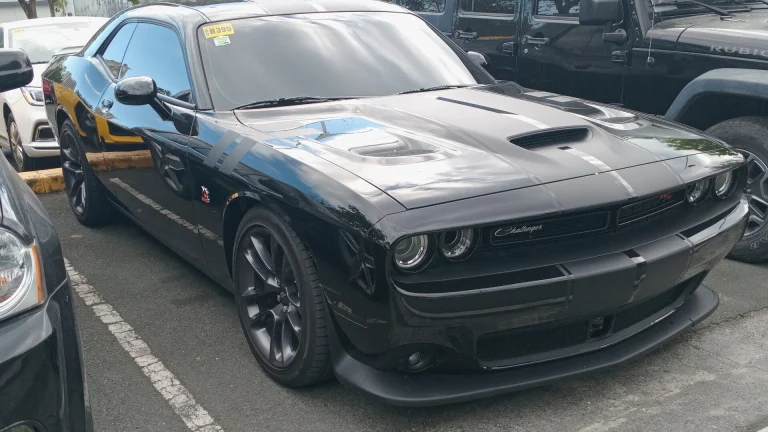
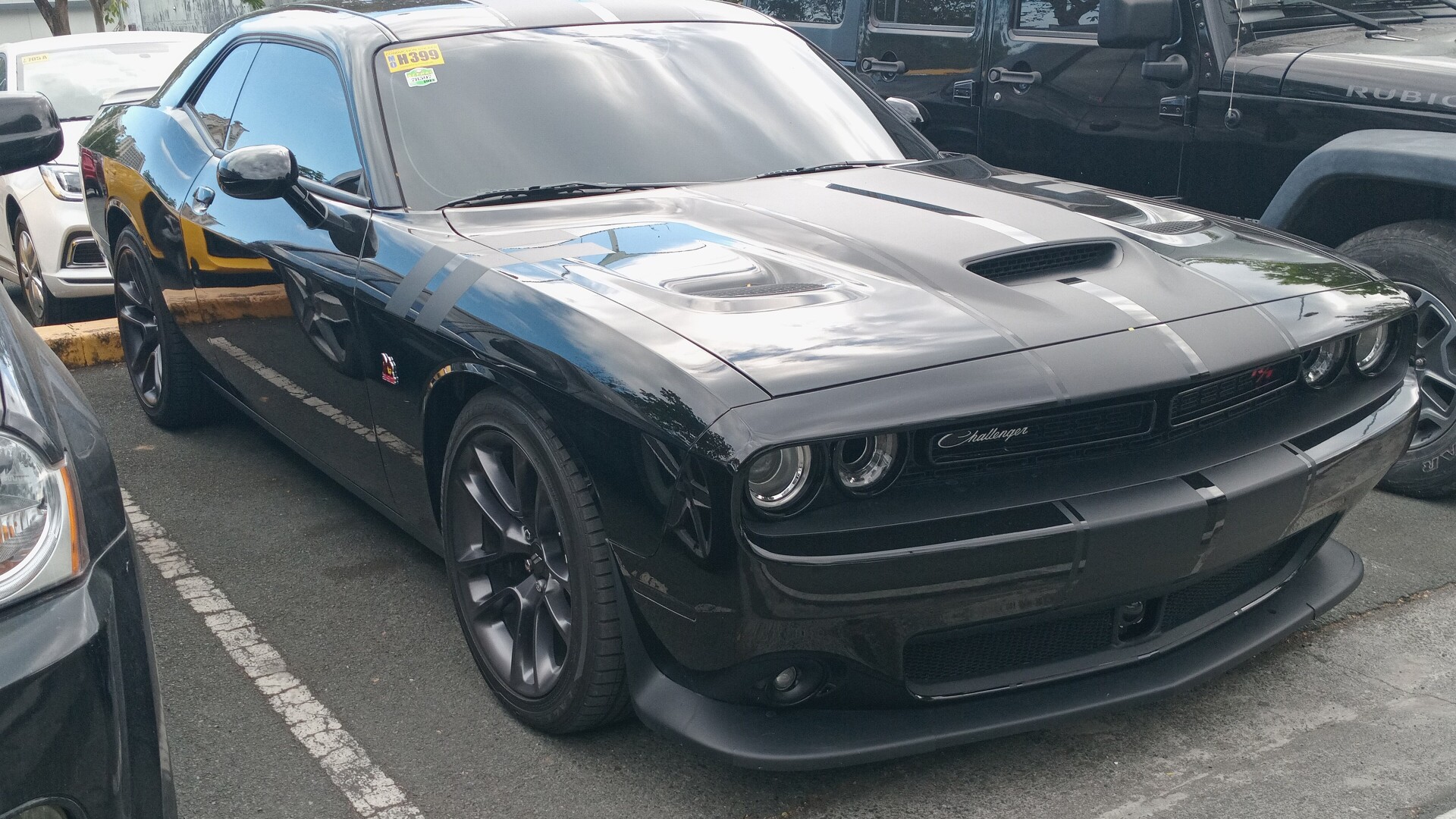
File photo of a 2023 Dodge Challenger R/T 392 Scat Pack. Auburn police did not release the model years or trims of the two Challengers. Photo: Ethan Llamas via Wikimedia Commons, CC BY-SA 4.0
An Auburn, Massachusetts, police officer clocked two Dodge Challengers at 60 mph in a 40 zone on Washington Street at about 3:12 a.m. on Thursday, Oct. 1, and when both drivers took off at well over 100 mph, he let them go. Both cars were stolen Challengers, police later said, and one of them came back.
The Auburn Police Department’s Oct. 6 account credits the no-chase decision for how the night ended: two arrests by officers who were waiting for the car instead of chasing it. The same night shows how little Massachusetts law does with the act of running. Refusing to stop for a uniformed officer violates Chapter 90, Section 25 of the General Laws, and the penalty written there is a $100 fine.
Auburn officers set up stop sticks instead of chasing
According to the department, Officer Lareau backed off and broadcast the cars instead of starting a high-speed pursuit. Officers from neighboring departments kept track of the Challengers. One crashed, its driver got into the other, and that car kept going, then turned back toward Auburn.
Auburn officers got ahead of it. Once the Challenger was back in town, Officer Hemingway put down stop sticks and flattened its tires. “The Challenger was considerably less challenging without air in the tires,” the department wrote. It crashed a short distance later, and both people inside ran. Officer Ljunggren and K9 Biza tracked on foot while Officer Laskes flew the department’s drone, and Auburn officers and Massachusetts State Police set a perimeter. Police said Biza followed a trail through the woods to one person hiding behind a business on Route 20, and the second was found nearby.
An 18-year-old charged and released on GPS
Police arrested an 18-year-old Worcester man and a 16-year-old from Worcester. The department said the 18-year-old’s charges include failure to stop for police, negligent operation, operating with a suspended license, possession of burglarious tools and receiving a stolen motor vehicle. The 16-year-old also faces charges, police said, without listing them.
MassLive reported, citing court records, that the 18-year-old pleaded not guilty to seven charges at his arraignment in Worcester District Court on Oct. 1, and that the judge released him on personal recognizance with conditions including a GPS monitor and an order to stay away from victims and witnesses. Backfire News found no later reporting on the case. The charges are accusations, and he has not been convicted.
That release follows the default in the state’s bail law. Chapter 276, Section 58 says a judge shall release a defendant on personal recognizance unless release won’t reasonably assure the person returns to court, and lets the judge attach restrictions like GPS and stay-away orders.
The stolen cars carry the heaviest penalties, not the running
Receiving a stolen motor vehicle under Chapter 266, Section 28 carries up to 15 years in state prison, up to 2½ years in a jail or house of correction, or a fine of up to $15,000, or a fine plus imprisonment. A conviction, or a juvenile delinquency finding on the same charge, requires the Registry of Motor Vehicles to revoke the license right away, and the registry can’t reinstate it for one year on a first offense.
Negligent operation, under Chapter 90, Section 24, covers driving recklessly or negligently enough to endanger the public. A first offense carries a fine of $20 to $200, two weeks to two years in jail, or both, and no new license for 60 days after conviction.
Then there’s Section 25. The $100 fine is the same whether a driver rolls a few hundred feet before pulling over or, as police describe here, leaves a 3 a.m. speeding stop at more than 100 mph. Prosecutors can reach the danger of the driving through negligent operation, but Massachusetts has no separate crime of fleeing police in a car whose penalty rises with how dangerous the flight was.
Four eluding bills on Beacon Hill, four study orders
Rep. Josh Cutler of Duxbury filed a failure-to-yield bill in 2017 as H.759 and in 2019 as H.3270. The 2019 version would have added up to 2½ years in a house of correction and a fine of $1,000 to $10,000 for a driver who won’t stop when pursued by a police vehicle with lights and siren on. Both went to study orders.
Rep. William Galvin of Canton tried a different design in H.1503 in 2023 and H.1707 in 2025. His bill would create a crime for drivers who flee or try to elude police willfully or with wanton disregard, counting property damage or three or more moving violations during the flight as that disregard. The penalty would be a fine of $100 to $1,000, six months to two years in jail, or both, plus a 60-day license suspension. Both went to study orders, the second on March 26, 2026.
The two designs matter for a night like Auburn’s. Cutler’s bill attached the penalty to a driver who keeps going while being pursued. Auburn’s officer didn’t pursue, so that version wouldn’t have applied. Galvin’s version keys on the flight and the driving, which fits what Auburn describes. Any version has to be refiled when the next session opens in January 2027.
National guidance now says a speeding stop doesn’t justify a chase
A 2023 Police Executive Research Forum guide written for the Justice Department’s COPS Office, with NHTSA as a partner, recommends allowing pursuits only when a violent crime has been committed and the suspect poses an imminent threat to commit another. It says more than 90 percent of pursuits start with traffic violations, and cites NHTSA data showing pursuit-related deaths rose from 382 in 2015 to 532 in 2020. Under that standard, a 60-in-a-40 stop doesn’t justify a chase, and neither does a stolen car on its own.
Challengers are a familiar target. The insurance-funded Highway Loss Data Institute reported in August 2023 that 2020-22 Dodge Charger HEMI models had a whole-vehicle theft claim frequency nearly 22 times the all-vehicle average, with the Challenger at 766 against an average of 100. Auburn police didn’t release the model years or trims, so there’s no way to tell whether either car was eligible for Dodge’s 2021 anti-theft software update. The owners get back two crashed cars, and the claims land on their comprehensive coverage.
The 18-year-old’s case is pending in Worcester District Court, and the 16-year-old’s proceeds as a juvenile matter. If either is convicted of or found delinquent on the receiving charge, the license revocation follows automatically and outlasts any fine. Running from the stop itself still costs $100.
In Massachusetts, leaving a 3 a.m. stop at 100-plus mph draws the same $100 fine as rolling a few hundred feet before pulling over. What should running from police actually cost?
About the Author