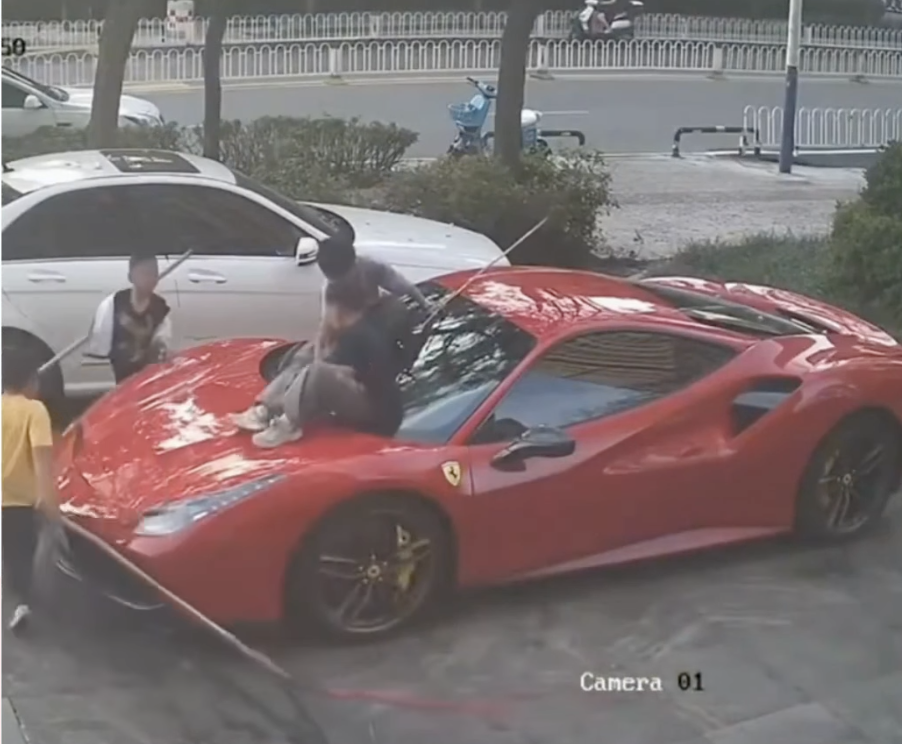
Somewhere in Kunming there’s a Ferrari owner who now knows, down to the yuan, what it costs when four neighborhood kids decide your supercar is a better slide than anything the developer bolted into the courtyard. The bill, after he shopped it around like a man who has made peace with disappointment, came to 29,360 yuan — a little over $4,300 — spread across two garages, one for a full vinyl wrap and repaint and another that patched the rest with aftermarket and salvaged parts. The parents of the children responsible have offered him 5,000 yuan, roughly $730, and, by his account, not a single in-person apology.
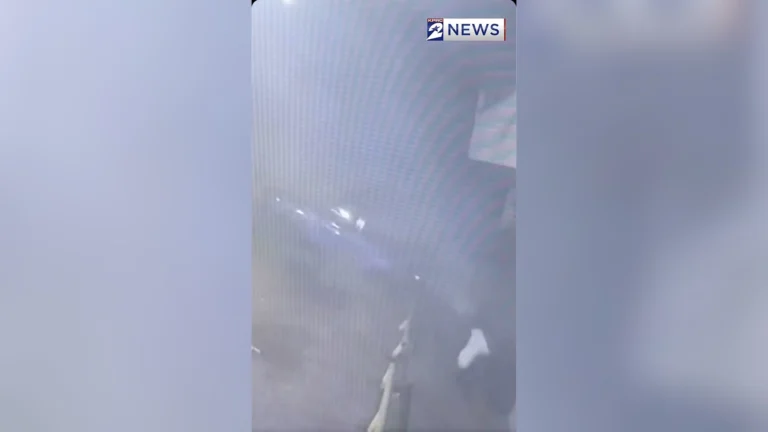
Let’s start with what the cameras caught, because the footage is the whole story. The owner, identified in Chinese media only as Mr. Zhang, had parked the car in his fixed, long-held space in a compound in Kunming’s Panlong district and left town on business on May 28. While he was gone, the building’s surveillance system recorded four boys — described as roughly six to ten years old — walking up to the car carrying long bamboo poles, clambering up over the wheels onto the hood, then onto the roof, and sliding down the bodywork for the better part of ten to twenty minutes. The poles dragged across the paint the entire time. The detail that torpedoes the “they’re just kids” defense: the audio caught one child noticing the camera and shouting the Mandarin equivalent of “we’re done for,” warning the others — and they kept going anyway, until a patrolling security guard broke it up and they scattered.
Related Articles
- Drivers Say Gas Stations Used AI To Quietly Jack Up Prices, And They’re Taking It To Court
- McMurtry’s Fan-Powered Madness Is Going Into Production, and the Laws of Physics Should Probably Lawyer Up
The damage was exactly what you’d expect from small humans treating carbon-and-aluminum bodywork like a jungle gym: scratches across the roof, fenders, hood, taillights and glass, plus a cracked front bumper. That’s where the real lesson for enthusiasts hides. Zhang, being a father himself, deliberately skipped the authorized dealer — the “4S” store in Chinese parlance — because an OEM repair there would have opened at around 100,000 yuan (roughly $15,000), and even a single independent shop’s initial damage assessment came in at 48,000 yuan. Supercar body panels aren’t stamped steel you can knock out and blend; they’re low-volume composite and aluminum with multi-stage paint, and the “wrap” line item alone ran him over 8,000 yuan because the protective film has to be stripped and re-laid across the whole car. Using aftermarket parts and pulled-from-salvage components is how he got the number down to under a third of dealer pricing — a decision that, as we’ll see, may end up looking very smart in court.
Now, about that $530,000 headline figure. It’s real — Zhang bought the 2020-model-year car new for 3.6 million yuan — but it’s not what a comparable Ferrari costs anywhere sane. China stacks import duty, a 10% purchase tax, and a punitive luxury consumption tax on top of the base price, which routinely makes an exotic cost close to double its European or American sticker. The same car stateside would have been a mid-$200,000s proposition. So when you see “$530,000 supercar” in a Chinese story, mentally translate it to “an already-expensive car made brutally more expensive by tariffs.” It matters here because the repair bill, painful as it is, is a rounding error against that inflated purchase price — which is precisely why the compensation gap reads as an insult rather than a genuine hardship dispute.
The legal mechanics are the genuinely instructive part, and they’d play out similarly under most jurisdictions’ tort law even if the specifics differ. Under China’s Civil Code, guardians bear liability for damage caused by minors, and where the child has personal assets — a Chinese kid’s accumulated New Year’s cash, for instance — compensation comes out of that first, with the parents covering the shortfall. Because there were four families involved, they’re on the hook jointly, meaning Zhang can pursue all of them together or lean on one deep pocket and let that guardian chase the others for contribution. What he can’t do is get anyone charged: China’s Criminal Law exempts anyone under 14 from criminal responsibility entirely, so “intentional destruction of property” — which the camera footage arguably establishes — is a criminal non-starter and a purely civil fight. The parents’ negotiating posture, meanwhile, has been to argue they can’t tell which scratches are new, and to climb from a few hundred yuan per family up to a combined 5,000, never bringing the kids to apologize and only appearing when police summoned them to mediation. That “can’t-distinguish-old-damage” gambit is a real defense in diminished-value cases, but it collapses when the plaintiff has timestamped footage of an undamaged car being systematically scuffed.
Related Articles
- This Steam-Powered Drag Bike Hits 62 MPH In 0.4 Seconds And It’s Absolutely Unhinged
- Florida Man Allegedly Used His Car As A Weapon Against His Girlfriend, Because Of Course He Did
Here’s the practical takeaway for anyone who parks something nice outdoors, and it’s the piece most coverage skips: don’t assume insurance rescues you. Chinese legal commentators note that most policies exclude intentional damage caused by minors, which can kill an insurer’s subrogation route and leave the owner personally suing the guardians — a warning that applies just as much to a comprehensive policy in the U.S., where “intentional acts” and vandalism exclusions vary wildly by carrier. Read your declarations page before you find out the hard way. And Zhang’s instinct to use cheaper parts may actually strengthen his case: legal analysis suggests a court is more likely to award repair costs a plaintiff has reasonably minimized than an inflated dealer estimate, so long as the invoices and the damage line up. Mitigating your loss isn’t just good manners — it’s good litigation strategy.
None of this is unprecedented, either. Chinese courts have been grinding through a steady run of these: a 12-year-old in Guangzhou who scratched a Rolls-Royce to the tune of 120,000 yuan in 2024, a child who snapped a Lamborghini mirror in Hangzhou for 80,000-plus, and an Inner Mongolia case where a court ordered guardians to pay 60,000 yuan in 2,000-yuan monthly installments. The through-line every time is the same one Zhang keeps repeating: the money was never really the point. He wanted the car put back to how it was, and he wanted somebody’s parents to act like the incident meant something. Filing suit is what happens when a father decides that being lenient and being taken advantage of have started to feel like the same thing.
About the Author