Going fast on two wheels is a different flavor of terror than going fast in a car. Strap yourself into a coupe and you’ve got crumple zones, airbags, and a steel cocoon to keep you honest. Hop on a motorcycle and the only thing standing between you and a high-speed cheese grater impression is your own nerve. Graham Sykes has apparently misplaced his fear receptors entirely, because the bike he built doesn’t even run on gasoline. It runs on steam.
Check out: 10 Gifts for Car People That Don’t Suck (and Don’t Cost a Fortune)
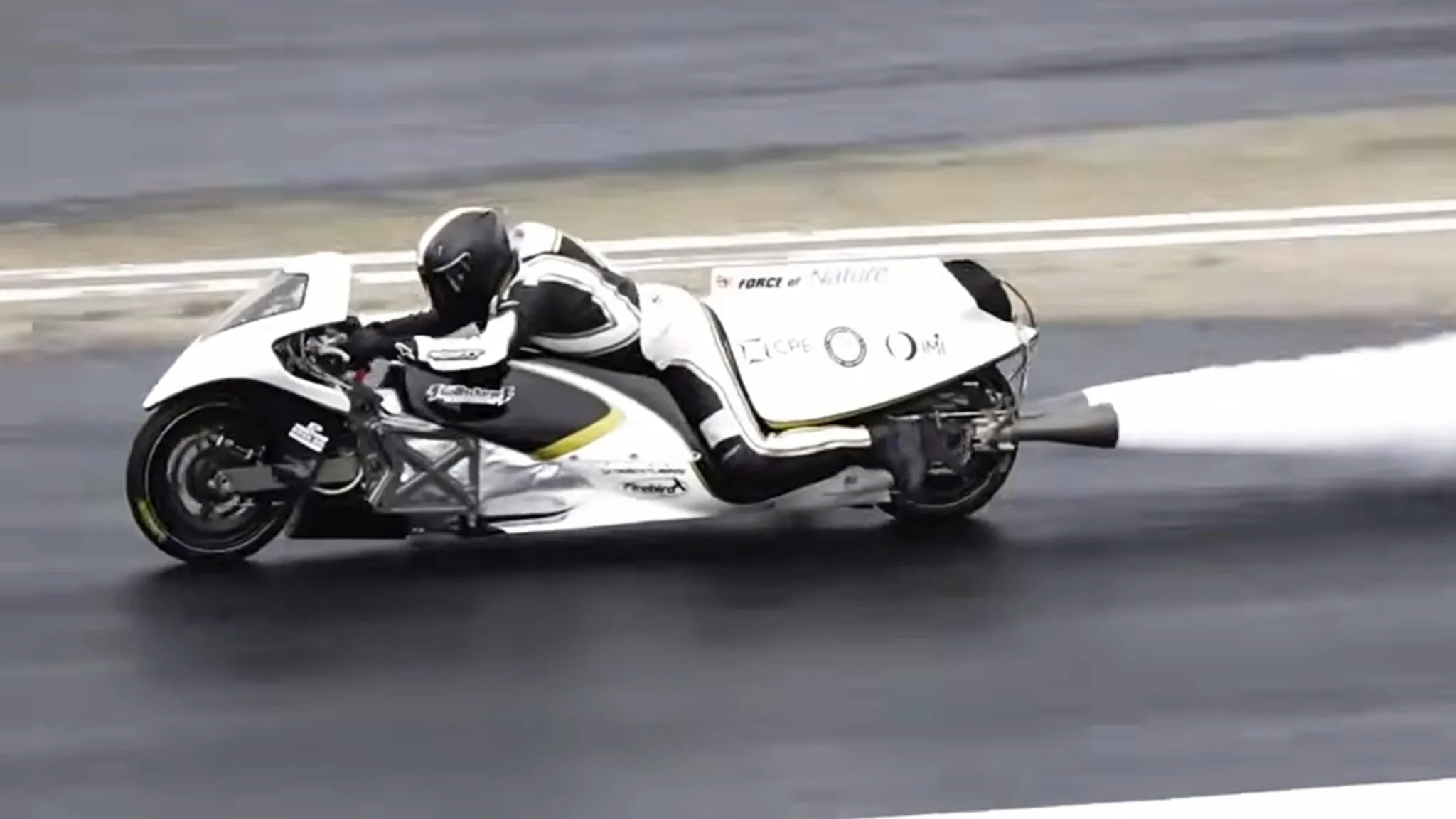
Sykes, a 62-year-old precision engineer from North Yorkshire, is the brain, builder, and brave soul behind “Force of Nature,” which now holds the title of the world’s quickest-accelerating motorcycle that isn’t strapped to a rocket. The machine recently strutted its stuff at Santa Pod Raceway in the UK, and the numbers it put down are the kind that make your inner ear hurt just reading them.
Here’s the headline figure: zero to 62 mph in 0.4 seconds. During this run, Sykes ripped down the quarter-mile in 5.5 seconds at 192.94 mph. The only bike that has ever gone quicker over the quarter is Eric Teboul’s hydrogen peroxide rocket bike, which clocked 4.976 seconds back in September 2022. But over the shorter stuff, the steam machine is king, taking the eighth-mile in 3.17 seconds at 203 mph and the 1,000-foot run in 4.53 seconds at 193 mph.
Sykes started cobbling this thing together back in 2022, and the version tearing up Santa Pod is already the fifth iteration. He’s not done, either. He reckons there’s another 0.6 seconds to be found, which would finally drag the quarter-mile time below the magical five-second barrier. At a separate outing, he already trimmed his best down to 5.44 seconds.
Check out: The 10 Best Outdoor Knives of 2026: Top-Rated Picks for Hunting, Camping, and Survival
So How On Earth Does A Steam Bike Work?
Glad you asked, because the recipe is gloriously bonkers. A small burner sips kerosene or vegetable oil to generate heat, which gets funneled through a manifold into six burner tubes. That heat cooks a 120-liter pressure vessel packed with deionized, demineralized water until temperatures hit 250 degrees Celsius and pressure climbs to 580 psi. The payoff is roughly 2.9 seconds of violent thrust. The team is now chasing more than three seconds by killing off the turbulence and cavitation that interrupt the flow.
And here’s the part that should genuinely concern you: Sykes says the bike pulls up to 6.8 Gs under acceleration. That’s fighter-pilot territory. At that peak, an 85 kg rider momentarily weighs the equivalent of 578 kg, which is exactly why Sykes pins himself to the handlebars and yanks his feet up the instant he releases the launch button. Steam power, it turns out, is anything but old-fashioned.
Related
- A Custom Motorcycle Gets Its Power From A Ferrari V8
- Electric Motorcycles And The Military
- Motorcycle Chariot Racing: The Thrill of Yesterday
About the Author