The Germans have a particular talent for building things that make you tilt your head and ask “who exactly is this for?” — and the Vanyx camper van is a near-perfect specimen. It looks like a standard delivery van that grew a carbon-fiber top hat, wears knobby off-road tires, and carries a price tag that, fully loaded, brushes up against seven figures. Underneath the internet’s “$1.1 million adventure vehicle” framing, though, there’s a genuinely clever piece of packaging engineering worth unpacking — plus a pricing story that’s more interesting than the headline number lets on.
Let’s start with what it actually is, because that gets lost in the “million-dollar van” noise.
The bones: a commercial van in a tuxedo
The Vanyx is built by Smart Adventure GmbH out of Ringsheim, Germany, on a MAN TGE 3.180 4×4 chassis. If that platform sounds familiar, it should — the MAN TGE is the corporate twin of the Volkswagen Crafter, sharing the same body-in-white and much of the same running gear. That “180” in the name refers to 180 metric horsepower from the 2.0-liter turbodiesel, which the manufacturer lists as 177 hp in the more familiar SAE measure. Power runs through a four-wheel-drive system with a differential lock.
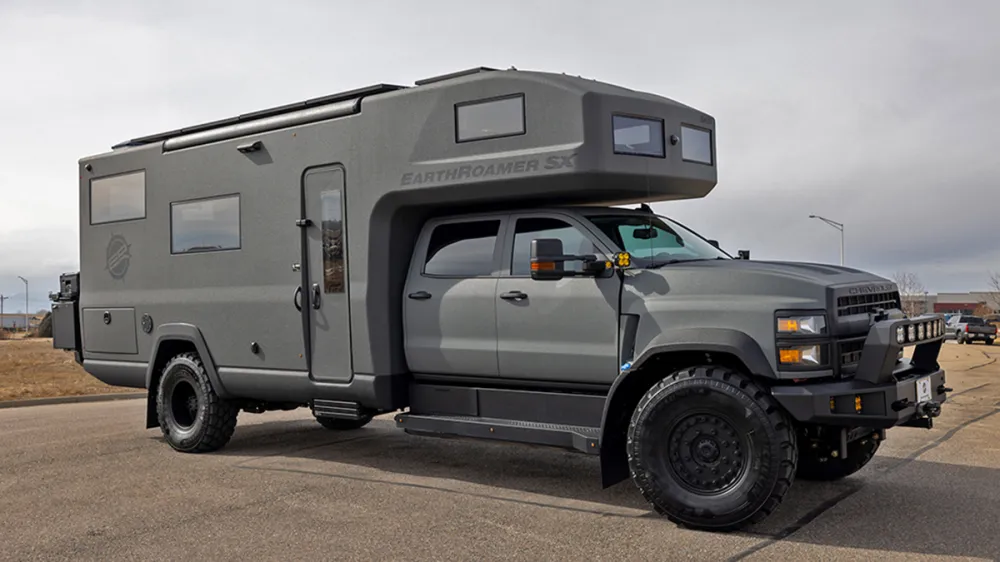
So no, there’s no bespoke portal-axle expedition chassis here, no 600-hp Cummins, none of the American EarthRoamer bravado. This is a mid-size European panel van with all-wheel drive and a very expensive interior. That’s not an insult — it’s the entire point, and it’s where the engineering gets clever.
The top-hat trick
The signature move is that cartoonishly tall roof. Rather than stretch the wheelbase into a bus to find sleeping space — the usual RV solution — Vanyx bolts on a carbon-sandwich high roof developed with an aerospace company and Germany’s Fraunhofer Institute, and turns the attic into a dedicated sleeping floor. Two double beds live up top (the front measures 1.95 by 1.40 meters), and the entire ground floor is freed up for living space. The company claims you can stand fully upright down below even if you’re 1.95 meters tall.
Here’s the part that’s easy to miss: putting the beds in a lightweight carbon roof isn’t just a space gimmick, it’s a weight-and-balance decision. All the heavy hardware — water tanks and batteries — is mounted low, under the floor, to keep the center of gravity down. That matters enormously on a vehicle this tall, because a high roof full of mass is exactly how you make an off-road van that wants to tip over on side slopes. Carbon up high, ballast down low. It’s the same logic a race engineer uses, applied to a camper.
The “full-size kitchen” reality check
The headline promises a full-size kitchen, so let’s be honest about what that means in a six-meter van. The galley is a two-burner induction cooktop with an integrated extractor hood and a prep counter — residential-grade appliances, genuinely nice ones, but this is a compact L-shaped galley, not a suburban kitchen you can host a dinner party in. “Cook like at home” is the pitch, and for one or two people making real meals, it’s credible. Just don’t picture a range and a double oven.
Related Articles
- Two Car Dealership Managers Walked Free After 176 Charges Vanished, Now They Want $11 Million From Toronto Police
- This 800-HP GT40 Restomod Hides A Secret Under The Body, And It Isn’t Even A Ford
Where the Vanyx earns its keep is the off-grid plumbing and power, and this is the stuff prospective owners should actually care about. It runs completely gas-free — no LPG bottles — using a Truma Combi D 6 E diesel heater that pulls from the main tank and can also run on electricity. An 800 Wp solar array on the walkable roof feeds a 400 Ah LiFePO4 battery, expandable to 1,200 Ah, rated for 7,000 charge cycles. The water system includes a UV-and-multi-stage filter that the company says can turn gray water or water pulled from nature into drinking water, paired with a dry-separation toilet that splits liquids and solids without chemicals. Ditching gas is a legitimately smart call for a vehicle meant to cross borders — swapping propane bottles in a foreign country is a genuine pain, and eliminating them removes a fire-risk item and frees up weight.
Why the weight obsession is a legal issue, not just an engineering one
Every “carbon this, lightweight that” claim on the Vanyx traces back to one number: 3.5 tonnes. Keep the fully-built van under that gross weight and, in Europe, an ordinary Class B car license covers it — no truck endorsement required. Blow past 3.5 tonnes and your buyer suddenly needs a heavier license class, which shrinks the market dramatically. That’s why the roof is carbon, why the rear doors are a carbon-sandwich system instead of the factory steel units, and why the company is so twitchy about payload. Vanyx notes the registration can be bumped to 4.2 tonnes if you want to haul more than about 500 kg of gear — but then you’re back in heavier-license territory. The entire vehicle is essentially a physics exercise in staying under a regulatory line.
Ownership, repair, and the parts you can’t get at NAPA
A carbon-bodied vehicle is wonderful until you crease a panel. Composite repair isn’t a job for the corner body shop, and structural carbon components typically get replaced rather than hammered out. Combine that with a factory-direct sales model — Vanyx says you can only buy directly from the factory, with no dealer network — and you’re looking at an ownership experience where anything specific to the van goes back to Ringsheim. The company backs the bespoke parts with a four-year warranty and offers two years on the rest of the vehicle-specific components, plus a 24-hour hotline and mobile service across mainland Europe. That coverage is telling: they know the ownership base won’t have a local specialist to lean on.
Insurance-wise, this is the classic low-volume-exotic problem. There’s no established loss history, replacement panels are made-to-order composites, and the total value is house-money. Expect an agreed-value specialty policy, not a quick quote from a mainstream insurer.
The pricing story nobody’s telling
Here’s where the “$1.1 million” headline needs context. When the Vanyx debuted at Germany’s CMT show in early 2024, it was pitched as a “Luxury Edition” with a genuinely eye-watering price — the company’s own press archive still links German TV segments titled “The €860,000 Campervan” and one asking why anyone would pay €890,000 for a single van. That’s the number that seeded all the millionaire-motorhome coverage.
Related Articles
- This Steam-Powered Drag Bike Hits 62 MPH In 0.4 Seconds And It’s Absolutely Unhinged
- This Guy Walked Out of Jail and Immediately Stole an SUV From the Courthouse Parking Lot
But look at the manufacturer’s site today and the story has shifted. Vanyx now lists a base price of €340,000 — roughly $370,000 at current exchange rates — and its own press page includes an April 2025 broadcast titled, plainly, “€340,000 Full Carbon Most Expensive Motorhome Van.” In other words, the eye-popping seven-figure figure represents a maxed-out, fully-optioned build; the actual entry point has come down to earth considerably as the thing moved from wild prototype to something you can genuinely configure and order. That’s a common arc for concept-adjacent vehicles — the debut number is a flex, the production number is the business.
One more thing for the American reader
Don’t get attached. The MAN TGE isn’t sold in the United States, the Vanyx isn’t federalized for U.S. roads, and because it’s a current-model-year vehicle, the 25-year classic-import exemption doesn’t apply either. This is a Europe-and-beyond machine — the company’s own marketing shows it in India, Morocco, and Norway, not the American Southwest. If you want the concept stateside, you’re looking at the domestic expedition-truck crowd, at similar or higher money.
The practical takeaway: strip away the luxury-van theater and the Vanyx is a smartly-engineered lightweight overland platform whose every design decision — carbon roof, gas-free systems, low-mounted ballast — serves the goal of squeezing four-person, go-anywhere capability under a 3.5-tonne license limit. Whether that’s worth €340,000, let alone a fully-loaded seven-figure build, is between a buyer and their accountant. But it’s a lot more thoughtful than “expensive van with a big hat” suggests.
Images Via: EarthRoamer
About the Author