There’s a specific kind of car guy who orders a Duesenberg — already the most expensive, most extravagant thing on any American road in 1935 — and then, before it’s even reached him, decides it isn’t quite enough. That car guy was Clark Gable. And come August, the machine he obsessed over is going to make somebody very poor and very happy.
Check This Out: Best Dash Cams of 2026: How to Choose the Right One for Your Vehicle
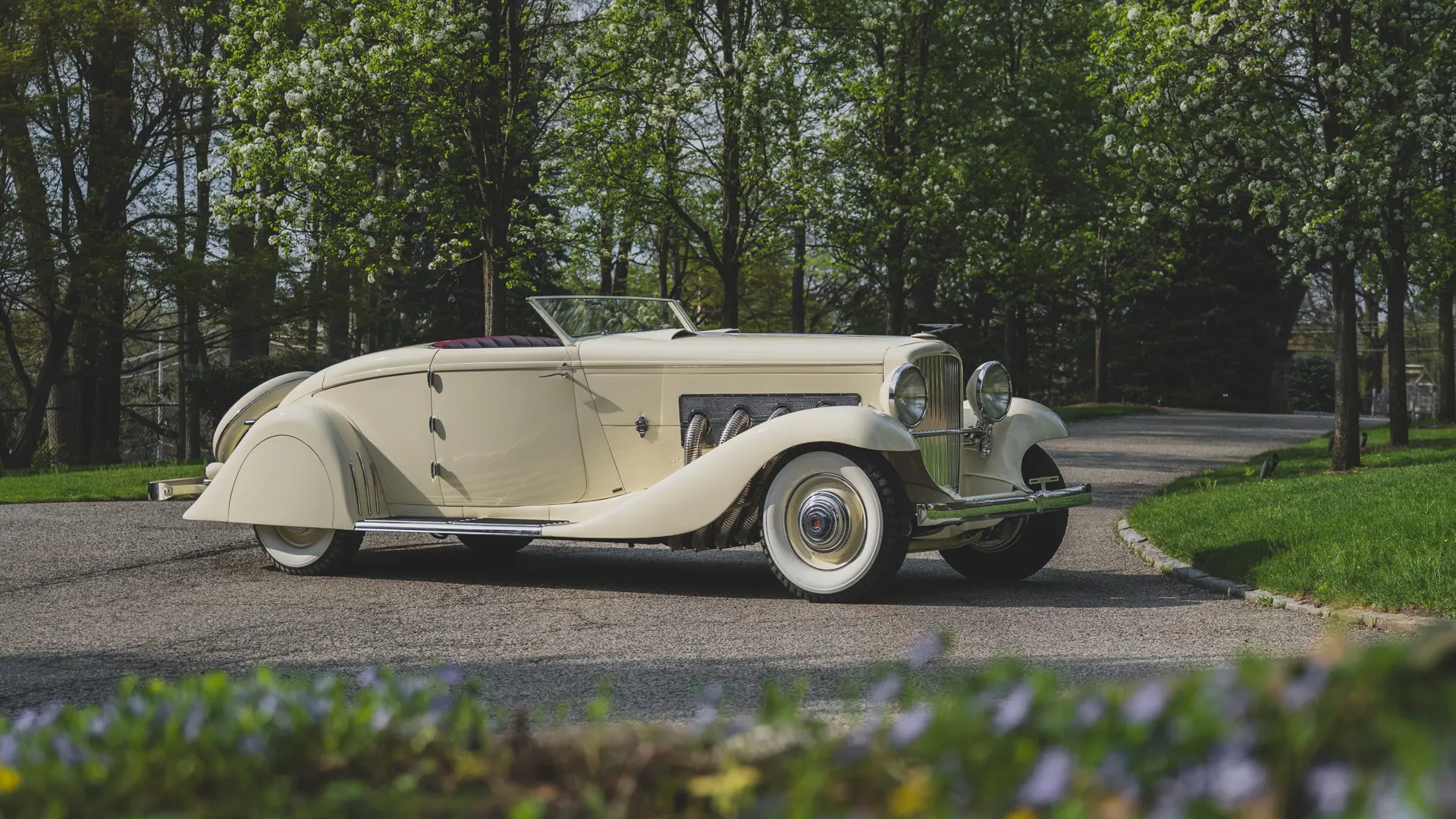
RM Sotheby’s is offering Gable’s 1935 Duesenberg Model JN Convertible Coupe at its Monterey sale, running August 13-15 at the Portola Hotel and Monterey Conference Center. The estimate: $5.75 million to $8 million. It’s the headliner of the 22-lot Sam and Emily Mann Collection, which the auction house announced back on June 4. If it lands mid-estimate, it’ll be one of the priciest Duesenbergs ever moved at public auction — and given what this specific car is, that’s not the flex of hype it sounds like.
What actually makes it special
Start with the metal. The Model JN was Duesenberg’s last hurrah for the two-seat open car, and per RM Sotheby’s, Gable’s is one of just four Rollston-bodied convertible coupes in the series. The JN itself was already a departure from the earlier Model J: it sat lower on the chassis, rode on 17-inch wheels, wore a raked windshield and a disappearing top, and ditched the external battery and tool boxes that cluttered the older cars. In other words, this was Duesenberg’s sleekest, most modern statement right as the company was running out of runway.
Under the hood is the reason Duesenbergs still make grown collectors misty: a 420-cubic-inch, dual-overhead-cam straight-eight backed by a three-speed manual. In an era when most American cars made do with flathead sixes and prayed, Duesenberg was building an engine architecture — DOHC, four valves per cylinder — that wouldn’t go mainstream for decades. These things were genuinely, violently fast for the 1930s.
But Gable didn’t leave it stock, and that’s the whole story. Rather than take delivery of the finished Rollston car, he had it shipped from New York straight to Bohman & Schwartz, the Pasadena coachbuilder that dressed half of Hollywood. There, working with staff designer W. Everett Miller, Gable literally sketched what he wanted. Per the RM Sotheby’s lot description, those sketches survive in the car’s file. The result: the hoodline was stretched back over the cowl for the illusion of length, the windshield raked even harder, the radiator shell painted body color, plus rear fender skirts, dual rear-mounted spares, and body-color wheel covers. It’s a bespoke commission on top of a bespoke commission — a custom of a custom.
The Hollywood provenance is the multiplier
Provenance is where six-figure cars become seven- and eight-figure cars, and this one is loaded. This was the Duesenberg Gable drove while courting Carole Lombard, the car RM Sotheby’s says the two used up and down the California coast and on runs to Vancouver. It got a movie credit in the 1938 Hal Roach picture Merrily We Live — wearing a temporary dark, water-soluble paint job, which is a fantastic period detail. After Lombard was killed in a 1942 military plane crash, Gable, per the lot listing, had the car sold outside California because he couldn’t stand to see it again. That’s the kind of narrative that moves a room full of bidders who’ve heard every story twice.
Then it disappears into the weeds for decades. The RM Sotheby’s history is a proper barn-find soap opera: an engine swap at a New Mexico dealer (the original numbered J-560 bell-housing was kept), an ownership run that included a pro wrestler nicknamed “Hans” Hermann, a $4,500 sale in Illinois that was reportedly a record at the time, and a stint where an owner discovered the thing wouldn’t fit in his garage. Sam and Emily Mann bought it in 2005 and handed it to New Jersey restoration shop Stone Barn for a return to its as-delivered Gable specification. It won the Gwen Graham Trophy at Pebble Beach in 2007 and Best of Show at both Amelia Island and Meadowbrook in 2008.
The buyer’s-side reality check
A car like this is a museum piece with a title, and the practical implications are their own conversation. Parts don’t exist at any price — fewer than three dozen Model Js survive with their original engines, and Duesenberg specialists who can actually service a DOHC straight-eight are a tiny, aging club. This is not a car you hand to the corner shop.
Which is why the matching-numbers detail matters more than usual. The car currently runs an engine from another Duesenberg (J-521), but RM Sotheby’s notes the Manns recently tracked down the car’s original crankshaft, numbered 560, which will be crated and go with it. Reuniting the car with all its original numbered components is left as an exercise for the buyer — an expensive, painstaking exercise that would meaningfully affect long-term value. At this level, originality and documentation aren’t footnotes; they’re most of the price.
On the insurance side, an eight-figure car doesn’t get a standard collector policy — it gets an agreed-value fine-art-style arrangement, likely stored in climate control, driven rarely and deliberately, and appraised by someone the underwriter trusts. The good news for the eventual owner: blue-chip prewar Full Classics with this depth of story tend to hold value better than the momentum-driven modern market, which lurches with fashion. A Gable Duesenberg isn’t a bet on a trend. It’s a bet that Hollywood’s golden age and America’s greatest marque will still mean something in 20 years, which is about as safe as this hobby gets.
Read Next: The 10 Best Outdoor Knives of 2026: Top-Rated Picks for Hunting, Camping, and Survival
Is it worth eight million dollars? “Worth” is doing heavy lifting on a one-of-one object with no comparables. But if you accept that some cars are art, this is the one they’d hang in the museum — and it already has been.
Source – Source – Source – Source – Source – Source
Images via: RM Sotheby’s
About the Author