The real technology behind the stunt
Strip away the bear and the technology underneath is reasonable. The Ford Security Package sends owners alerts when it detects cabin intrusions, opened doors, tampered or disabled hardware, and vehicle movement the owner did not expect. There is a remote element too, letting owners pull up camera feeds from their phone and store that footage in the cloud for later. None of this reinvents the wheel, but it beats walking out to an empty parking spot and trying to figure out where your truck went.
There is more under the hood. Owners can use a feature called Start Inhibit to keep the vehicle from starting, and there is a dedicated security call center standing by if something goes wrong. Taken together, it is a sensible bundle of tools for anyone worried about their truck disappearing overnight. The features themselves are not the problem here. How you have to access them is where things get complicated.
A bear is not how trucks actually get stolen
Here is the part Ford would probably rather you not think too hard about. A bear clawing at a window is not remotely close to how modern vehicle theft works. Today’s thieves are not betting on brute force and a smashed window. Most break-ins now happen electronically and leave no visible damage at all, whether that means intercepting a key fob’s signal, boosting it across a driveway, programming a blank key, or tapping into the car’s internal network through a diagnostic port.
Those electronic methods are quiet, fast, and far more common than anything involving an angry animal. Tag would be completely lost against a relay attack, and that is exactly why the demonstration, as entertaining as it was, does not reflect the real threat. The stunt proves the truck can detect tampering, which is fine as far as it goes. What it does not do is show how the system holds up against the techniques criminals are actually using right now.
That would have been the test worth watching. Pit the security package against the electronic tricks of a real car thief and let the public see how it performs under genuine pressure. It would have told owners something useful. It also would have been a lot less fun to film, which is probably why we got the bear instead.
The subscription strings attached
Now for the wrinkle that should bother enthusiasts most. A lot of these security features only work if you buy into Ford’s connected ecosystem, which means active subscriptions, constant vehicle connectivity, and a steady stream of your data flowing back to the company. You do not just get the protection. You hand over information about how and where you drive in exchange for it.
The frustrating thing is that many of these functions could plausibly exist without an automaker hoovering up so much driver data in the process. The industry has simply decided that connected services and data collection are a package deal, and customers are left to accept it or go without. Want the useful feature? Then you agree to the data sharing. There is no menu where you pick one and skip the other.
To be clear, this is an industry-wide habit rather than something Ford invented. Nearly every major automaker has gone down the same road, treating driver data as a resource to be collected, packaged, and shared with partners. That does not make it any easier to swallow. It is a quiet erosion of privacy dressed up as a convenience, and the bear demo is a clever way to keep your attention on the spectacle instead of the strings attached.
So while the security tech looks legitimately handy, the real standout of the whole event turned out to be Tag. He gave Ford exactly what it wanted, which was attention, and the fact that people are talking about a truck security system because a bear figured out how to break into one means the stunt worked. He did his job and then some. The bigger question for owners is whether the protection is worth the privacy they have to surrender to get it.
Source: Ford Motor Company
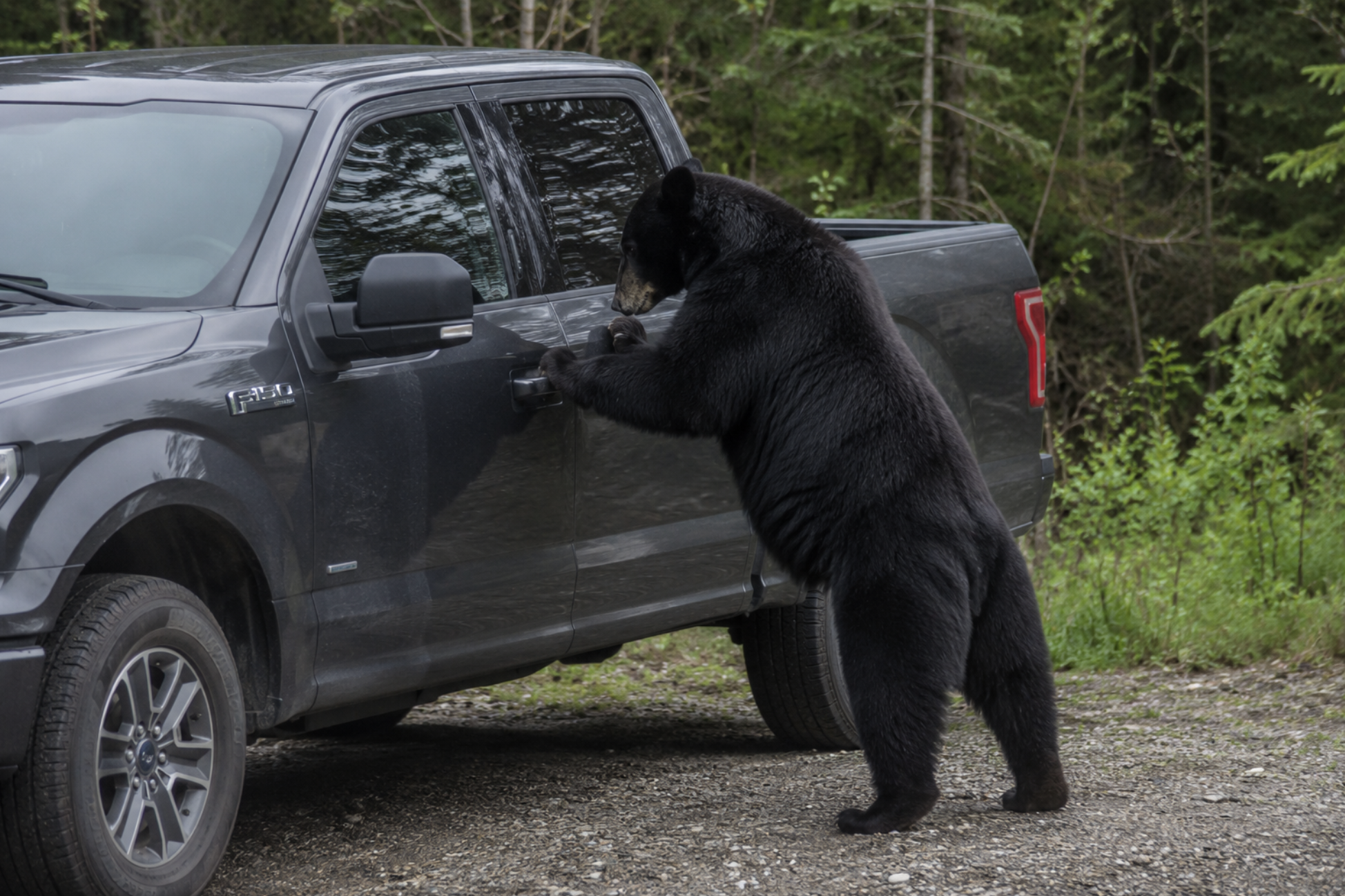
Ford just hired an 800-pound Kodiak bear to break into one of its own trucks, and honestly, the bear stole the show. The automaker turned a security demonstration into a spectacle by setting a trained bear named Tag loose on an F-150 Platinum, hoping to prove how tough its new Ford Security Package really is. Tag, whose acting credits include Yellowstone, did not disappoint. He rocked the truck back and forth, raked his claws across the body panels, smashed a window, and somehow worked out how to pop a door open.
Give the animal his due. That is a genuinely impressive performance, and the fact that the F-150 came out the other side still in one piece says something about how these trucks are built. It is also a lot more watchable than the usual corporate rollout stuffed with slides and marketing speak. It is the kind of footage that spreads far more easily than any slide deck, and Ford clearly understood that going in.
The real technology behind the stunt
Strip away the bear and the technology underneath is reasonable. The Ford Security Package sends owners alerts when it detects cabin intrusions, opened doors, tampered or disabled hardware, and vehicle movement the owner did not expect. There is a remote element too, letting owners pull up camera feeds from their phone and store that footage in the cloud for later. None of this reinvents the wheel, but it beats walking out to an empty parking spot and trying to figure out where your truck went.
There is more under the hood. Owners can use a feature called Start Inhibit to keep the vehicle from starting, and there is a dedicated security call center standing by if something goes wrong. Taken together, it is a sensible bundle of tools for anyone worried about their truck disappearing overnight. The features themselves are not the problem here. How you have to access them is where things get complicated.
A bear is not how trucks actually get stolen
Here is the part Ford would probably rather you not think too hard about. A bear clawing at a window is not remotely close to how modern vehicle theft works. Today’s thieves are not betting on brute force and a smashed window. Most break-ins now happen electronically and leave no visible damage at all, whether that means intercepting a key fob’s signal, boosting it across a driveway, programming a blank key, or tapping into the car’s internal network through a diagnostic port.
Those electronic methods are quiet, fast, and far more common than anything involving an angry animal. Tag would be completely lost against a relay attack, and that is exactly why the demonstration, as entertaining as it was, does not reflect the real threat. The stunt proves the truck can detect tampering, which is fine as far as it goes. What it does not do is show how the system holds up against the techniques criminals are actually using right now.
That would have been the test worth watching. Pit the security package against the electronic tricks of a real car thief and let the public see how it performs under genuine pressure. It would have told owners something useful. It also would have been a lot less fun to film, which is probably why we got the bear instead.
The subscription strings attached
Now for the wrinkle that should bother enthusiasts most. A lot of these security features only work if you buy into Ford’s connected ecosystem, which means active subscriptions, constant vehicle connectivity, and a steady stream of your data flowing back to the company. You do not just get the protection. You hand over information about how and where you drive in exchange for it.
The frustrating thing is that many of these functions could plausibly exist without an automaker hoovering up so much driver data in the process. The industry has simply decided that connected services and data collection are a package deal, and customers are left to accept it or go without. Want the useful feature? Then you agree to the data sharing. There is no menu where you pick one and skip the other.
To be clear, this is an industry-wide habit rather than something Ford invented. Nearly every major automaker has gone down the same road, treating driver data as a resource to be collected, packaged, and shared with partners. That does not make it any easier to swallow. It is a quiet erosion of privacy dressed up as a convenience, and the bear demo is a clever way to keep your attention on the spectacle instead of the strings attached.
So while the security tech looks legitimately handy, the real standout of the whole event turned out to be Tag. He gave Ford exactly what it wanted, which was attention, and the fact that people are talking about a truck security system because a bear figured out how to break into one means the stunt worked. He did his job and then some. The bigger question for owners is whether the protection is worth the privacy they have to surrender to get it.
Source: Ford Motor Company
About the Author