Carson Hocevar didn’t just win at Talladega on April 26. He gave everyone watching a reason to keep talking about it long after the checkered flag fell. The 23-year-old Chevrolet driver snapped a three-year winless drought in the Cup Series, and instead of a routine celebration, he capped it off with a victory lap nobody saw coming.
The race itself needed no help in the drama department. Talladega has a habit of turning chaotic in the closing laps, and this one was no exception. Hocevar put his No. 77 Chevrolet Camaro ZL1 out front with 19 laps remaining and held that position through a superspeedway pack where leads can vanish in seconds. When the restart came, the field bunched up tight behind him looking for an opening. Chris Buescher made his move, closing hard as the two charged toward the line in what turned into a drag race finish, exactly the kind Talladega is known for. Hocevar held his line and crossed the stripe just over a tenth of a second ahead, close enough that a single mistake either way could have flipped the result.
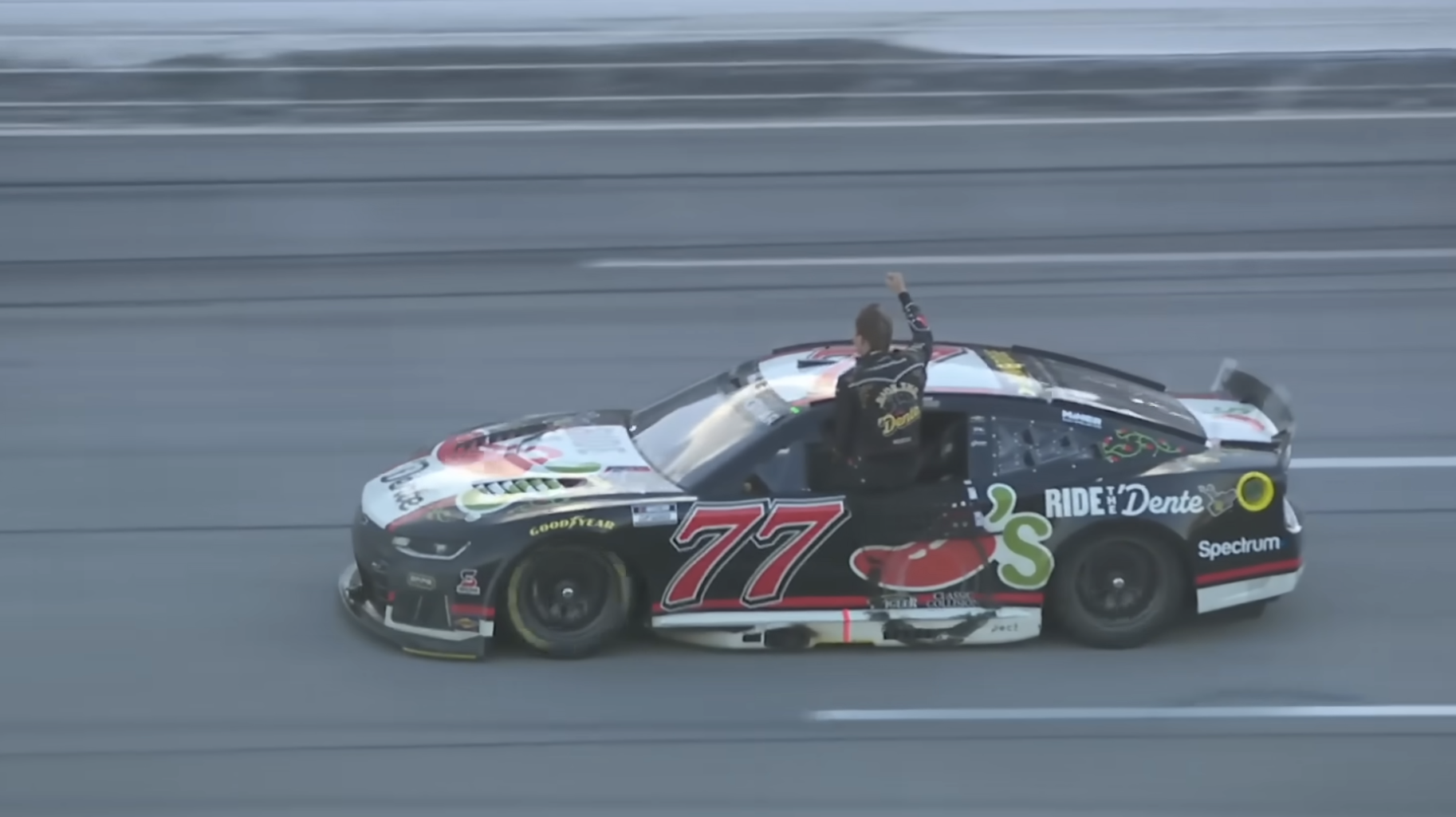
On its own, that result was the story: a first Cup win in three years for a young driver proving he belongs among NASCAR’s elite. But Hocevar wasn’t finished. After bringing the car to a stop, he didn’t climb out right away. Instead, he perched on the windowsill, seemingly working something out in his head while the crowd waited to see what came next. Then he fired the car back up and rolled out for a victory lap unlike any typical burnout-and-wave routine. Still sitting on the windowsill rather than in the seat, Hocevar guided the car in front of the grandstands and, at one point, lifted both hands completely off the wheel while rolling through the tri-oval at Talladega in front of a packed crowd.
Victory laps are normally controlled and a little predictable by design. This wasn’t that. It was risky, arguably reckless depending on how you look at it, but it was also the kind of bold, unscripted moment stock car racing doesn’t produce very often anymore.
Hocevar has built a reputation as an aggressive driver, sometimes overly so, and he’s rubbed more than a few competitors the wrong way without backing down when confronted about it. That kind of edge can make a driver difficult to root for in a series where respect among peers still counts for something. But Talladega has a way of rewriting narratives. Pulling off a clean, pressure-filled win at one of NASCAR’s toughest superspeedways already forces people to take a driver seriously, and pairing that with a stunt like the hands-free victory lap shifts the conversation from how he races to who he’s becoming in the sport.
Even inside the garage, the reaction leaned positive. Alex Bowman, another Chevrolet driver who recently returned to competition after dealing with vertigo issues, finished third and credited Hocevar for earning the win the hard way. That kind of acknowledgment doesn’t come easily, especially from a competitor who has seen both the aggressive and the disciplined sides of Hocevar’s driving.
Fans don’t tune in for safe, predictable racing. They tune in for moments, and this was one of them. You could see it in how Hocevar handled everything after the checkered flag. Nothing about it was polished or rehearsed for the cameras. It was just genuine reaction from a driver who’d just delivered under pressure, and that kind of authenticity is something NASCAR could use more of right now.
So what does it mean going forward? For Hocevar, it resets the conversation entirely. He’s no longer just the aggressive young driver trying to prove he belongs. He’s a race winner again, and at Talladega no less, which carries real weight in any garage. For fans, it’s a reminder that personality still exists in this sport and that not everything has to be clean and controlled to be memorable. And for the rest of the field, it’s a warning: Hocevar isn’t just fast anymore. He can close, and that’s the part nobody in the garage can afford to ignore.
About the Author