Image via nerosgarage/Instagram
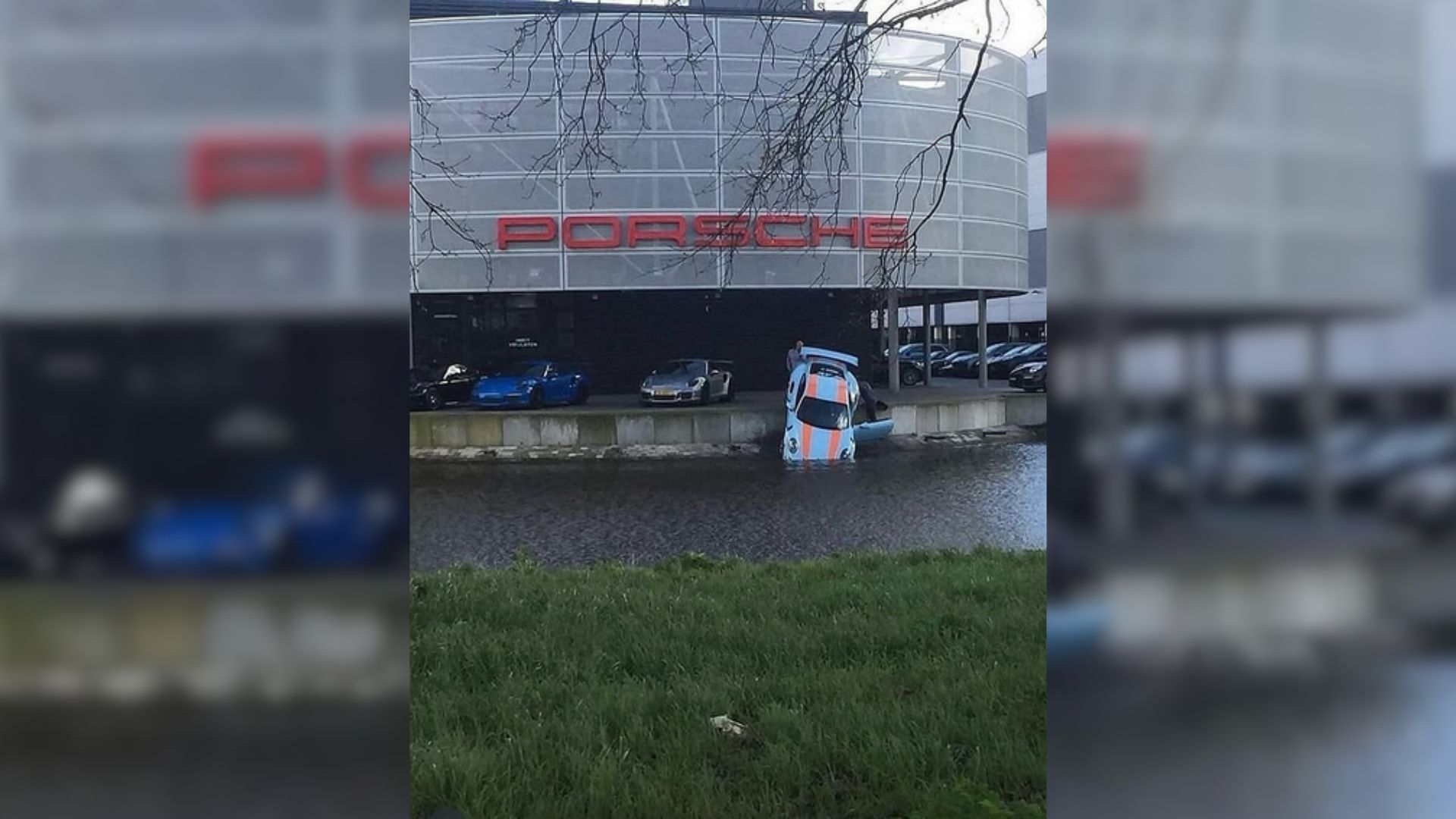
A brand new Porsche 911 GT3 RS, finished in an eye-catching Gulf-style livery, ended up nose-first in a canal in Amsterdam. Not a light scrape or a fender bender. The front of the car went fully into the water, as if it had missed its mark and just kept rolling. And this wasn’t a case of an overconfident owner getting carried away behind the wheel, which almost makes it sting more. The car reportedly never made it that far. The mistake happened inside the dealership, before the customer who’d already paid for it ever got the keys.
The GT3 RS isn’t a car dealerships can afford to be careless with. Even when it launched back in 2016, it carried a sticker price north of $175,000, which looks almost modest next to where clean examples trade today. Add a Gulf-style livery, the kind of finish that turns heads and adds a premium of its own for enthusiasts, and this was clearly not a car anyone wanted rolling anywhere without a driver at the wheel.
Exactly how it happened is still a little murky, and there isn’t one account everyone agrees on. One version says the car was left in neutral during the livery installation process with the parking brake never engaged. Another says an employee was moving the car on a ramp when something went wrong and it started rolling forward with nothing to stop it. Either explanation points to the same root cause: not a mechanical failure, but a basic procedural lapse in a place where cars worth this much are supposed to be handled with extra care.
Whatever set it in motion, the car went somewhere it never should have gone, and it could have been dramatically worse. The canal at that exact spot happened to be shallow, deep enough to swallow the nose of the car but not deep enough to fully submerge it. Whether that was luck or just how that stretch of water happens to be graded, it kept the car from becoming a total loss. The GT3 RS’s rear-mounted engine layout, usually a talking point for weight distribution and handling, ended up doing the car a real favor here too. With the engine sitting behind the cabin, the components most vulnerable to water damage were largely spared when the front end went under.
That doesn’t mean the car walked away unscathed. Water intrusion in a front trunk area, sensors, wiring, and brake components can cause problems that don’t show up immediately, which is exactly why an incident like this calls for a full inspection rather than just a wipe-down and a shrug. This wasn’t some car sitting on a lot waiting for a buyer either. It had already been ordered and paid for, with a customer waiting to take delivery. Finding out your new GT3 RS took an unscheduled swim before you ever laid eyes on it isn’t part of any ownership experience anyone signs up for.
Despite all of that, the story has a relatively soft landing. The car was recovered, inspected, and ultimately delivered to its buyer, which says a lot about how contained the damage actually was. In a situation that could have easily ended in a total loss and an insurance write-off, the GT3 RS survived well enough to still fulfill its original purpose. That’s a genuinely uncommon outcome for a car that spent time nose-down in a canal.
The bigger takeaway here isn’t really about the water. It’s about how these things happen in the first place. A missed parking brake or a ramp mishap isn’t a mechanical defect, it’s a human one, and it’s a reminder that even dealerships handling six-figure cars every day aren’t immune to basic mistakes. This time, a shallow canal and a rear-engine layout lined up just enough to prevent disaster. A few more inches of water or a slightly different angle, and this would be a very different story, and likely a far more expensive one.
Image via nerosgarage/Instagram
About the Author