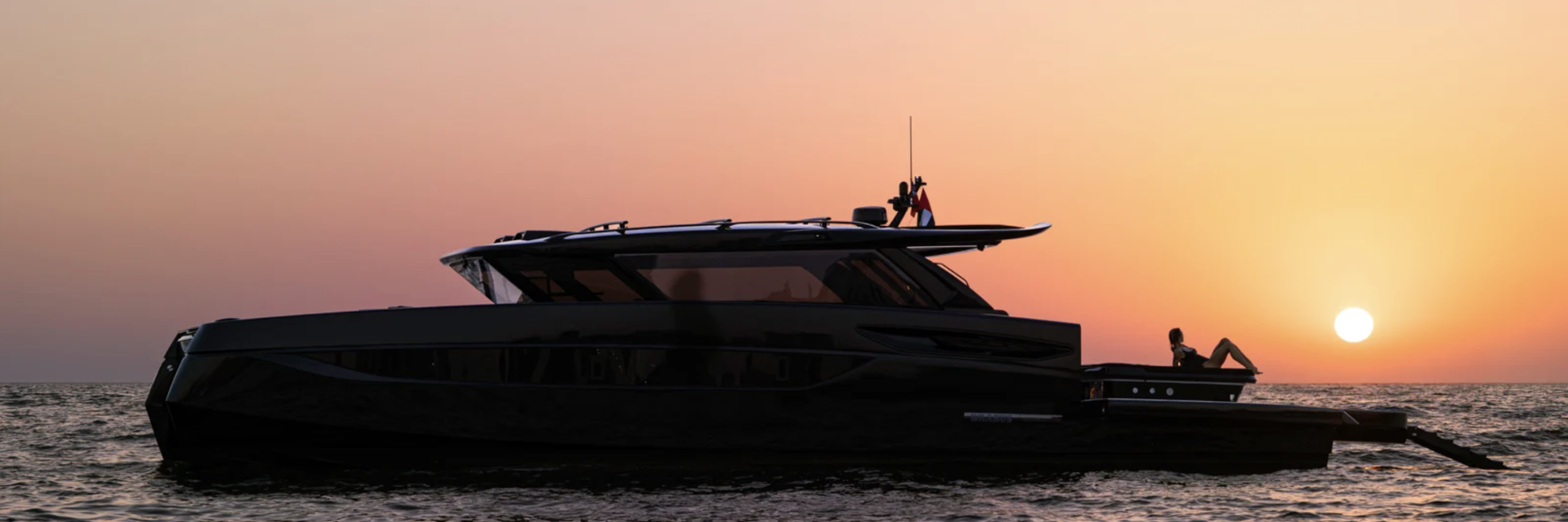
Brabus has spent nearly five decades making Mercedes-Benzes louder, faster and harder to miss in a parking lot. Its newest product can’t park in a lot at all. The Bottrop tuner and Italian builder AB Yachts have revealed the Brabus AB110, a 110-foot performance yacht that premiered this week at the Monaco Yacht Show. It’s the first of a three-boat range, and Brabus clearly wants to dress up yachts the way it dresses up G-Wagens.
Who builds what
Brabus isn’t new to the water. Its marine division already sells powerboats and catamarans. But the AB110 is the company’s first proper yacht, and the work is split. AB Yachts, part of Next Yacht Group, supplies the hull, the engineering and decades of experience with waterjet boats. Brabus supplies the look, the cabin materials and the marketing machinery.
That’s a familiar model for Brabus. It doesn’t build the G 63 either. It takes a capable platform and makes it more extreme. Here, the platform is a fast Italian sport yacht, and the “extreme” part mostly means carbon fiber, red stitching and a spoiler.
The hardware: 107 liters of diesel V16
The AB110 runs three MTU 16V 2000 M96L diesels, each rated at 2,600 hp. That’s 7,800 hp combined. MTU’s own spec sheet lists each engine at 35.7 liters with 16 cylinders and a rated speed of 2,450 rpm, so there are roughly 107 liters of displacement and 48 cylinders in the engine room.
Related Articles
- Senna Gloves and a Schumacher Endplate Puzzle Headline Budds’ Motorsport Sale
- Greg Biffle’s Estate Blames the Pilots, and North Carolina Law Makes That a Big Deal
Power goes to the water through two steerable MJP waterjets plus a single MJP booster. The steerable units handle maneuvering. The fixed center booster adds straight-line thrust once the boat is up and running. It’s a proven layout on fast yachts, and it’s the reason the AB110 draws just 1.3 meters (4.3 feet). With no propellers, shafts or rudders hanging below the hull, it can creep into anchorages that would make a conventional 110-footer’s captain sweat.
Brabus claims a top speed of 48 knots, or 88.9 km/h (about 55 mph). Cruise is 41 knots at 90 percent power, and the claimed range at that speed is 370 nautical miles. An onboard stabilization system is designed to work both underway and at anchor.
The number Brabus didn’t publish
Horsepower means little on a boat without displacement, and Brabus hasn’t published a weight.
There’s also a curious comparison. Marine Jet Power’s case study of the standard AB 110 lists it with triple MAN V12-2000 engines, the same MJP jet setup, and a top speed of more than 50 knots. The Brabus version has bigger MTU engines and claims 48 knots. There are plausible explanations: added weight from the fit-out, different load conditions, or simply a more conservative claim. But anyone paying for the extra horsepower should ask for sea-trial data at their intended load, not just a brochure figure.
The fuel math is wild
The spec sheet lists 11,500 liters of fuel, roughly 3,038 US gallons. At a 41-knot cruise, 370 nautical miles takes about nine hours.
If that range uses the full tank, the three MTUs are drinking roughly 1,275 liters (about 337 gallons) per hour. That works out to around 8 gallons per nautical mile. If the range figure holds back a reserve, which is normal practice, the hourly burn is a bit lower, but the order of magnitude doesn’t change. A single fill-up at marine diesel prices will cost more than a lot of people’s cars.
What makes it a Brabus
The branding goes well beyond a badge on the transom.
- Exterior carbon: An illuminated roof spoiler, exposed-carbon front wings, carbon details along both sides, and carbon trim around the aft engine air outlets.
- Brand signatures: LED roof lights, red accents, and Brabus’s “Triangle” quilting on the exterior upholstery.
- Helm: A bespoke Brabus steering wheel and a driver’s seat in Masterpiece leather.
- Sun deck: It doubles as a flybridge, and the secondary helm controls for harbor maneuvering are fully retractable.
Brabus’s own pitch is aimed at people who want to “live BRABUSIZED.” You either find that charming or you don’t.
Living aboard
The AB110 sleeps up to 10 guests in four cabins: an owner’s suite with its own bathroom and closet, a VIP cabin, and two guest cabins, each with a private bathroom. Four crew live in two cabins alongside the galley and a crew mess on the lower deck.
The stern garage holds a jet tender and a full-size three-seat jet ski, launched with an integrated winch and roller system. Once the toys are in the water, the aft platform becomes a beach club at sea level. There’s also 2,000 liters of fresh water on board.
Owning one
Classification: The yacht carries RINA classification for unrestricted pleasure navigation. RINA is the Italian classification society, and that notation should help with insurance, resale and financing, since lenders and underwriters prefer classed hulls with a documented survey history.
Maintenance: Three high-output V16s mean three sets of scheduled MTU service intervals, and waterjets add their own checklist. Intakes collect debris, and impellers and wear rings need periodic inspection. Anyone using this boat hard should budget for a dedicated engineer, not just a captain.
Insurance: Expect underwriters to focus on the combination of 48-knot capability and crew experience. Fast boats with jets are specialized to handle, and premiums will reflect who is actually at the helm.
Related Articles
- F1 Movie Sequel: Hamilton’s Script Work and the 2026 Car Problem
- Joe Gibbs Racing Wants Denny Hamlin’s Ex-Crew Chief and Spire Motorsports Held in Contempt Over a NASCAR Debrief
For American buyers: MTU lists the M96L as certified to EPA Tier 3 recreational and IMO Tier II standards. That removes one potential headache for anyone planning to bring the boat to US waters, though it’s no substitute for a proper import review.
Where this is going
The AB110 sits in the middle of the new range. A smaller 95-foot AB95 comes next, followed by a 150-foot AB150 superyacht scheduled to debut at the 2027 Monaco show, the year of Brabus’s 50th anniversary. No prices have been published, just an inquiry form.
The strategy makes sense: Brabus is applying its tuning formula to a market where buyers already pay a premium for design. A carbon roof spoiler on a 110-foot yacht is a matter of taste. The 48-knot claim is a matter for the sea trial, preferably with the boat fully loaded.
Images Via: Brabus
About the Author