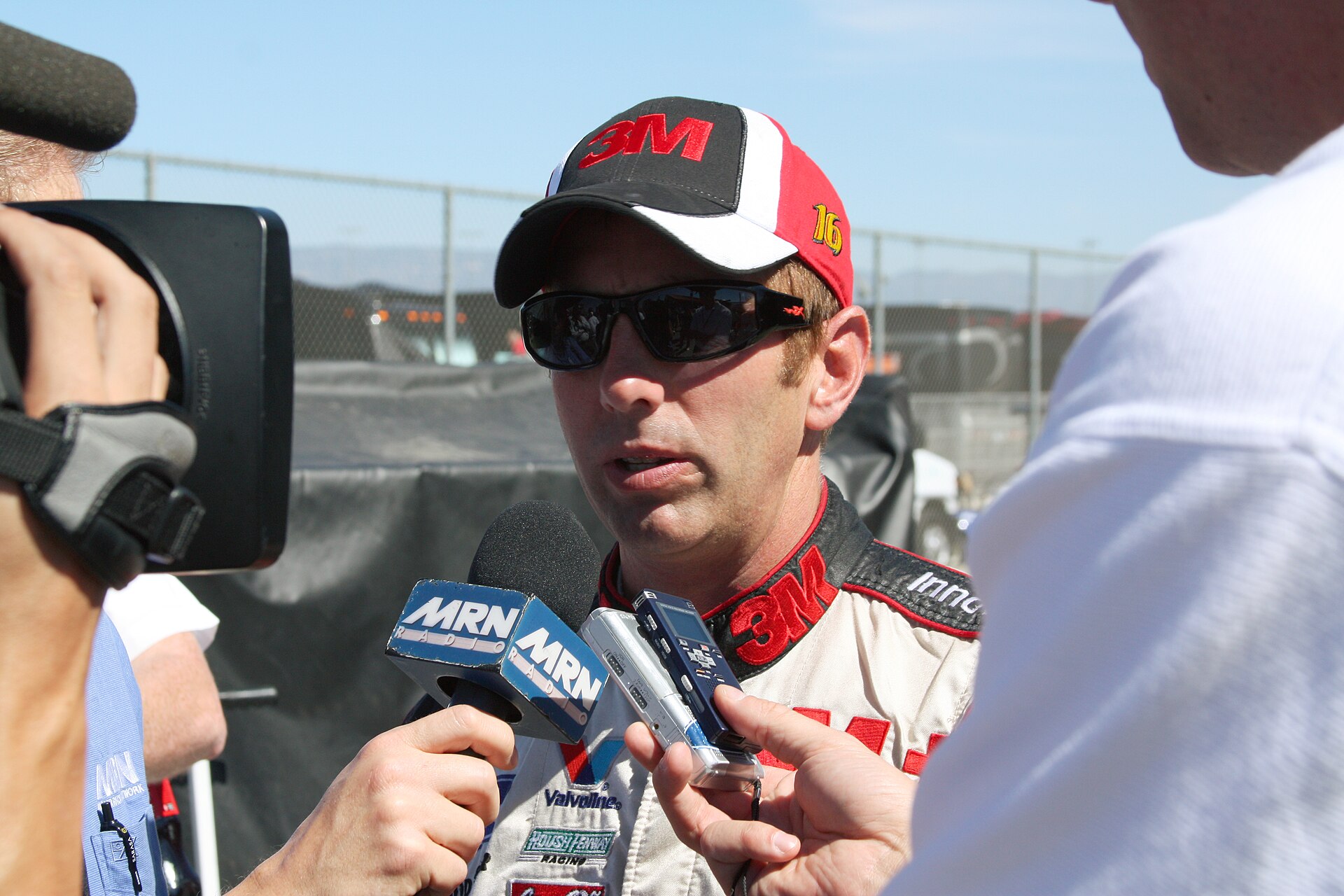
Greg Biffle. Photo: Raniel Diaz via Wikimedia Commons, CC BY 2.0
Nine months after a Cessna Citation went down short of the runway at Statesville Regional Airport, the fight over who is to blame has settled into a familiar civil-court shape: everybody points at somebody else. The newest finger belongs to Greg Biffle’s estate, which has asked a North Carolina court to throw out the wrongful-death claims brought on behalf of the two men in the cockpit, Dennis Dutton and his son, Jack.
The estate’s position, as disclosed on X by FOX Sports NASCAR reporter Bob Pockrass, is that the Duttons were negligent in how they operated the airplane. That sounds like routine lawyering, and in part it is. But in North Carolina, that one allegation carries far more weight than it would almost anywhere else in the country, and the federal paperwork already on file gives both sides plenty to work with.
None of what follows is a finding of fault. The National Transportation Safety Board has not determined a probable cause, and every claim in these lawsuits is an allegation until a court or jury says otherwise.
Two lawsuits, one airplane, opposite stories
The crash on December 18, 2025, killed all seven people aboard: Biffle, his wife Cristina, his daughter Emma, his son Ryder, Dennis Dutton, Jack Dutton and Craig Wadsworth. The jet, registered N257BW, was listed by the NTSB as operated by GB Aviation Leasing LLC, Biffle’s aircraft company, and was on a personal flight bound for Sarasota, Florida.
In April, the Dutton estates filed wrongful-death suits against Biffle’s estate seeking $15 million apiece. Their theory runs through ownership: Biffle’s company owned the airplane, so Biffle was responsible for keeping it airworthy, and the plaintiffs allege it wasn’t. The Biffle estate’s motion flips the lens from the hangar to the cockpit.
These aren’t the only cases. The crash has also produced a suit from the pilot’s widow aimed directly at Biffle’s aviation company, plus a claim on behalf of Emma Biffle. We walked through how the early filings stacked up back in May.
The line on the pilot certificate
The most useful document in this whole saga isn’t a complaint. It’s the NTSB’s preliminary report for investigation WPR26MA063, and one entry in it deserves more attention than it has gotten.
Dennis Dutton was no weekend flier. The report credits him with roughly 17,000 hours and type ratings for the Airbus A320, A330 and A350, the Boeing 737, 757 and 767, the DC-10, and the CE-500, which covers the Citation family. But the CE-500 rating carried a limitation: “Second in Command Required.”
That matters because the Citation 500 series is one of the classic business jets that can be flown by a single pilot, but only by a pilot who has trained and checked for single-pilot operations. Without that, the rating says you need a qualified second pilot in the right seat. It’s the aviation equivalent of a learner’s permit clause, except it’s printed on the certificate of a man type-rated in widebody airliners.
The right seat held Jack Dutton, a private pilot with about 175 hours, all in single-engine airplanes, and an instrument rating. The NTSB states plainly that he was not qualified to act as second in command under 14 CFR 61.55. Read the regulation itself and the gap is obvious: a second in command needs a certificate with the appropriate category and class rating (a twin jet requires multi-engine), plus aircraft-specific familiarization and logged takeoffs, landings and engine-out work in type within the prior 12 months.
Biffle, seated behind the pilots, held a private certificate with multi-engine land, instrument and helicopter ratings and roughly 3,500 hours, according to the report. He was a passenger on this flight.

Eight minutes of trouble
If the crew qualifications help the Biffle estate, the airplane’s behavior is what the Dutton estates will lean on. The preliminary report describes a jet that was misbehaving before it ever left the ground.
- The left engine did not start on the first attempt, and the crew discussed a thrust reverser indication.
- The airplane departed around 10:06 a.m. under visual flight rules, with the plan to pick up an instrument clearance en route. Surface weather at the airport included heavy drizzle, five miles visibility and a broken layer at 1,200 feet.
- Starting around 10:10, the pilot reported his altitude indicator wasn’t working properly and that other left-side instruments might be affected. Control passed to Jack Dutton in the right seat at about 4,500 feet around 10:11.
- Dennis Dutton took the controls back by 10:13 and turned for Statesville. Flaps and gear went down, but the gear indicator lights did not illuminate. At 10:13:48, the right-seat occupant radioed, “we’re having some issues here.”
- The jet hit the runway 28 approach lighting about 1,380 feet short of the threshold, sheared trees roughly 12 feet off the ground, and came to rest in the overrun area, where fire consumed the fuselage.
Two details from the wreckage are worth noting for anyone trying to read the tea leaves. Both engines showed fan blade damage consistent with turning at impact, with no sign of an uncontained failure, and both thrust reversers were stowed. So far, the evidence reads less like an engine quitting and more like an instrument or electrical problem the crew was fighting while trying to get back down in marginal weather, though the NTSB has drawn no such conclusion.
There’s one more clue. The cockpit voice recorder’s audio drops out from 10:10:14 to 10:14:05, exactly the window when the instruments went sideways. When the audio returns, a voice from the back asks about the “alternator.” The NTSB pointedly notes that the Citation 550 doesn’t have one; its engines drive starter-generators. A recorder losing audio at the same moment flight instruments fail raises the obvious question of a common electrical thread, but answering it is a job for the final report, not for anyone reading a preliminary one.
Why “negligent” is a loaded word in North Carolina
Most states use comparative fault. If a jury decides a plaintiff was 20 percent responsible for their own harm, the damages shrink by 20 percent and the case goes on. North Carolina is one of a handful of holdouts, along with Virginia, Maryland, Alabama and the District of Columbia, that still apply pure contributory negligence. Under that rule, a plaintiff who contributed to their own injury in any meaningful way can be barred from recovering at all.
In a wrongful-death case, the estate generally stands in the shoes of the person who died. So if a court eventually accepts that the pilot in command flew outside the limits of his own rating, or that the crew’s handling of the emergency contributed to the crash, the Dutton estates could be facing an all-or-nothing defense rather than a haircut on damages. North Carolina does carve out exceptions, including the “last clear chance” doctrine and cases involving a defendant’s gross negligence, which is why plaintiffs in cases like this often reach for words like “reckless” rather than stopping at “careless.”
A caution on the motion itself: a motion to dismiss typically tests whether a complaint states a legal claim, not whether the defendant is right on the facts. Filing one is a standard early move, and the full legal basis of this one has not been made public. Denial would not mean the estate loses, and a grant could still leave the door open to an amended complaint.
The NTSB report can’t be Exhibit A
Here’s something that surprises a lot of people: whatever the NTSB eventually concludes about probable cause, federal law keeps that conclusion out of the courtroom. Under 49 U.S.C. § 1154(b), no part of a Board report on an accident may be admitted as evidence in a civil suit for damages. Investigators’ factual findings, such as radar data, maintenance records and wreckage measurements, can come in through other means, but the Board’s opinion on why the jet crashed cannot.
That’s why both sides are already building their own cases instead of waiting. The NTSB says a final report typically lands 12 to 24 months after an accident, which puts this one somewhere between late 2026 and late 2027. Expect the litigants to hire their own avionics experts to pick through the electrical system well before then.
What owners should take from this
Racing and private aviation have been intertwined for decades, because the schedule demands it, and the sport has buried too many people because of it. Plenty of drivers, team owners and car collectors hold airplanes through an LLC, and this case is a painful reminder of what that structure does and doesn’t protect.
Putting an aircraft in a company doesn’t take the owner out of the airworthiness conversation, which is precisely the theory the Dutton estates are pursuing. And the paperwork side is just as unforgiving. Aircraft hull and liability policies commonly spell out which pilots are approved to fly the airplane and what ratings and experience they must hold. A crew that doesn’t match the policy language can give an insurer grounds to contest coverage, which can leave an estate, rather than an insurer, holding the liability. Anyone who lends out a car, a race car or a jet should know exactly who their policy considers a permitted operator.
For now, the Biffle case sits where most aviation litigation sits at the nine-month mark: dueling allegations, an incomplete federal investigation and a state law that makes the question of pilot conduct unusually decisive. Biffle’s story has taken other strange turns since the crash, including a burglary that sent his NASCAR rings to Georgia. This one will take far longer to resolve.
Featured image: Greg Biffle. Photo by Raniel Diaz via Wikimedia Commons, CC BY 2.0.
About the Author