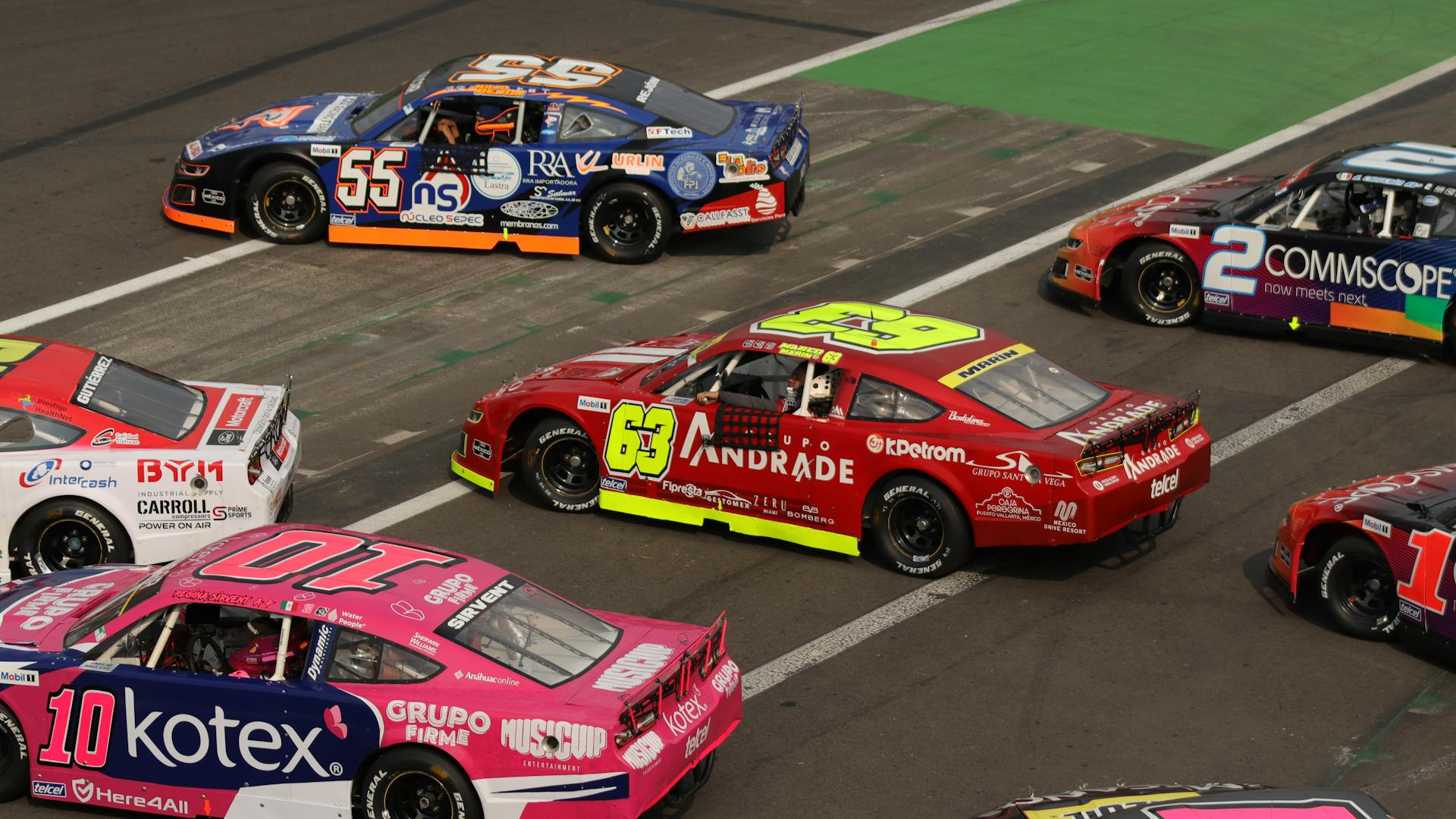
Photo by Diego Martinez on Pexels
On October 13 at 10 a.m., in Courtroom 5B of the federal courthouse on West Trade Street in Charlotte, a judge will spend a morning on a question that sounds ridiculous for about ten seconds and then stops sounding ridiculous at all: when a man who used to run competition at Joe Gibbs Racing sits in a Spire Motorsports post-race debrief and suggests that two drivers share one bucket seat, has he performed a service?
Gabehart is not a back-office hire. He started at JGR as an engineer in 2012, spent 2019 through 2024 as Denny Hamlin’s crew chief on the No. 11, and was promoted to competition director in December 2024 with oversight of race and vehicle strategy across the whole four-car Toyota operation. Hamlin signed a sworn declaration in this case in March calling the files Gabehart allegedly held onto “the crown jewels of our racing operation,” and explaining why two one-hundredths of an inch of setup difference matters in a spec car.
The bucket seat is the actual battleground now. On September 15, JGR asked U.S. District Judge Susan C. Rodriguez to order both Christopher Gabehart and Spire Motorsports II, LLC to show cause why they should not be held in civil contempt of two standing orders in Joe Gibbs Racing, LLC v. Gabehart, case number 3:26-cv-00133 in the Western District of North Carolina. The next day JGR filed a separate sanctions motion aimed only at Gabehart. The day after that, it filed a renewed motion for a preliminary injunction. The court bundled the contempt motion and the renewed injunction request into a single hearing slot, which is how one Tuesday morning in October became the most consequential date on this case’s calendar since the April ruling that let Gabehart keep his Spire job.
What the orders actually forbid
This is the part most people get wrong. The court never ordered Gabehart to resign, never barred him from Spire’s property, and never told him to stay home on Sundays. What it did was enforce Section 6 of his JGR employment agreement, which prohibits him from providing a competitor with services of the same general type he provided JGR during his final year there. The temporary restraining order arrived March 2 as a text-only order, was confirmed in writing March 5, and got extended five times before the preliminary injunction took over on April 23. Both orders also told him to stop retaining, copying, using, or disclosing JGR confidential information and to hand back whatever he still had. Both explicitly left the door open for other services he had not performed at JGR in that final year.
Spire’s exposure comes from a quieter piece of plumbing. Federal Rule of Civil Procedure 65(d)(2) makes an injunction binding not just on the party it names but on anyone acting in active concert with him. JGR’s theory is that Spire knew exactly what the orders said, kept inviting Gabehart to Cup competition meetings anyway, and built him an executive title that functioned as camouflage. Spire’s counter is that a title is not a service and that nothing Gabehart said in a meeting moved the needle.
There is a genuine drafting lesson buried here. North Carolina courts will not rewrite an overbroad covenant to make it work, so narrow, role-specific language like JGR’s tends to survive where a blanket industry ban would be struck. But enforceable and administrable are different things. Nobody in a race shop has a job description that maps cleanly onto the phrase “services of the general type,” and the closer you get to the top of a competition department, the blurrier it gets. JGR won a covenant a court would actually enforce, and then discovered it has to prove, meeting by meeting, what the covenant means.
The timeline JGR is pointing at
JGR’s contempt memorandum is 29 pages of calendar entries, and the calendar is the argument. Spire has maintained that Gabehart’s first day was February 16, 2026. JGR points to February 14, when Gabehart was already trading messages with Spire Cup competition director Matt McCall about the No. 7 car and receiving pit-stall diagrams for the Daytona 500. On race day itself he was in Spire’s war room beside technical director Dax Gerringer, texting live observations to co-owner Jeff Dickerson. A week later he turned up in a recorded Atlanta competition debrief.
The post-order entries are the ones that matter legally. On March 21, with the TRO in force, he was discussing technical problems on the Nos. 77 and 71 with McCall. On March 28, Carson Hocevar texted him about a specific handling complaint and Gabehart replied with a single word: “Stop.” At an April 20 debrief after the Kansas race, Gerringer’s contemporaneous notes record two concrete recommendations touching power and aerodynamics. At the May 18 Dover All-Star debrief, nearly a month after the injunction, the notes show him asking drivers about ride quality and floating a way to streamline Spire’s backup-car process. Dickerson, in deposition, described leaning on him for the Cup program and asking him to map out where the shop was weak on equipment for the next two to three years.
Why a shared bucket seat is a real engineering argument
Casual readers will hear “bucket seat” and assume the lawyers have run out of material. The opposite is true, and this is where the case gets interesting for anyone who has ever prepped a race car. In the Next Gen era a seat is molded and mounted to one driver’s body, and swapping one is not a bolt-in job. Spire’s own No. 7 crew chief explained in deposition that pulling out a backup car costs many hours of prep, and that a single seat two drivers could share removes a chunk of that work. That is a process improvement with measurable labor and logistics value, which is precisely the category of work a competition director exists to produce.
The ride-quality question is the same kind of thing wearing different clothes. In a spec chassis with a common parts list, the differentiator is not exotic hardware, it is how fast a team can convert driver feel into a setup change. Asking drivers directly about ride quality is not chit-chat; it is the first step of that loop. JGR’s sharpest evidentiary move is a causation argument built from Spire’s own witnesses: the shop foreman testified that Spire had not used one of the two Kansas recommendations until midsummer 2026, and the other not until the week before the late-May Charlotte race, roughly three weeks after that meeting. Whether a jury or a judge reads that as influence or coincidence in a shop that was hiring and spending aggressively anyway is the whole ballgame.
A spreadsheet with a timestamp problem
The second alleged violation is cleaner and, for Gabehart personally, uglier. On November 7, 2025, days before his JGR exit, he photographed an internal season-long post-race audit the court has already held to be a trade secret. He then built his own version of it. An operational copy of that file was pulled off his Spire-issued computer, and a version populated with Spire results from Daytona, Atlanta and COTA carries a last-modified date of March 5, 2026 – three days after the TRO landed. Separately, his counsel disclosed that an undisclosed personal OneDrive account held JGR material, including 2024 Cup setup comparisons, until at least June 2026, months after he had sworn twice that his phone and a personal Google Drive were the only places anything lived.
The practical lesson for every engineer and crew member in the Mooresville-Charlotte corridor is unglamorous and worth more than any legal theory in this file: metadata is the witness that never gets nervous. Cloud sync does not care about your intentions, and a file’s modified date will outlive every declaration written about it.
Spire’s answer is not remotely subtle
Spire’s June 24 pleading opens by accusing JGR of taking competition off the racetrack and into a courtroom because it cannot keep a three-car upstart in its mirrors. Spire says Gabehart left in a way that tripped a bespoke clause in his agreement that shrank his noncompete to a single week, that JGR elevated family over performance when it put the owner’s grandson in the No. 54, and that Gabehart had no interest in the babysitting job that came with it. Its technical defense is the one that should interest engineers: the two teams field cars from different manufacturers, so a Toyota setup sheet is close to useless in a Chevrolet shop supported by a Hendrick Motorsports and General Motors technical alliance. Spire also notes that it has asked since February for a list of the trade secrets it supposedly used, and says JGR has revised that list repeatedly – most recently in August, after nearly every fact deposition was finished, with a sixth revision promised. Spire’s discovery briefing adds a detail that tells you how this litigation actually feels day to day: JGR has parked more than 450 documents in a protected clean room while claiming roughly 170 of them as trade secrets.
Dickerson’s deposition supplies the quotable version of the defense. He waved off the Kansas recommendations as something a janitor could have said, drew a line between behaviors and services, and argued that anything an executive would normally do is fair game. It is a real argument, and it is also exactly the argument JGR wants, because the orders restrict conduct rather than job titles. That tension is not new in this case; JGR already had to withdraw its most sensational allegation in July when it could not substantiate it.
Then both defendants went looking for a default
On September 24, Gabehart and Spire each filed an application under Rule 55(a) asking the clerk to enter default against JGR for failing to plead in response to their counterclaims. Gabehart’s counterclaims, served June 24, run to six counts: breach of contract, a North Carolina Wage and Hour Act claim, a declaratory judgment that the noncompete is inapplicable, unenforceable and unbroken, a federal Computer Fraud and Abuse Act claim, a North Carolina Computer Trespass Act claim, and a state unfair and deceptive trade practices claim. JGR moved to dismiss both sets of counterclaims on July 15, and that briefing closed on August 5.
Read that sequence carefully before you assume JGR is about to lose by forfeit. Rule 12(a)(4) normally suspends the deadline to answer while a Rule 12 motion is pending, restarting it 14 days after the court rules, and clerks almost never enter default against a plaintiff in that posture. What the twin applications really do is put a stopwatch on a set of motions that has been sitting for seven weeks, and remind the court that the defendants believe they have affirmative claims of their own worth real money. The Wage and Hour count is the sleeper: North Carolina allows liquidated damages and attorney’s fees on top of unpaid wages, which is the kind of exposure that changes settlement math.
The blast radius now reaches both manufacturers
This stopped being a two-team dispute months ago. Gabehart has a pending motion to compel Toyota Racing Development, which is being litigated alongside four other motions to compel set for hearing on October 1 before Magistrate Judge David Keesler. On September 23, HMS Holdings – Hendrick Motorsports – filed a limited notice of appearance to protect its interests in JGR’s demands for Spire’s technical documents, and signaled it planned to show up and be heard. Keesler’s order the same day noted the notice was not timely, with the motions fully briefed and the hearing a week out.
That is the detail every team principal should be reading twice. A noncompete fight between two organizations has produced subpoena exposure for a manufacturer’s competition arm on one side and a top-tier alliance partner on the other. In a sport where charters trade like nine-figure assets and cost control is suddenly a live conversation, the discovery bill in a case like this is not a rounding error, and the collateral risk of having your own technical files pulled into someone else’s lawsuit is a cost nobody prices into an alliance agreement.
What a contempt finding would actually change
Civil contempt is remedial, not punitive, and that distinction does most of the work here. Intent is close to irrelevant, good faith is a defense the defendants have to prove rather than something JGR must disprove, and a single violation is enough to support a finding. Nobody is going to jail. What JGR is really shopping for is a tightened order with teeth – a prohibition specific enough that attending a competition meeting at all becomes a violation – plus its fees for bringing the motion. Spire’s best outcome is a finding that its guardrails, thin as they were, counted as reasonable efforts.
The calendar behind October 13 is unforgiving. Mediation has to happen by October 23, dispositive motions are due in early November, and a nine-day jury trial is on the books for February 1, 2027, which means jury selection lands squarely in the run-up to Speedweeks. Two organizations that need every dollar in the shop will instead be feeding a courtroom during the busiest month of their year. Whatever else this case decides, it has already answered the question of whether a NASCAR noncompete is worth litigating to the mat. Somebody thinks it is, and that reprices every competition-side contract in the garage – a point worth remembering next to how modest this dispute looked when it was first filed in February.
If you work in this industry and you are signing something this offseason, take three things from the docket. Narrow, role-specific covenants are the ones that survive, which means your future fight will be about what you did rather than what your card said. Keep employer work product off personal cloud accounts, because a sync you forgot about is now a federal exhibit. And if you are the team doing the hiring, a new title is not a compliance program: put a written screen in place on day one, log who is allowed to talk to whom about what, and keep the person out of the room. Spire’s most expensive mistake so far may simply have been leaving the door open.
About the Author