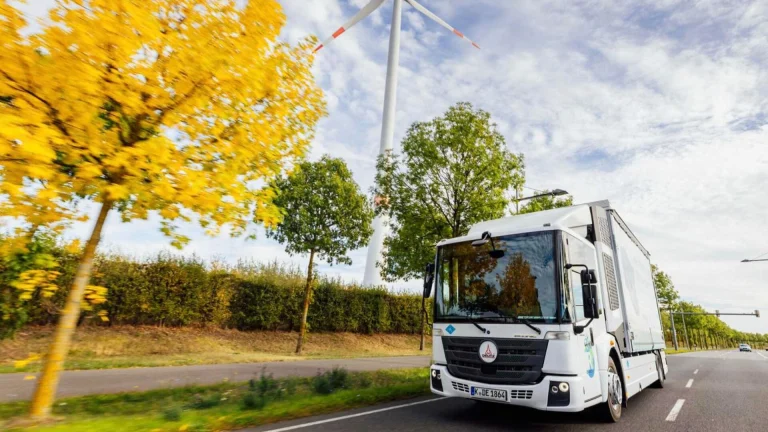
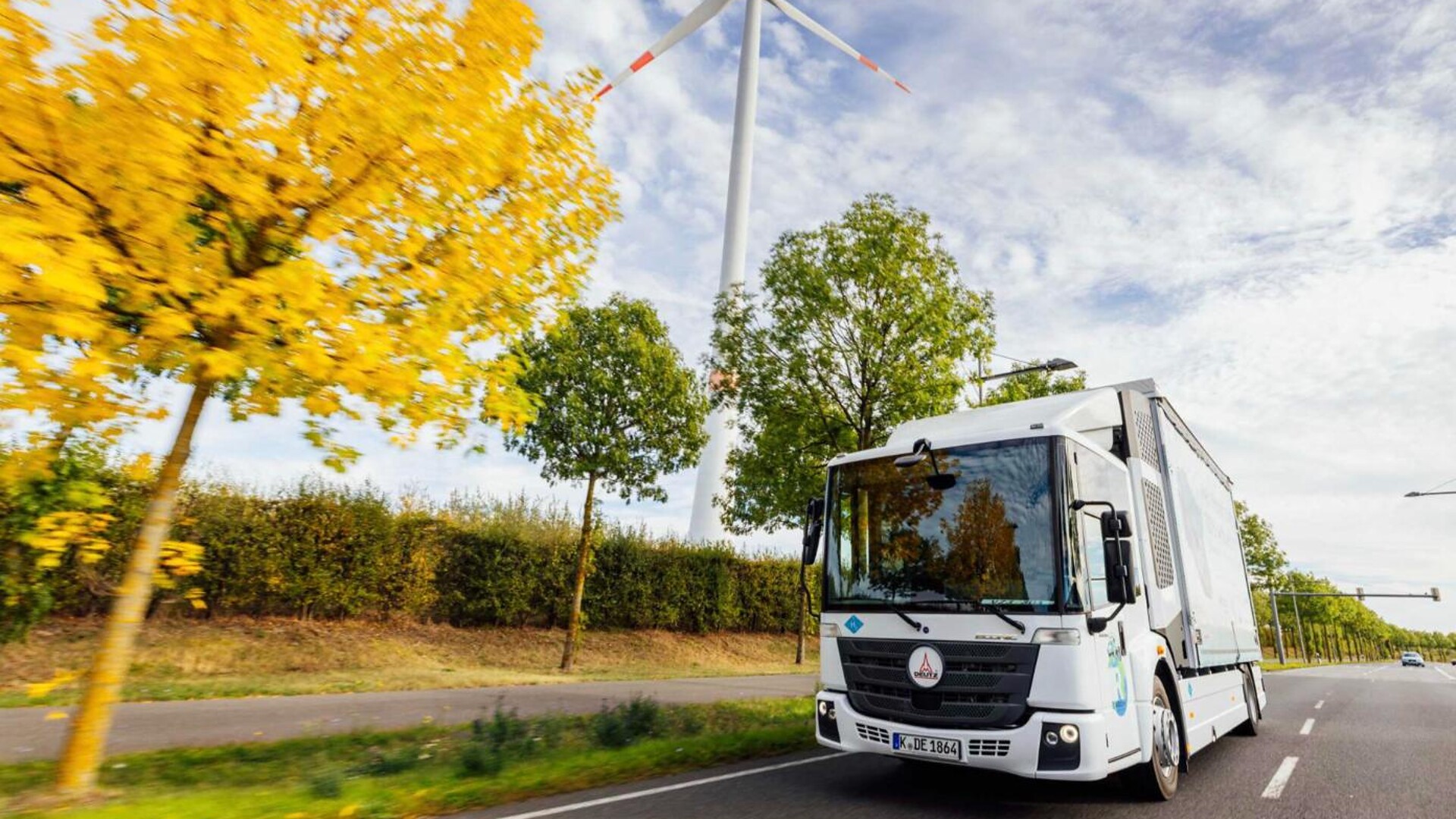
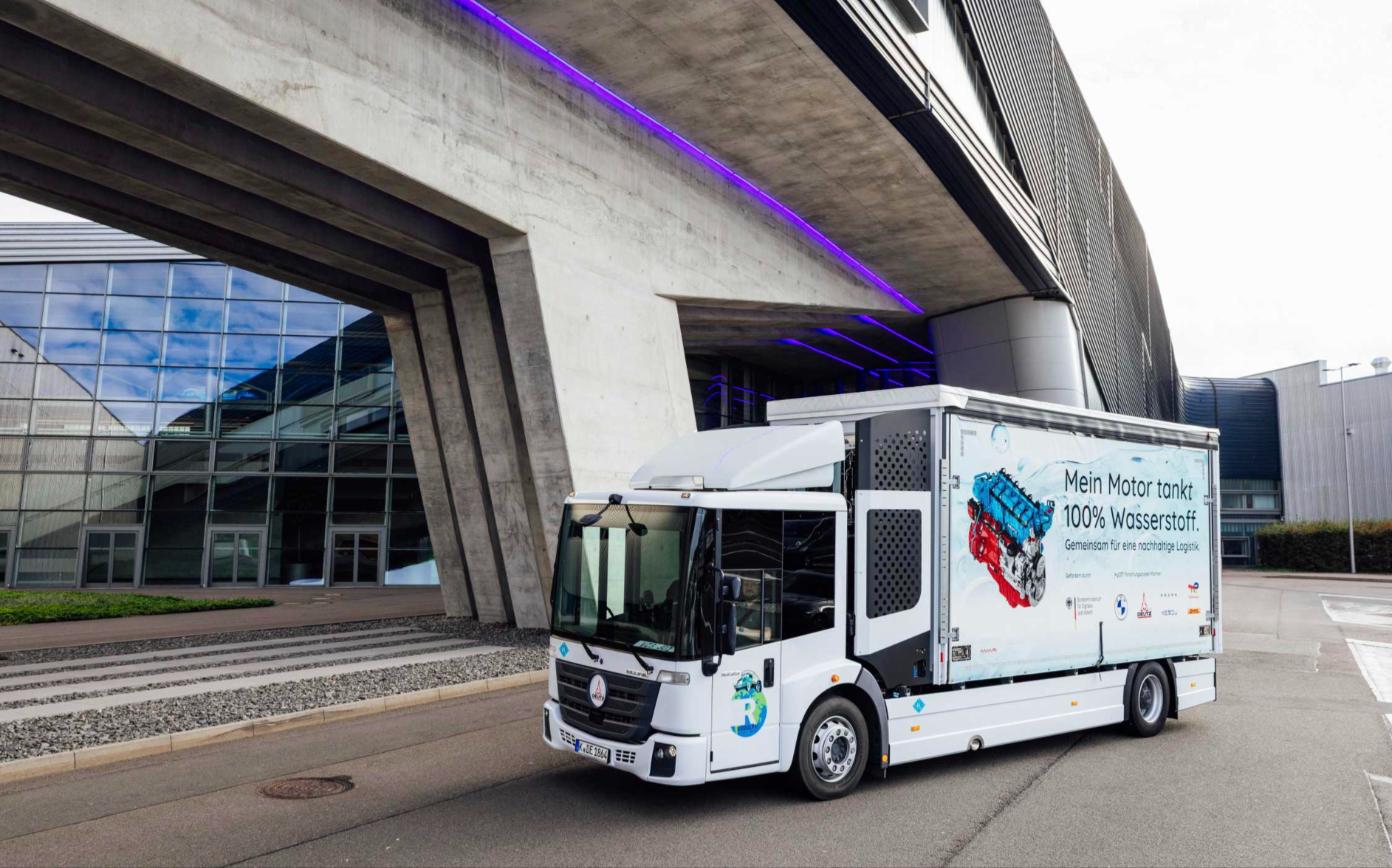
The HyCET test truck on a road near BMW Group Plant Leipzig. Photo: BMW Group (press image)
An 18-tonne truck with a DEUTZ hydrogen engine is now hauling bumper parts at BMW Group Plant Leipzig, according to a BMW press release dated October 6. It is the only truck the release mentions. When BMW announced the HyCET research project in September 2022, the plan called for four.
For now the truck carries material to Leipzig’s Technology Exterior Components division, the part of the plant that molds plastic bumpers and spoilers. In a second phase it will run finished exterior parts from that division to final assembly on a just-in-time schedule. BMW says the test covers longer transport routes as well as three-shift work around the plant.
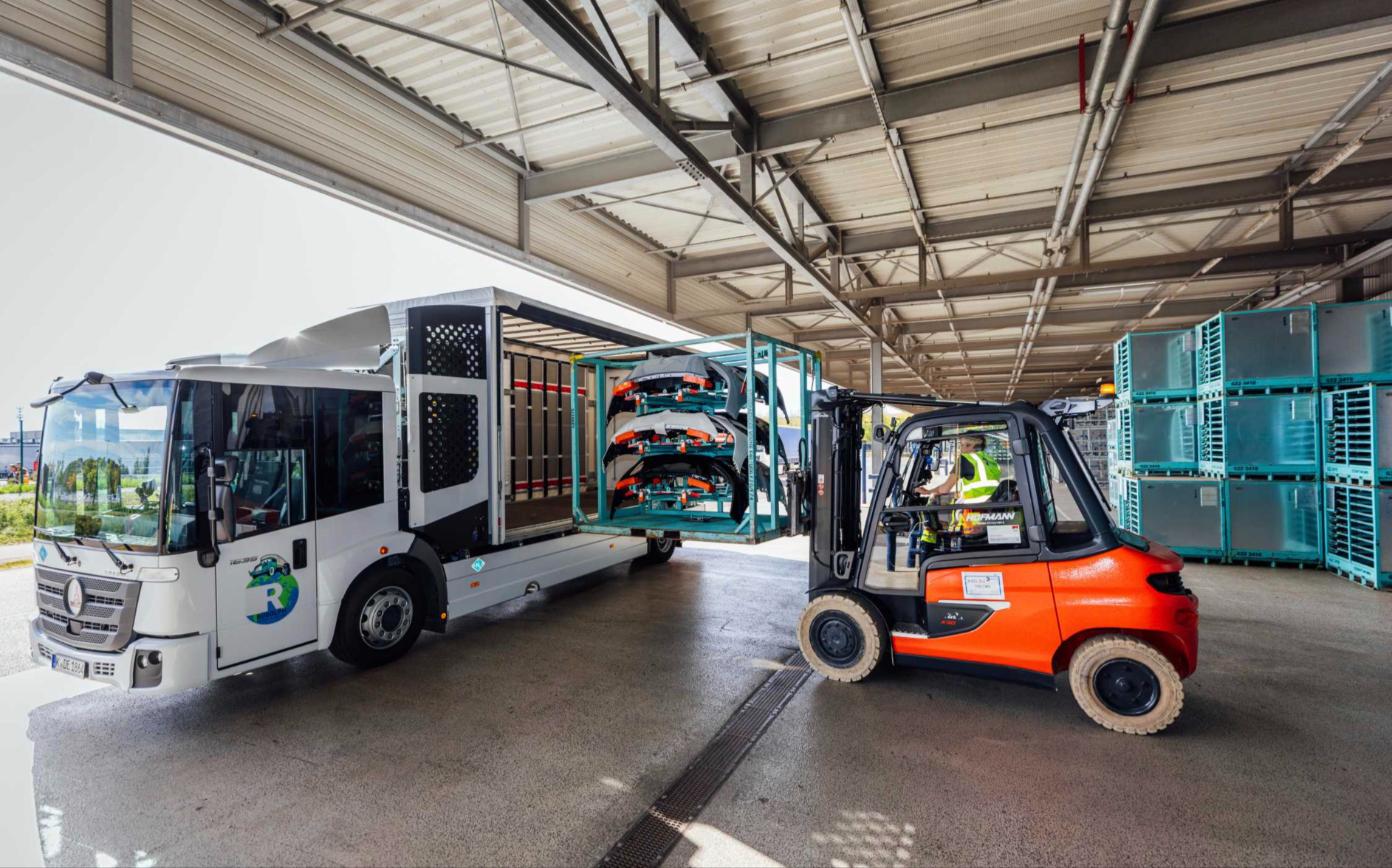
Dirk Wiedmann, who heads BMW’s production network and logistics, called it the first hydrogen-combustion truck in regular operation in German car production. The engine burns hydrogen in cylinders derived from a diesel design instead of feeding a fuel cell, and BMW says what comes out the tailpipe is water vapor and “virtually no CO₂.”
The numbers BMW left out
The release gives the truck’s weight class and nothing else you would find on a spec sheet. There is no power figure, no range, no tank capacity or storage pressure, no hydrogen consumption and no refueling time, even though short refueling is one of the advantages BMW claims for hydrogen. It doesn’t say who built the chassis, how long the test will run or where the hydrogen comes from.
The 2022 announcement filled in one blank: the 18-tonner would get a 7.8-liter DEUTZ engine that was already running in a stationary generator. DEUTZ’s data sheet for the TCG 7.8 H2 lists six cylinders, 220 kW (295 hp) at 2,200 rpm and 1,000 Nm (738 lb-ft) between 1,400 and 1,600 rpm, with hydrogen fed to the engine at 25 bar. BMW hasn’t said whether the Leipzig truck uses that rating. Its photos show a DEUTZ badge on the grille and a Cologne “K” registration plate. DEUTZ is headquartered in Cologne.
Where the other trucks went
In 2022, HyCET was a four-year project worth €19.5 million, with €11.3 million from what was then Germany’s Federal Ministry for Digital and Transport and another €5.7 million for two public hydrogen stations in Leipzig and Nuremberg. The plan was two 18-tonne trucks and two 40-tonners. KEYOU and Volvo were to fit a 13-liter hydrogen engine to the two heavy Volvos, DHL Freight would run shuttles to the Leipzig plant, and TotalEnergies would build the stations.
By February 2025, BMW counted three HyCET trucks, two at 40 tonnes and one at 18, and still listed DHL, Volvo Trucks, KEYOU and TotalEnergies as partners.
The October release names a different lineup. DEUTZ developed the engine, the Rudolph Logistics Group operates the truck and TEAL MOBILITY installed the filling stations. Volvo, KEYOU, DHL and TotalEnergies don’t appear, and neither do the 40-tonne trucks. The truck hasn’t been updated to match. In BMW’s own photos, its curtain side still carries a panel headed “HyCET Forschungsprojekt-Partner” with the Volvo, KEYOU, TotalEnergies and DHL logos, under a funding credit to the ministry’s old name.
Four years from September 2022 puts the project’s original end at about now. The release doesn’t say whether HyCET was extended or what happened to the heavy trucks.
Water vapor, and what else
Burning hydrogen produces no carbon dioxide from the fuel itself. The “virtually” in BMW’s claim covers the lubricating oil that every piston engine burns in small amounts. DEUTZ markets the engine as a 99 percent CO₂ saving.
Neither company publishes a figure for nitrogen oxides. Hydrogen burns hot, and in an engine it burns in air that is about 78 percent nitrogen, so a hydrogen combustion engine still forms NOx. Engine makers control it with lean mixtures and, often, diesel-style catalytic aftertreatment. DEUTZ’s data sheet says the engine’s NOx output meets EU standards without giving a number. BMW’s release doesn’t mention NOx, and it doesn’t say whether the hydrogen in the tanks is made with renewable electricity or from natural gas, which settles most of the CO₂ question before the truck turns a wheel.
Why not a fuel cell
BMW already runs fuel-cell trucks. In 2025 it put two Iveco S-eWay Fuel Cell trucks into service on routes from Leipzig through the EU-backed H2Haul program, and the plant has five hydrogen stations and more than 200 fuel-cell industrial trucks such as forklifts. The new release argues the combustion engine slots into existing diesel maintenance routines and is far less sensitive to hydrogen quality than a fuel cell. That second point comes down to chemistry. Fuel cells for road vehicles are specified to 99.97 percent hydrogen purity under ISO 14687 because traces of carbon monoxide and sulfur poison their platinum catalysts. A combustion chamber tolerates them.
A fuel cell generally turns more of hydrogen’s energy into useful work than a piston engine does, so a combustion truck should need more hydrogen per kilometer. BMW has published no consumption figure for either type. The release also concedes that “an appropriate and reliable hydrogen filling infrastructure is still required,” the same constraint that shapes Toyota’s plan for 1,500 hydrogen rigs and 30 stations. Hydrogen piston engines have found other work this year, too: JCB’s Hydromax streamliner runs on two of them.
The next step BMW has committed to is phase two, with the truck feeding exterior parts straight to the assembly line, and the release gives no date for it. BMW’s stated target, from February 2025, is a series-production hydrogen car in 2028. The release doesn’t say whether HyCET’s data will be in before then, or from how many trucks.
Four trucks promised, one on the road, no consumption figures: is hydrogen combustion a real bridge for fleets, or should BMW put its logistics money into batteries and fuel cells?
Sources: BMW Group press releases of October 6, 2026, February 20, 2025 and September 28, 2022; DEUTZ TCG 7.8 H2 product data sheet; BMW Group press photography.
About the Author