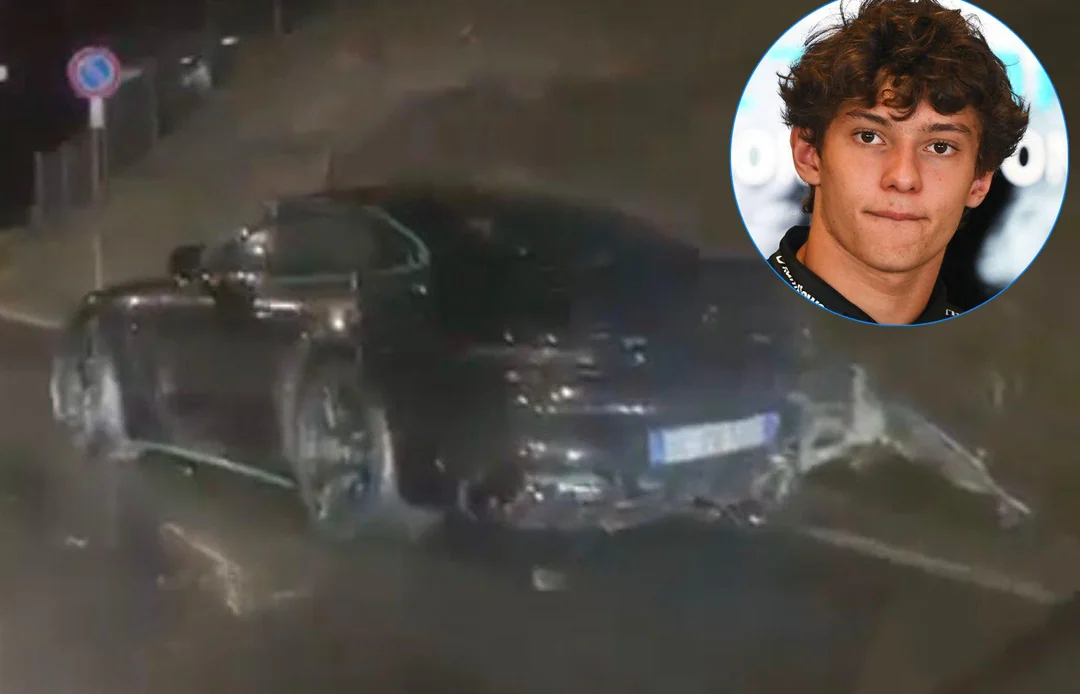
Kimi Antonelli walked away unhurt from a violent road crash near San Marino last weekend. His Mercedes road car didn’t fare nearly as well, and neither, potentially, does his driver’s license.
What’s Confirmed and What Isn’t
Photos show the car badly damaged after hitting a guardrail in what authorities described as a single-vehicle accident, with the 17-year-old Formula 1 prospect unharmed. Social media quickly filled with claims that Antonelli may have been traveling as fast as 180 kph in a 70 kph zone, but that figure remains unconfirmed at this stage. What is confirmed is that his license has reportedly been temporarily confiscated while authorities investigate, and his Mercedes F1 team is still waiting on the official police report before commenting further.
What Italian Law Says About Excessive Speed
If investigators ultimately determine he was exceeding the posted limit by 60 kph or more, Italian law doesn’t leave much room for leniency. Fines can climb into the thousands of euros, and a license suspension of six to twelve months becomes automatic once that speed threshold is confirmed. None of that has been established yet, but it frames exactly what’s at stake once the police report is finalized.
Why His F1 Seat Isn’t Actually at Risk
Antonelli’s Formula 1 future remains technically untouched by any of this. A road license suspension wouldn’t prevent him from racing, since F1 competitors operate under a separate racing license issued independently of a driver’s road credentials, and points only become an issue if a driver accumulates 12 penalties during race weekends specifically. He’s currently in Bahrain for preseason testing alongside George Russell, and nothing about the road crash changes that schedule.
Why It’s Still Worth Talking About
None of this is an argument that performance cars themselves are the problem. Cars don’t make decisions; drivers do, and enthusiasts generally understand that real speed belongs on a closed circuit, not on public roads lined with guardrails. For a young driver entering the sport under enormous scrutiny, a road incident like this becomes a public test of judgment separate from anything that happens on track, and it’s a reminder that the accountability attached to driving a high-performance car on public roads doesn’t scale down just because the driver is talented enough to race in Formula 1.
Antonelli will very likely still be on the grid this season regardless of how the road case resolves. But the outcome of the police investigation, and whatever penalty follows if the higher speed figures are confirmed, will say a lot about how seriously Italian authorities treat a young public figure who happens to also be a professional racing driver.
About the Author