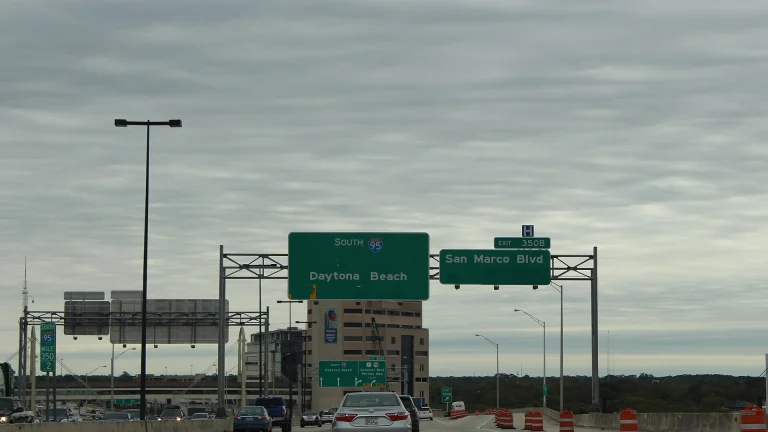
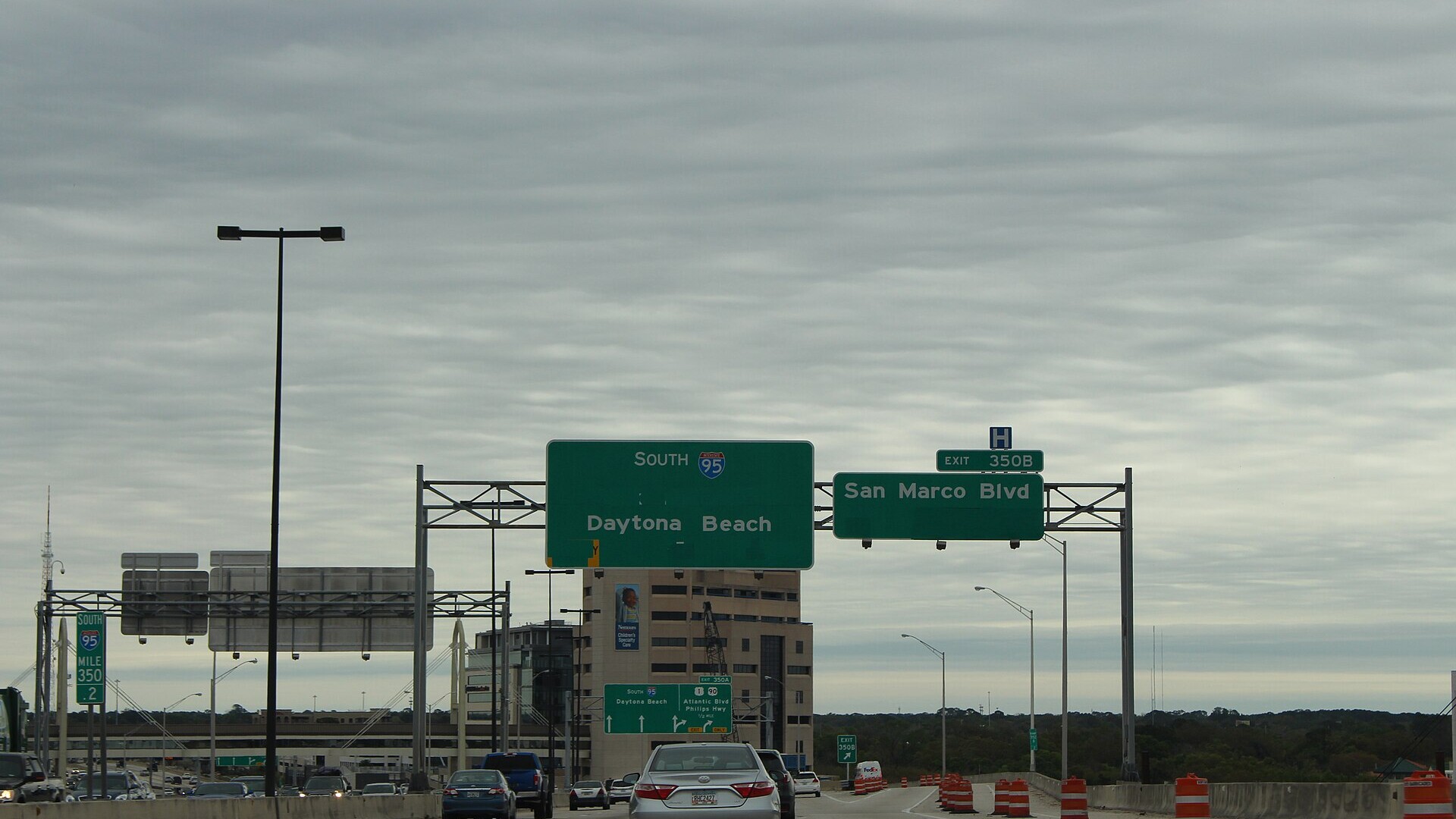
File photo of an I-95 exit in Florida; not the Volusia County ramp in this case.
A rider’s phone video now carries the case against an Uber driver who, she says, missed his exit on I-95 in Volusia County, Florida, cut through a median crossover reserved for law enforcement and drove the wrong way up an on-ramp with her in the back seat. Florida law lets deputies do exactly nothing with that video at the scene.
The Volusia County Sheriff’s Office told FOX 35 Orlando it received the rider’s report but could not make an immediate arrest because no deputy saw the violation. A deputy can instead file an affidavit with the State Attorney’s Office, where prosecutors will review the footage and decide whether the driving meets Florida’s reckless driving standard.
Uber moved faster. The company told the station it has removed the driver’s access to its platform. That is a real penalty, but it belongs to Uber alone. Whether this driver can switch on a different rideshare app next month depends on the prosecutor’s decision.
What the rider recorded
According to FOX 35’s report, published Nov. 17, the rider said the trip was ordinary until the driver missed her exit and his demeanor changed. In the recording she suggests getting back on the interstate. The driver answers, “No, we don’t have to.” The car then hugs the ramp’s shoulder as traffic comes straight at it. She told the station she held off on calling 911 because she didn’t want to startle the driver into something worse while she worked out how to get out safely. Neither the station nor the Sheriff’s Office identified the driver, and no charge had been reported when the story ran. Backfire News has covered rideshare trips that went sideways before, including the one Titus O’Neil described.
Why deputies could not arrest him on the spot
Florida’s warrantless-arrest law, section 901.15, lets an officer arrest a driver without a warrant for a traffic-code violation when it was committed in the presence of the officer, or when another officer on the ground or in the air relays the violation and identifies the vehicle. Reckless driving is a chapter 316 traffic offense, so that rule covers it. A civilian’s report, even one with video attached, does not satisfy it.
The Legislature has carved out exceptions. The same statute lets officers arrest on probable cause, without having seen it, for battery, criminal mischief and, under subsection (9)(d), racing, street takeovers and stunt driving as described in section 316.191(2). Reckless driving is not on that list. A street-takeover driver can be arrested on probable cause that someone else’s footage supplies. A rideshare driver who heads the wrong way up an interstate ramp with a paying customer aboard goes through the slower affidavit process.
That process can still produce a charge. Section 316.192 defines reckless driving as driving in willful or wanton disregard for the safety of persons or property. A first conviction carries up to 90 days in jail, a fine of $25 to $500, or both, and the tougher tiers apply only when property or a person is damaged or hurt. By every account, no one was hit here.
The U-turn through the crossover is a separate issue. Section 316.090 bars driving across a divided highway’s median except through an established opening or crossover, or where public authority specifically allows it. A violation is a noncriminal infraction, but it counts as a moving violation, and moving violations matter in the next part of this story.
A conviction would bar him from every app
Florida’s rideshare law, section 627.748, sets screening rules that every transportation network company operating in the state has to follow. Under subsection (12), a company may not let someone drive if that person was convicted within the past five years of a misdemeanor for reckless driving, along with offenses such as DUI, hit-and-run and fleeing or eluding. The same subsection bars anyone whose record shows more than three moving violations in the prior three years.
That provision reaches every app. If the State Attorney files and wins a reckless driving conviction, Florida law bars this driver from Uber, Lyft and any other network company in the state for five years. If prosecutors decline, nothing the statute requires another company to act on lands on his record, and Uber’s own Community Guidelines, which tell users to follow traffic laws and warn that violations can cost them access, govern only Uber’s platform.
The companies’ shared safety channel doesn’t cover this either. Uber and Lyft’s Industry Sharing Safety Program, announced in March 2021, exchanges information on drivers deactivated for the most serious incidents: the most severe categories of sexual misconduct and sexual violence, plus physical assaults that ended in a death. Dangerous driving is not among them, so a reckless-driving deactivation at Uber does not show up at Lyft through that program.
Background checks also run on a schedule. The statute requires a company to rerun its check on each driver every three years, and Uber says on its safety page that it screens drivers before they start and annually after that. Any of those checks can only find what a court or the state has put on the record.
Wrong-way defenses are built for a different driver
The National Transportation Safety Board’s 2012 special investigation of wrong-way driving counted 1,566 wrong-way drivers in fatal crashes on U.S. highways from 2004 through 2009, crashes that killed 2,139 people. The board found that 60 to 70 percent of those wrong-way drivers were impaired by alcohol.
The countermeasures that came out of that era are aimed at the driver who doesn’t know he is going the wrong way. Florida DOT’s wrong-way driving program uses detection systems and warning signs to alert wrong-way drivers, warn other motorists and notify law enforcement. That fits a drunk or disoriented driver at 2 a.m. It does little against a driver who has decided a ramp is his shortcut and has just turned down his passenger’s suggestion to go another way, which is what the rider’s video shows. For that driver the remaining checks are a prosecutor and a background screen.
What happens next
Riders already have more than a phone camera. Uber’s in-app Safety Toolkit includes an emergency button that connects to 911, and its RideCheck feature is designed to detect unexpected route changes and trips that end early and to check in with both rider and driver. A 911 call placed through the app, plus a recording, builds a record without a confrontation inside a moving car.
Watch for two things: whether a Volusia deputy files the affidavit, and whether the State Attorney’s Office decides the footage meets Florida’s willful-or-wanton test.
Florida already lets deputies arrest street racers on someone else’s footage. Should a rider’s video of a wrong-way ramp run count the same way?
About the Author