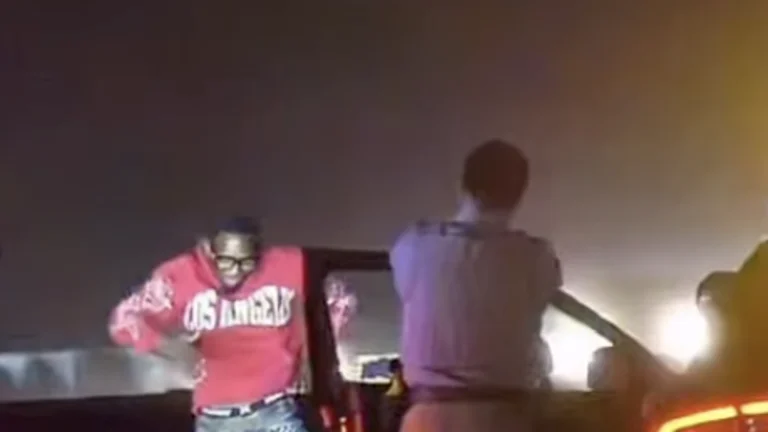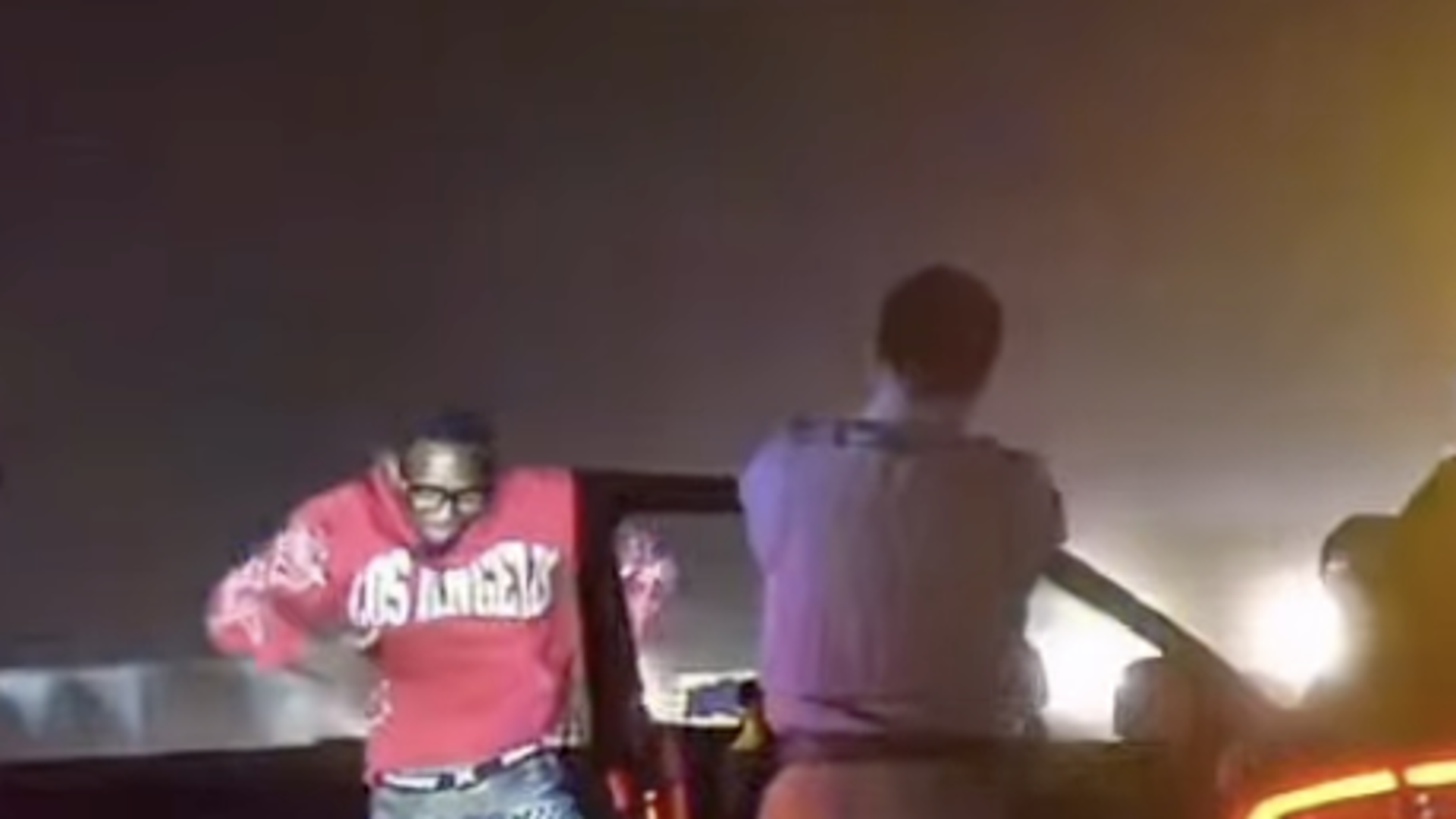
Police didn’t end this chase. The gas tank did. Early Tuesday, Nov. 17, 2026, a driver in what authorities described as a stolen Honda Accord led Los Angeles police and the California Highway Patrol east out of Los Angeles, reached the Inland Empire, turned back west and stopped near Cedar Avenue in Bloomington, Calif., on an empty tank. Officers ordered him out and told him to put his hand on his head. Video shows him dancing. Then he was handcuffed and arrested. yahoo
The dancing got the views. California law puts the cost of a chase like this on three groups: the suspect, the agencies chasing him, and the car’s owner, who wasn’t there. Of the three, the owner has the fewest protections.
What LAPD and CHP have said about the Bloomington chase
So far, all the details come from agency spokespeople quoted by KTLA. The chase began around midnight, when CHP officers were called to help Los Angeles police with a pursuit. The suspect drove east on the 10 Freeway toward the Inland Empire, briefly switched to the 215, then got back on the 10 heading west. An LAPD spokesperson said the car died near Cedar Avenue. That puts the stop in Bloomington, an unincorporated community in San Bernardino County, after the driver had already turned back toward Los Angeles. yahoo
Related Articles
- A GMC Sierra Test Drive Ended Pinned at Golden Glades, Police Say. Then the Woman They Arrested Was Gone From Her Hospital Room
- A Tennessee 19-Year-Old Allegedly Topped 130 MPH in a Nissan Rogue, Then Ran a Red Light. Now It’s Vehicular Assault and DUI Charges
KTLA reported no name or age for the suspect, no charges, no injuries, no pursuit speeds, and no information on where or when the car was stolen. A day later, authorities still hadn’t publicly identified him. The arrest is an accusation. Whether the Accord was stolen and what the driver did along the way are still allegations until prosecutors file charges and a court rules on them. yahoo
The charges California prosecutors could weigh
The key question for a prosecutor is how the car was driven, not how far it went. Under Vehicle Code Section 2800.1, fleeing a marked police car is a misdemeanor. Section 2800.2 makes it a possible felony when the driver shows willful or wanton disregard for safety. The statute says that standard is met if three or more traffic violations that carry DMV points occur during the chase, or if property is damaged. Running three red lights or making three unsafe lane changes can be enough. The penalty ranges from six months to a year in county jail up to state prison, with fines from $1,000 to $10,000. So the counts against this driver will depend on what the pursuing officers wrote down about each lane change, speed and signal along the 10 and the 215.
The car is a separate charge with its own wrinkle. The California Supreme Court held in People v. Page, filed Nov. 30, 2017, that Proposition 47’s petty-theft rule covers the theft form of a Vehicle Code Section 10851 violation. That means prosecutors who charge a felony for stealing the car must prove it was worth more than $950. The decision drew a line between taking a car and driving it later, after the theft is over. A driver arrested days after a theft may be charged with driving, not stealing. The value of the car matters less for that charge.
Stolen cars and California’s 13,627 pursuits
Chases that start over a stolen car are common in California. Under Vehicle Code Section 14602.1, every police agency must report its pursuits to the CHP, which compiles them for the Legislature. In the most recent of those reports I could locate, dated July 2024 and covering 2023, agencies statewide reported 13,627 pursuits, up 13.7% from 11,985 in 2022. Of those, 2,593 (19.0%) ended in a crash. Speeding started the most chases, at 2,592. Stolen vehicles were next, at 2,133, or 15.7% of all pursuits. Stolen vehicle was also the most common charge when someone was caught, at 1,044 arrests. ca
The cost falls partly on people who weren’t involved. Forty-three people died in California pursuits in 2023, and 13 of them were uninvolved third parties. Another 473 bystanders were injured. Statewide, police caught the driver in 49.2% of pursuits. The most common way a chase ended was police calling it off for public safety. Among chases that ended in an arrest, the most common ending was the suspect stopping voluntarily. That’s the closest category in the report to what happened in Bloomington, and the Accord didn’t stop by choice. ca
Bystanders and the Accord’s owner
If a chase like this hurts a bystander, California law makes it hard to collect from the police agency. Vehicle Code Section 17004.7 gives an agency immunity for damages from collisions caused by a fleeing driver, as long as it has adopted a written pursuit policy and trains officers on it every year. In Ramirez v. City of Gardena, filed Aug. 13, 2018, the state Supreme Court made that shield easier to get. The policy must require officers to certify that they have read it, but the agency doesn’t have to prove every officer signed. That case came from a Feb. 15, 2015, chase in which a passenger died after a Gardena officer’s PIT maneuver sent a pickup into a streetlight pole. The court affirmed judgment for the city.
Related Articles
- A Lathrop, California, 670-HP Corvette Z06 Driver Wouldn’t Pull Over for CHP, Police Say. Then a Warrant Put It on a Flatbed for 30 Days
- Grounded in Charlotte by an FAA Ground Stop, 3 Women Bought a $48,000 Bronco and Drove 27 Hours to North Dakota
The car’s owner loses the Accord for the night and gets a towing and storage bill. Under Vehicle Code Section 22524.5, towing and storage after a stolen car is recovered must be “reasonable,” and the owner’s insurer is liable to the tow yard when the policy covers it. Owners without comprehensive coverage pay the bill themselves. In 2025, the Legislature considered giving theft victims a break. Assemblymember LaShae Sharp-Collins’s fact sheet for AB 987 proposed a one-week grace period for fees on recovered stolen vehicles, and an earlier draft would have made those fees presumptively unreasonable. That provision isn’t in the version the governor signed on Oct. 6, 2025. The final law added other protections, including a cap of half a day’s storage when a car is picked up within four hours, which a theft victim at 1 a.m. is unlikely to manage. The statute also exempts fees set in written towing agreements with police from its list of unreasonable charges when police ordered the tow.
What happens next
The next documents to watch for are the arrest booking record and a criminal complaint. Those will name the driver, show whether prosecutors charge felony evading under Section 2800.2 or misdemeanor evading under 2800.1, and show whether they charge taking the Accord or only driving it. LAPD’s report to the CHP is due within 30 days of the chase. It will record how the pursuit ended and whether anyone was hurt, though it will appear only in statewide totals.
If your car is stolen in California, here’s what’s waiting at the tow yard. Whoever recovers the car can tow it at police direction. Storage fees begin as soon as it reaches the yard, and the four-hour discount in the 2025 law is the only fee relief in the statute tied to how fast you pick it up. Whether you pay out of pocket depends on your comprehensive coverage.
When the only alleged offense at the start is a stolen car, should California police keep chasing it from Los Angeles into San Bernardino County, or call it off and try to find the driver later?
About the Author