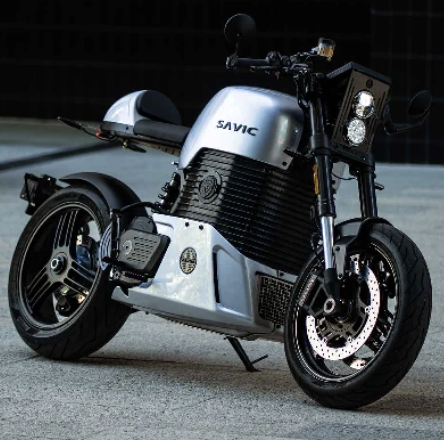
Australia’s only home-grown performance electric motorcycle maker has put up a sign that, stripped of corporate phrasing, reads “open to offers.” Savic Motorcycles has launched a strategic transaction page inviting acquirers, strategic investors and industrial partners to request information and a confidential discussion with its leadership team. The page names three kinds of deals: acquisition, strategic investment and industrial partnership.
It’s worth being precise about what that means. A company looking only for growth capital runs a funding round. A company that lists “acquisition” first is telling the market it would consider handing over the keys. Savic’s pitch to buyers makes the logic explicit: its combination of technology, product, team and customers can, in the company’s words, “materially compress the time, cost and execution risk” of building an electric two-wheeler business from scratch.
In other words, Savic isn’t just selling motorcycles. It’s selling a shortcut.
The name on the tank, and the name not on the page
The more personal part of the story is on the same page. The leadership section lists five people: CEO Marc Alexander, chief growth officer Victoria Brown, head of product Anton Simanikhin, head of customer experience Steve Jones and financial controller Dylan Richards. The man whose surname is on every fuel-tank-shaped battery cover isn’t among them.
Related Articles
- Ferrari’s 296 GT Modificata Proves Exactly How Much Horsepower the GT3 Rulebook Was Hiding
- The Worst Place to Stand During a Parking Lesson? Right Where King Harris Was Standing.
That’s a big shift for a company that has always been sold on its founder’s story. Savic’s own founder profile describes Dennis Savic as a weight attribute engineer at Ford Australia. In early 2017 he teamed up with Perth designer Dave Hendroff to sketch an electric café racer meant to carry a large lithium-ion battery and more than 200 Nm of torque. A separate company profile piece credits his time on Ford’s 2022 Everest program with giving him the skills to start the business.
The company’s current leadership is a different kind of team. The transaction page describes Alexander’s background as scale-up leadership spanning technology, product, commercial strategy and strategic transactions. That last phrase stands out. Founders build products. Executives with deal experience get hired when a company is heading toward a sale or a partnership. Nothing on Savic’s site claims a buyer has been found. The team it has assembled, though, looks built for exactly this process.
What a buyer would actually get
This is where the story gets interesting for anyone who cares about how motorcycles are engineered. Savic’s company timeline is unusually candid about how far the bike has come.
The 2018 prototype was a proof of concept built on Honda CB250F donor parts. It used an off-the-shelf 100-volt LiFePO4 pack of 9 kWh, a Sevcon controller and a Motenergy motor, good for 28 kW continuous. By 2022, Savic had moved to a 140-volt NMC pack of prismatic cells, 16 kWh, rated at 55 kW continuous and 60-plus kW peak. That was the first version to be fully road-compliant. It also had a custom Bosch ABS system developed with Bosch Australia and in-house suspension. Before first customer delivery in December 2024, the company says it ran the bike at 170 km/h at Phillip Island and completed durability testing equivalent to 100,000 km at Lang Lang.
The most important engineering decision in that history came in 2020, with what Savic calls the SM1 platform. It was the first Savic prototype in which the battery enclosure became the main stressed member of the chassis. That’s the real asset in this sale. Using the battery housing as the backbone of the frame saves weight and parts, and it’s why Savic keeps calling the design a multi-model platform. Keep the core structure, change the bodywork, geometry and tuning around it, and you have a family of bikes.
There’s an engineering trade-off any buyer’s team will look at closely. When the battery enclosure is the frame, its outer size and shape are fixed into the chassis. Savic says the design is modular inside that enclosure, which also houses the energy management system, and that the company is able to and intends to move to newer battery technology as soon as viable cells are available. That keeps a meaningful amount of upgrade work inside the box rather than requiring a new chassis. The limit is the box itself: changes that alter the enclosure’s dimensions, mounting or cooling architecture stop being a component swap and become a structural redesign, with fresh crash, fatigue and compliance work. A buyer gets a mature, tested architecture with room to update the cells, but the packaging envelope is locked in for a long time.
Two of those choices will likely end up on an acquirer’s to-do list. Savic’s owner FAQ confirms the C-Series charges only through AC, using a 3.3 kW onboard charger and a Type 2 plug. There is no DC fast charging. A full charge takes under six hours on a 15-amp outlet or a public Level 2 charger. The company’s range estimate for its top-spec Alpha is over 220 km in the city and around 140 km at a steady 100 km/h. Those numbers work well for a café racer used for commuting and weekend rides. For export markets where riders compare charging speeds, the lack of DC charging is the gap a well-funded partner would most want to close.
Buyers should also look closely at the spec sheet. The same FAQ describes the bike’s output as roughly 80 kW and 220 Nm, while the company timeline lists 60-plus kW peak for the production-representative model. Those figures may reflect different measurements, tunes or model years, but they don’t match on the company’s own website. Any serious due-diligence team will want that reconciled before signing.
The offshore piece
Savic has already taken a step most Australian manufacturing dreamers eventually face. Its timeline describes the company’s own powertrain assembly factory “south of Shanghai,” set up to speed up Australian production and simplify rollout to international markets. The site’s footer still describes the C-Series as “built to order in Melbourne,” and West Melbourne remains the company’s showroom and headquarters.
That hybrid setup is part of what’s being sold. For a Chinese, Indian or European industrial partner, a design team in Australia with a powertrain operation already in China is attractive, because much of the supply chain work is done. For Australian buyers who paid a premium partly for the local-manufacturing story, it’s a reminder that “Australian-made” in modern EVs usually means Australian-engineered and Australian-assembled, with critical components coming from the world’s battery and motor supply base.
Ambition versus arithmetic
Savic has never been shy about its goals. In its 2024 profile of the founder, the company set a target of 5,000 units a year within five to ten years. It described a first goal of matching MV Agusta’s scale and a longer-term aim of growing to the size of Indian Motorcycle. The same profile says Savic had completed three capital raisings by then, combining federal and state government grants with private, institutional and ethical venture funding.
Put that ambition next to the fact that customer deliveries only started in December 2024, and the transaction process makes sense. Going from hand-built, made-to-order bikes to thousands a year requires tooling, inventory, working capital and distribution, all at once. Repeated small raises can keep a hardware startup alive. They rarely pay for scale. A strategic owner with its own factories and dealer networks can.
What owners should do now
If you own a C-Series, your bike doesn’t stop working because the company is exploring a deal. But this is a good time to know exactly what you’re entitled to.
Savic’s published terms give the C-Series a 2-year, unlimited-kilometer component warranty and a 5-year warranty on the battery and battery management system. Servicing starts one month after delivery, then every 12 months or 12,000 km. The company lists authorized service partners in Victoria, Western Australia, New South Wales, Queensland, South Australia and Tasmania, with the Northern Territory and ACT still marked “coming soon.”
Australian law adds protection beyond the warranty card. Under the Australian Consumer Law, manufacturers must provide spare parts and repair facilities for a reasonable time after purchase, unless buyers were told otherwise at the time of sale. Businesses must also honor the express warranties they give. In practice, those guarantees are only as strong as the company standing behind them. If Savic is acquired, the key question is whether the new owner takes on the warranty and parts obligations along with the brand. Owners should watch any announcement for that detail.
Related Articles
- Honda Philippines Just Rolled Out Its 10-Millionth Motorcycle, and the Timeline Behind It Is the Real Story
- McLaren’s Next Era Finally Has a Price Tag: An 810-HP Hybrid, a 2+2 GT, and an SUV
The deeper exposure is digital. According to the FAQ, the C-Series receives software updates and performance features over the air through an onboard 4G modem. Connected bikes depend on servers, apps and cellular contracts that someone has to keep paying for. A buyer that values the software platform should keep it running, but owners should confirm that ride modes, diagnostics and updates will be supported under any new structure.
The battery is the other thing to understand. Savic’s FAQ puts battery replacement at roughly $5,000 to $10,000, with a pack weighing over 80 kg and built into the chassis. That creates an insurance issue owners should raise now rather than after a crash. On a bike where the battery enclosure is the frame, collision damage to that structure isn’t a simple bolt-on repair. Assessors may be quicker to declare a write-off than on a conventional motorcycle, especially while specialized repair capacity is limited to a small network. Check how your policy values the bike, and make sure your agreed value reflects what it would actually cost to replace.
If you’re shopping for one
For prospective buyers, uncertainty works in your favor. A small manufacturer running a sale process has every reason to keep bikes moving. That’s leverage on price, delivery timing and the extras that come with a made-to-order bike. The trade-off is long-term support risk, which is the same risk that comes with any low-volume EV brand, only more visible right now. Buy with the warranty terms in writing, confirm the nearest service partner, and ask directly whether warranty obligations would pass to any acquirer.
Savic has already done what many Australian vehicle ventures never do: it got a road-legal, homologated product into customers’ hands. The next chapter will be written by whoever buys into it. That could mean the SM1 platform finally reaching the scale its founder planned. It could also mean the Savic name ending up as one brand among many on someone else’s product list.
Images Via: Savic
About the Author