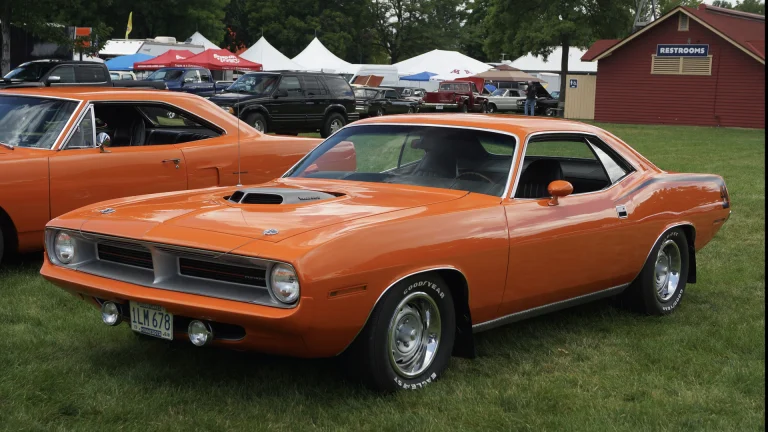
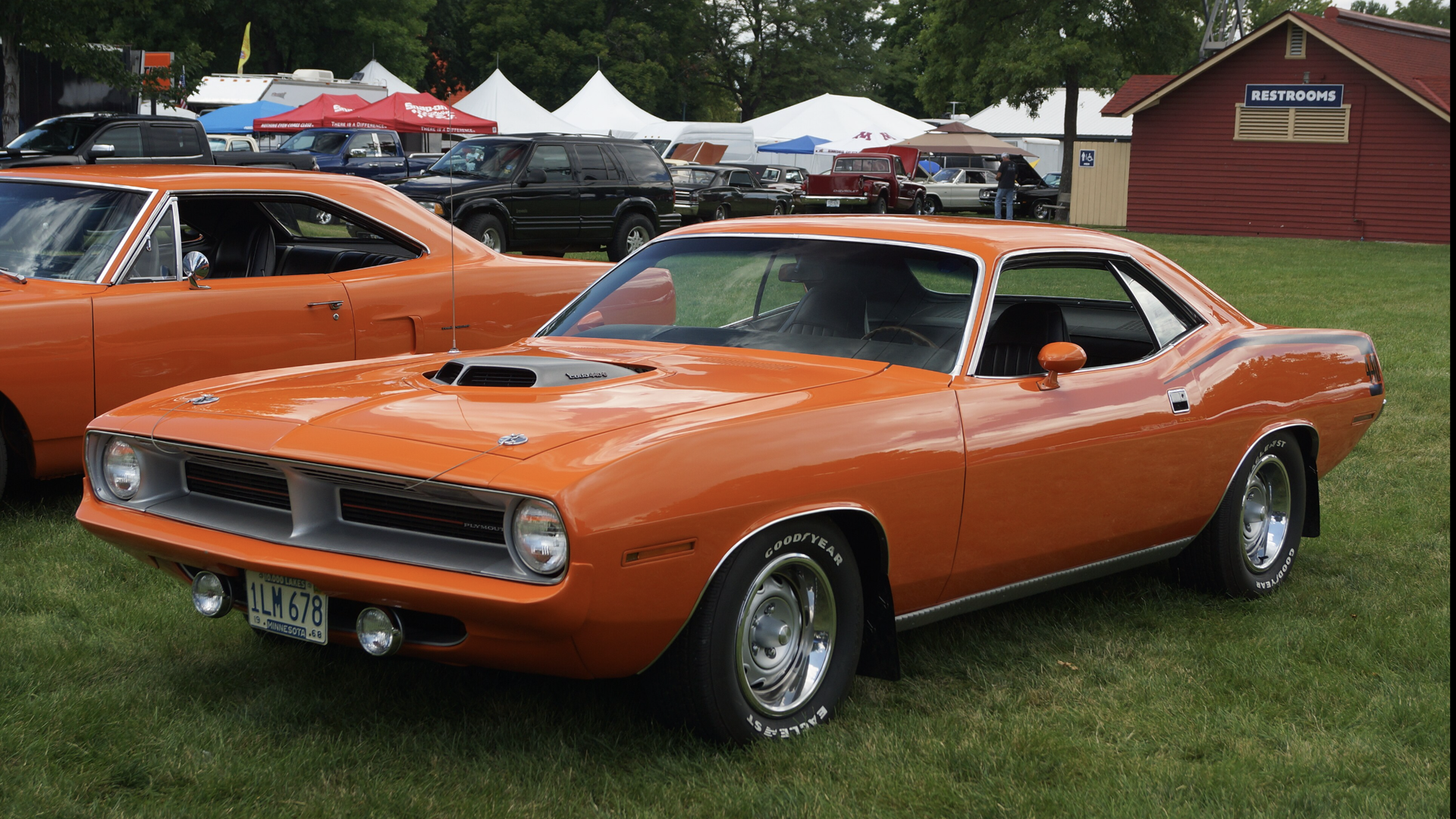
The Hemi ‘Cuda is the poster on the garage wall. The fish behind it has a stranger history.
1. It beat the Mustang and lost anyway
Plymouth introduced the Barracuda on April 1, 1964, two weeks before Ford’s Mustang, according to a Henry Ford archive record. Being first didn’t help much. Ford’s car became the template for the “pony car” category, and the Barracuda spent its first years looking like what it was: a Valiant with ambitions.
2. The back window was the headline
The early fastback’s rear glass was the largest glass area in the industry when the car launched. A fold-down rear seat turned the cabin into a long cargo floor, according to an RM Sotheby’s catalog. For owners, that glass fits only this model. If you crack it, you will be hunting for an NOS or reproduction part instead of calling a local glass shop. Your agreed-value insurance policy should account for that.
3. One name covers two very different cars
From 1964 to 1969 the Barracuda rode on Valiant underpinnings. From 1970 to 1974 it shared a platform with Dodge’s Challenger, and engines ranged from a 170-cubic-inch Slant Six to the 426 Hemi, per the museum’s catalog notes. For buyers, the badge alone tells you almost nothing about value. The documentation decides it.
4. Hurst built race cars with a warning label
For 1968, NHRA required at least 50 identical cars for Super Stock eligibility, so Hurst built just over 50 Hemi Barracudas. The doors were acid-dipped, the fenders and hood were fiberglass, the windows were thin Corning glass, and the seats were Dodge van buckets. The dash carried this plaque: “Not for use on public highways. Supervised acceleration trials only.” That detail comes from a Barrett-Jackson listing. Chrysler’s own paperwork said these cars weren’t for the street. Restorers should also know that acid-dipped panels can’t be swapped with stock steel without destroying originality.
5. The warranty man raced one
According to the same auction description, the second car built went to Jack Werst. His day job was East Coast regional director of Chrysler’s warranty program, and he raced the car as “Mr. 5 and 50,” a nod to the company’s five-year/50,000-mile coverage. A warranty executive running a car with a “not for public highways” plaque is a corporate irony that deserves a museum placard.
6. The prototype started as a small-block commuter
The R&D mule began as a 1967 Formula S with street miles. Chrysler engineers Tom Hoover and Dick Maxwell rebuilt it around the Hemi and tested it at Irwindale, as an NHRA feature describes. NHRA credits that car’s success with Chrysler’s decision to build the 1968 run.
7. The AAR was a homologation car
Plymouth hired Dan Gurney’s All American Racers to campaign ‘Cudas in Trans Am, driven by Gurney and Swede Savage. The SCCA required street versions, so Plymouth built 2,724 AAR cars in a six-week window. Each had a 340 rated at 290 horsepower, a fiberglass NACA-duct hood and side-exit exhaust, according to RM Sotheby’s records. Original hoods and exhaust pieces are the parts that separate real cars from tributes, so check them first.
8. Even the production numbers are disputed
RM Sotheby’s 1971 Hemi ‘Cuda catalog entry says normally reliable records show 108 hardtops ordered with the Hemi. It also notes that the owner put the figure at 144. When the auction catalog itself has to hedge, buyers should pay for broadcast sheets and expert inspections before writing a check.
9. An automatic convertible broke $3 million
On January 17, 2026, Mecum Kissimmee lot S190, a 1971 Hemi ‘Cuda convertible (VIN BS27R1B126869) with an automatic transmission, sold for $3,300,000, according to the auction record. Collectors usually chase four-speeds, but at this level the convertible body’s rarity matters more than the transmission. That should reshape how owners of automatic E-bodies think about agreed values.
10. Stellantis still wants the name
FCA US filed for the BARRACUDA trademark on January 27, 2026, as an intent-to-use application covering passenger automobiles, “specifically excluding armored vehicles.” The USPTO issued a Notice of Allowance on July 14, 2026. The company must now file a Statement of Use or request an extension within six months, per the USPTO status record. An intent-to-use filing means no product exists yet. It keeps the name protected, but it is not a launch announcement.
Sixty-two years on, the Barracuda is still collecting stories, records and legal paperwork.
Images Via: Wikipedia
About the Author