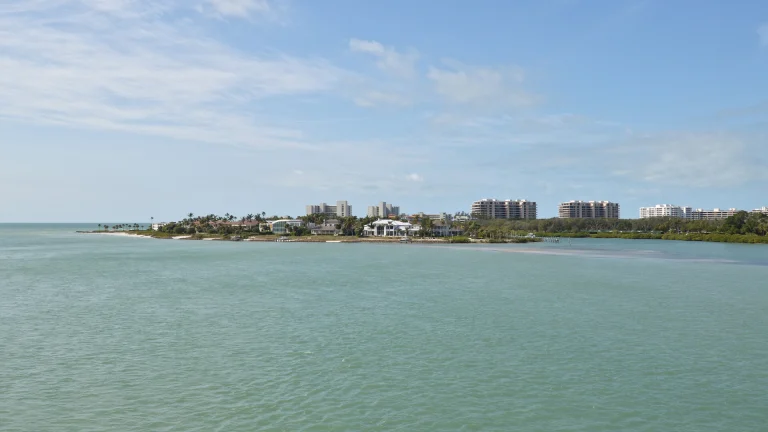
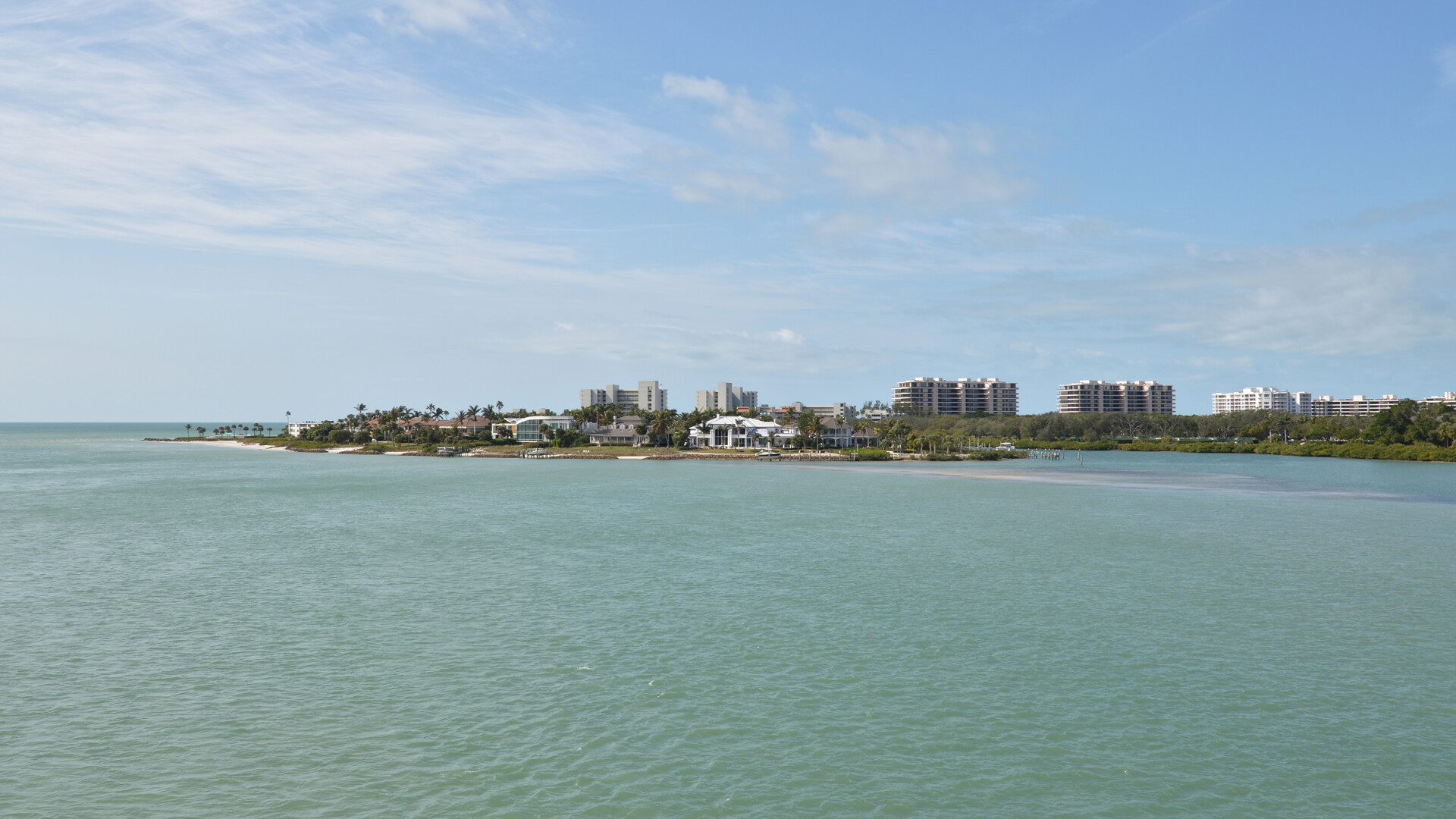
Longboat Key, Florida, in January 2023. Photo: Ryan Hodnett via Wikimedia Commons, CC BY-SA 4.0
Two Longboat Key, Florida, police officers turned around on Gulf of Mexico Drive at 1:13 a.m. on Saturday, Sept. 19, to stop a northbound car with its high beams on, and the DUI arrest that followed started with a seat change the officers say they watched happen.
According to the police report, as summarized in Your Observer’s Cops Corner column, the man driving got out of the driver’s seat and into the back seat as the car came to a stop. The woman in the front passenger seat moved behind the wheel and told officers she had been driving. The officers asked the man to step out, and the report says they smelled alcohol and heard slurred speech. He told them he’d had a beer, then said it was a glass of wine. The woman then took back her account and said she had not been driving. The man refused field sobriety tests and was arrested in the 5000 block of Gulf of Mexico Drive.
The Observer’s summary does not name him or list the charges. Until a prosecutor files a case and a court rules on it, what the report describes is an accusation. The seat swap is the part people will repeat, but it did the least to change his position. What shapes his case is what he said no to after he stepped out, under a Florida refusal law that turned one year old this fall.
Florida’s DUI law covers whoever officers saw driving
Section 316.193 applies to a person “driving or in actual physical control of a vehicle” while impaired or with a blood- or breath-alcohol level of 0.08 or higher. The “actual physical control” clause handles harder cases, such as a driver asleep behind the wheel of a parked car with the engine running. This case doesn’t need it. Officers who say they saw a man leave the driver’s seat while the car was still rolling are describing driving.
The woman’s exposure is narrower than it might look. Florida’s false-information law, section 837.055, makes it a first-degree misdemeanor to knowingly mislead an officer, but only one conducting a missing-person investigation or a felony criminal investigation. A first DUI with no crash and no injuries is a misdemeanor. The Observer’s summary does not say she was charged.
A high-beam violation is enough to justify the stop
Section 316.238 requires Florida drivers to dim their lights within 500 feet of an oncoming vehicle and within 300 feet when following one. Breaking that rule is a noncriminal moving violation. The officers were heading north and turned around to make the stop, which put this car in their oncoming lane and under the 500-foot rule.
Florida courts don’t ask whether officers cared about the headlights. In Holland v. State, decided July 3, 1997, the Florida Supreme Court adopted the U.S. Supreme Court’s objective test from Whren v. United States: if an officer sees a traffic violation, the stop is valid no matter what else the officer suspects.
Refusing roadside sobriety tests is legal, and jurors can still hear about it
The walk-and-turn, the one-leg stand and the eye-tracking test sit outside Florida’s implied-consent law, which covers breath, urine and blood tests. No statute punishes a driver for declining them. But in State v. Taylor, decided Jan. 5, 1995, the Florida Supreme Court let prosecutors tell a jury about a refusal as evidence of “consciousness of guilt.”
That ruling rested on a specific fact: the officer had told the driver that if he refused, the officer would judge his impairment from what he had already seen. In February 2019, Florida’s Fifth District Court of Appeal ordered a new trial for a Volusia County driver because jurors heard about his refusal even though officers never told him refusing carried a consequence. The Observer’s summary doesn’t say what the Longboat Key officers told this driver before he declined. If his case reaches a jury, that warning, or the lack of one, could matter more than the seat swap.
Since Oct. 1, 2025, a first breath-test refusal in Florida is a crime
Roadside exercises and the breath test after an arrest are separate decisions, and the Observer’s account covers only the first. Under section 316.1932, anyone who drives in Florida is deemed to have agreed to an approved breath test after a lawful DUI arrest. Until last year, a first refusal cost a driver’s license for a year and nothing more. Only a repeat refusal was a crime.
CS/HB 687, called Trenton’s Law, changed that. It passed the Senate 37-0 and the House 111-0, according to the Senate’s bill summary. Since Oct. 1, 2025, a first refusal of a lawful breath or urine test after a DUI arrest has been a second-degree misdemeanor, which carries up to 60 days in jail and a $500 fine. A refusal after an earlier suspension is a first-degree misdemeanor, punishable by up to a year. The license penalty still applies on top of that: a one-year suspension for a first refusal and 18 months after a prior one, under section 322.2615.
What a first DUI conviction costs a Florida driver
If this arrest ends in a first DUI conviction, section 316.193 sets a fine of $500 to $1,000 and up to six months in jail. The court also has to order probation with at least 50 hours of community service and, with limited exceptions, a 10-day impoundment or immobilization of the car he was driving or another car registered to him. His license would be revoked for six months to a year.
The insurance bill lasts longer than any of that. Florida’s ordinary minimum is $10,000 in personal injury protection and $10,000 in property damage liability, with no bodily-injury liability required. After a DUI conviction, section 324.023 requires $100,000 per person and $300,000 per crash in bodily-injury coverage, plus $50,000 in property damage, certified on a form called an FR-44 for three years. A driver who carried the state minimum goes from no required bodily-injury coverage to $300,000 per crash, bought from an insurer willing to cover a DUI conviction. Backfire News has followed what a DUI arrest can cost even without a conviction in a Nashville case that ended in a $70,000 settlement.
Two clocks start for the Longboat Key driver
Longboat Key straddles Sarasota and Manatee counties, so a misdemeanor DUI from this stop would land in county court in one of them, on the court’s schedule. The license case moves faster. Under section 322.2615, a driver whose license is suspended at a DUI stop gets a 10-day temporary permit if otherwise eligible, and has 10 days from the suspension notice to ask the state for a formal or informal review. Miss that window and the review is gone, whatever happens later in court.
Florida made a first breath-test refusal a crime last year without a single no vote in either chamber. Is that a fair price for a license, or should saying no the first time have cost you the license and nothing more?
About the Author