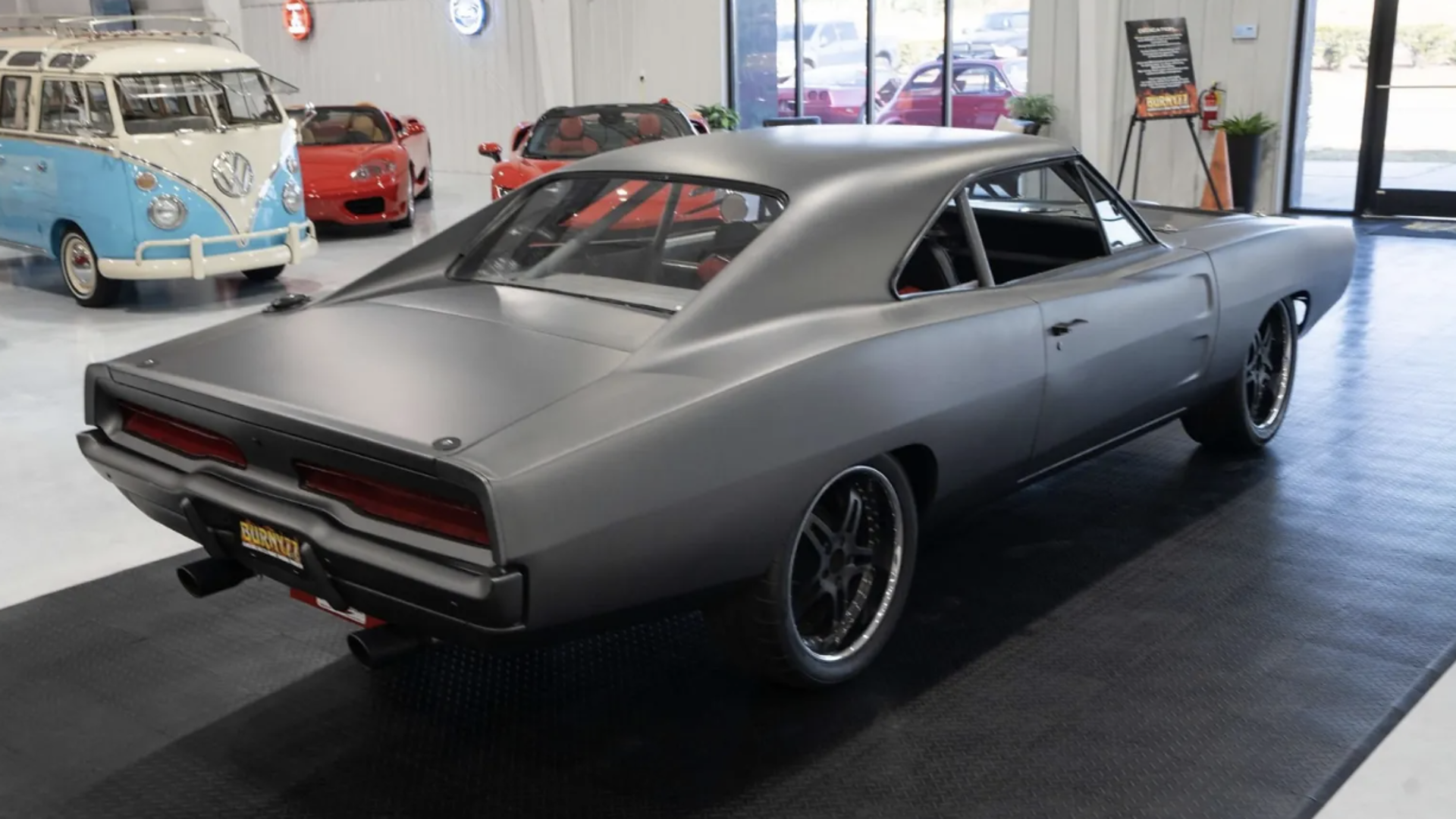
Hollywood has never been precious about muscle cars. It buys them cheap, paints them for the camera, and fits whatever engine survives a week of reshoots. That context matters for the 1969 Dodge Charger now listed on Bring a Trailer out of Ocala, Florida, billed as a car customized for 2011’s Fast Five and filmed in its Rio de Janeiro scenes. Bidding closes October 19.
It’s a mean-looking car. It also needs more homework than most cars you’ll bid on this year.
What’s Actually There
The vehicle record for chassis XP29F9B248618 describes a 426-cubic-inch Hemi V8 wearing dual four-barrel carburetors, four-into-one headers, and a dual exhaust with Flowmaster mufflers. Behind it sits an A727 three-speed automatic with a Hughes Performance oil pan. The cabin is more race shop than Rio nightclub: roll cage, Beard seats, red Simpson harnesses, a Sidewinder shifter, a hydraulic handbrake, and AutoMeter gauges, including a 10,000-rpm tach.
Related Articles
- Louisville Police Will Feed a Monster Truck a 2009 Charger With a Hellcat Engine They Say Was Stolen
- Koenigsegg’s Gemera Hit Dubai Autodrome. Is It 1,700 HP or 2,300? Koenigsegg’s Own Website Can’t Decide
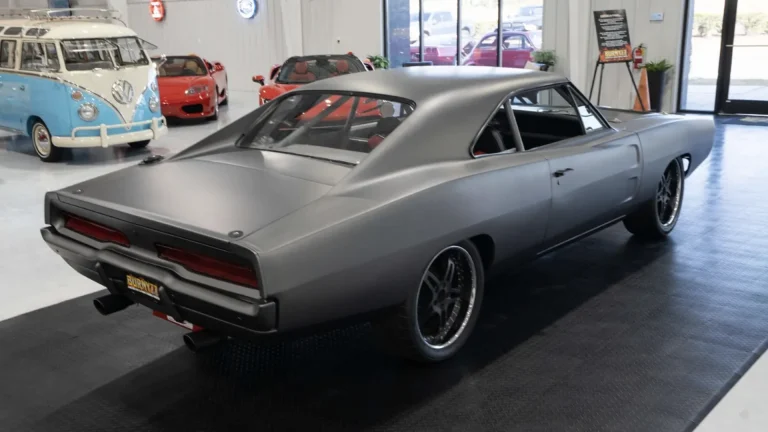
Outside, it’s matte gray with a black lift-off hood held by exposed pins, a mesh grille, and 20-inch multi-piece wheels on Mickey Thompson Street Comp rubber. Wilwood front discs, a line lock, Koni dampers, and a JAZ fuel cell in the trunk round out a spec sheet built to do burnouts on cue.
Read the VIN Before You Read the Hype
Here’s what the paperwork tells you that the photos don’t. In Chrysler’s 1969 VIN scheme, the fifth character identifies the factory engine. Genuine Hemi cars carry a “J” there, which is why sellers of real ones advertise a J-code Hemi. This car’s fifth character is “F.” Its “XP” prefix also marks a standard Charger, not an R/T, and the record classifies it as a base model with an engine swap.
That’s normal for movie cars, which get built from whatever parts are on hand. Universal’s own Chargers were routinely assembled from mixed ‘68, ‘69, and ‘70 parts, and one #2 hero car from the franchise’s fourth and fifth films crossed Barrett-Jackson with a 350-cubic-inch V8 under the hood. A Hemi in a film car is the exception. That makes the next question unavoidable: is this a vintage 426 block, a modern aftermarket Hemi, or something assembled later? The answer swings both value and parts costs, and only the seller’s documentation can settle it.
The Provenance Question
Fast Five Chargers aren’t unicorns. Barrett-Jackson has sold several, including a gray Fast Five Charger finished in Lamborghini Gray, described as used in Rio car-meet and race scenes, at its 2014 Palm Beach sale. Whether that’s this car is precisely what a serious bidder should ask. If it is, there’s a documented chain of custody. If not, the buyer needs studio paperwork tying this specific chassis to the production, because “appeared in” and “was the car” are worth very different amounts of money.
What It Might Be Worth
The market for customized second-gen Chargers is healthy. The market data puts its benchmark for custom 1968–1970 cars at $159,121, well above stock R/Ts at $106,444 and standard Chargers at $79,428. Modified Chargers with good builds already command more than many original ones. A credible film link could push this car higher; a fuzzy one makes it just another well-built Hemi street machine.
Ownership Reality Check
Mileage. The tracking record lists this car’s mileage as unknown. Federal odometer disclosure rules exempt model-year 2010 and older vehicles, so no law requires a verified number here. For a stunt car, odometer figures are meaningless anyway. Judge it by the build’s condition, not a number on a title.
Maintenance. Dual-quad Hemis reward owners who know how to synchronize carburetors and dislike those who don’t. The A727 is among the toughest automatics Chrysler built, so that’s the least of your worries. Fuel cells, however, age: bladders and internal foam degrade, and an older cell should be inspected before the car sees regular fuel.
Related Articles
- Haunted Highways #1: The Ghost Truck That Follows You on New Jersey’s Clinton Road
- Jay Leno Invited Joe Biden to Roll His Beloved ’67 Corvette Sting Ray Into Audrain’s Concours
Insurance. Standard auto policies won’t value this correctly. Collector carriers write agreed-value coverage, but they’ll want documentation for both the modifications and the film history before insuring provenance premiums. No paperwork, no premium.
Street use. A caged car with harnesses and a hydraulic handbrake is happiest at shows and cruise nights. Check your state’s inspection rules before planning road trips, and remember that a cage without a helmet can be more dangerous on the street than no cage at all.
The Takeaway
This Charger is a real piece of Hollywood hardware with a serious drivetrain, but its value hinges on two documents: proof of what engine is in it, and proof of what movie it was in. Without both, you’re paying Hemi-and-Hollywood money for a matte-gray maybe. How much extra would you pay for a movie credit you can’t document?
Images Via: Bring a Trailer
About the Author