The First Ferrari Luce Sells With No Reserve, And That Detail Matters More Than The Estimate
Ferrari has built plenty of first-off-the-line cars, and almost none of them have ever been available to you. Chassis 001 typically disappears into the museum, into a board member’s collection, or into the garage of a client whose Ferrari purchase history reads like a wine list. So it’s genuinely unusual that the first production example of the Luce — Ferrari’s first battery-electric road car — is being sold in public, to anyone with a bank letter and a pulse.
It crosses the block as Lot 345 on Saturday, 15 August, at RM Sotheby’s Monterey sale, chassis ZFF21BUA8T0338000, carrying a published value in excess of $1,100,000 and — here’s the part worth circling — offered without reserve. Ferrari is donating the proceeds to The Ferrari Foundation, the US 501(c)(3) that helps bankroll M-TECH Alfredo Ferrari, the 32,000-square-metre technical education campus taking shape in Maranello for a 2029 opening.
The estimate is a floor, not a forecast
If you want to know how seriously to take that $1.1 million number, look at what happened in the same room twelve months ago. RM’s 2025 Monterey sale offered a one-of-one Daytona SP3 ‘Tailor Made’ — same beneficiary, same charity framing, same no-reserve theater — with a published value in excess of $3.5 million. It sold for $26 million. That is not an estimate being beaten; that is an estimate being ignored entirely.
Related Articles
- Tom Cruise’s ‘Days of Thunder’ Sequel is Officially Moving Forward
- F1, MotoGP, IndyCar, and NASCAR Are All Racing the Same Weekend — Good Luck Picking Which One to Watch
Charity lots break normal valuation math because the underbidder isn’t competing on the car. He’s competing on the room, the announcement, and the relationship with Maranello that a nine-figure-net-worth collector considers a strategic asset. A first-in-line Ferrari with a philanthropic halo is about the purest form of that trade available.
Which is exactly why “no reserve” is the interesting word here. Ferrari is putting its most divisive product in a decade on an open block with no safety net, in front of the collector class that spent the spring arguing about whether the thing should exist. Whatever number the hammer lands on becomes the first hard market datapoint on the Luce, and it will be quoted for years.
What you’re actually bidding on
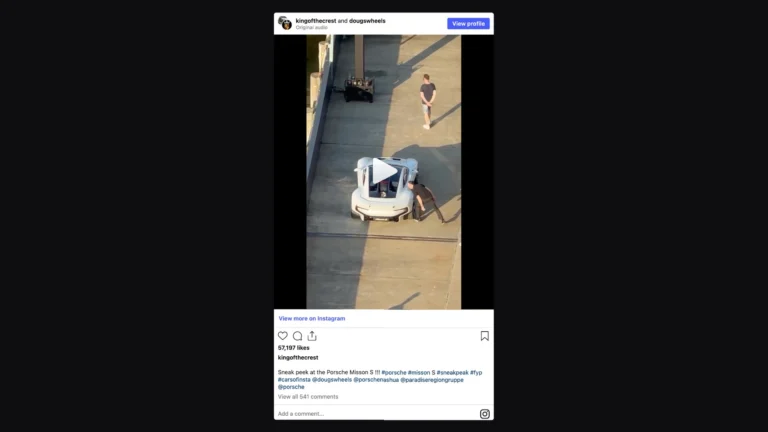
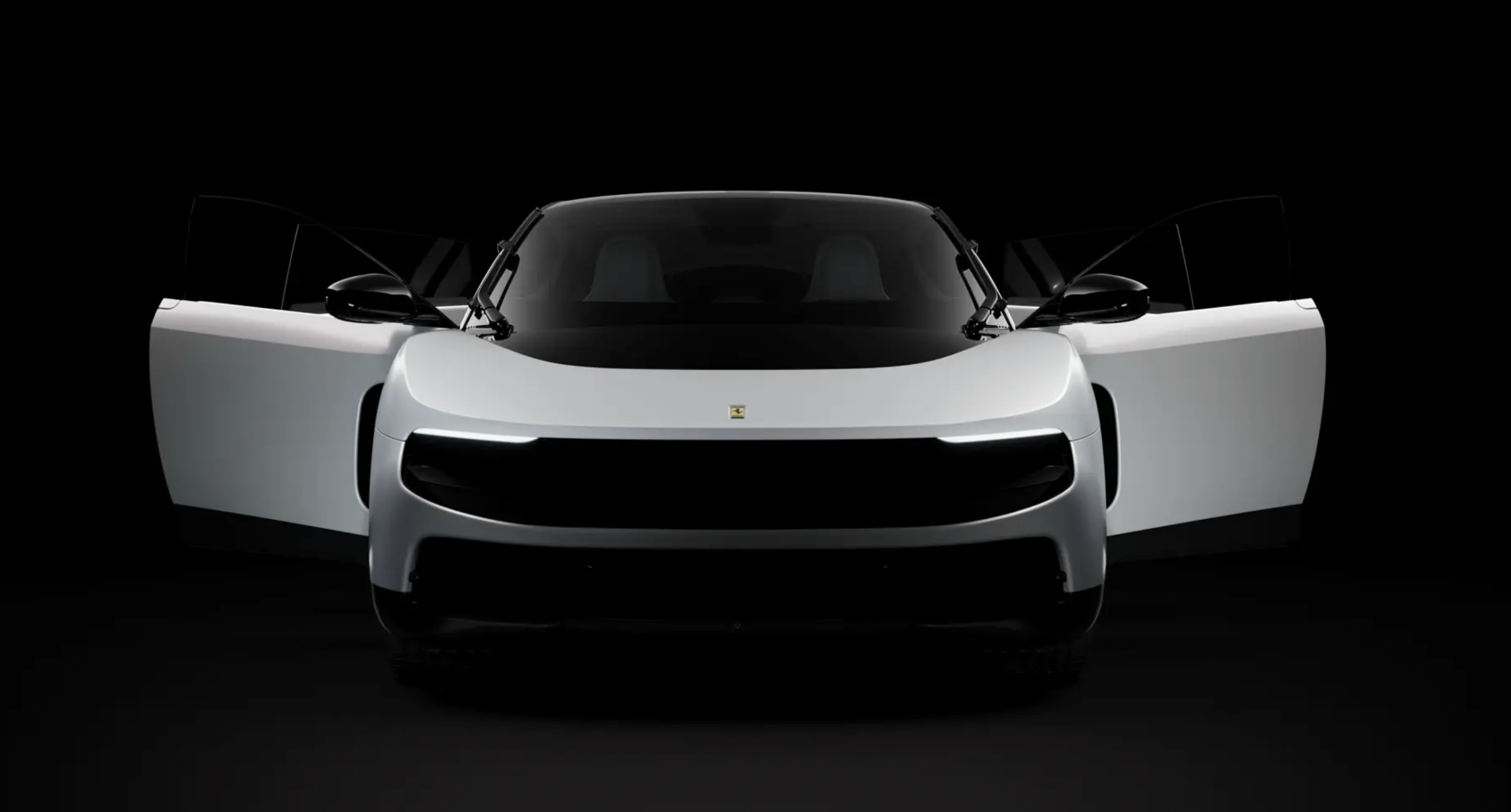
Chassis 0 is a Tailor Made commission built around a single idea: white. The exterior is a bespoke Madreperla Semi-Gloss finish formulated with a Tailor Made pigment that throws iridescent reflections shifting from green to violet with light angle. Semi-gloss is a deliberate choice — full gloss flattens pearl effects into glare, and matte kills the depth entirely, so the middle ground is where a pigment like this actually reads. It’s also, practically speaking, the finish most likely to give a future detailer a nervous breakdown, since semi-gloss clear can’t be polished the way a conventional gloss coat can without altering the sheen.
Inside is Le Mans metallic leather in Perla, and — a first for the model — Grigio Corvara replacing black on the secondary trim. The wheels, calipers, and even the Prancing Horse badge background are executed in the same optical white theme. There’s a dedicated plaque marking it as Chassis 0.
Mechanically it’s a standard Luce, which is to say four radial-flux permanent-magnet motors, one per corner, 1,035 horsepower, 990 Nm, a 122-kWh pack on an 800-volt architecture with 350-kW DC capability, all of it built at Ferrari’s e-building in Maranello. Ferrari revealed the production car in Rome in May, on the anniversary of the marque’s first win in that city.
The paperwork nobody else is going to tell you about
This is where a charity headline meets reality. RM’s published terms for Monterey set the buyer’s premium at 12% on the first $250,000 of hammer price and 10% on everything above it. On a $1.1 million hammer, that’s $115,000 on top — and that money is the auction house’s commission, not a donation. Push the car to $5 million and the premium alone is $505,000. Anyone doing “it’s all for charity” math should separate the hammer from the invoice.
The addendum adds two conditions most coverage will skip. First, the car is US-spec, and any buyer outside the United States owns the entire export, import, and federalization problem — a serious warning on an EV, where homologation touches charging standards, lighting, and battery transport rules rather than just a speedometer face. Second, a US-resident winner can’t simply load it on a trailer: delivery must route through an authorized US Ferrari dealer to complete documentation and title work first.
Standard RM terms also put risk of loss and insurance on the buyer the instant the hammer drops, and set a removal deadline of 17 August before storage charges start. Underwriting is the sleeper issue. Agreed-value collector policies depend on comparables, and there are no comparable Luces — there is exactly one Chassis 0, and its value will be set by this auction. Expect a carrier to want the sale price documented and to ask pointed questions about battery-fire storage conditions, which several insurers now treat differently than a carbureted V12 sitting on a lift.
Living with a collector EV
Here’s the genuinely new problem for the trophy-garage set. A Daytona SP3 parked for fifteen years needs fuel stabilizer, a battery tender, and fresh fluids. A Luce parked for fifteen years is aging chemically whether it moves or not. Lithium NMC cells degrade on a calendar, not just a cycle count, and storage state of charge and temperature drive that rate. A car bought to be preserved unmiled is, in EV terms, the hardest use case there is.
Related Articles
- The Most Reliable Used Trucks You Can Actually Buy in 2026
- A Florida Dealership Dissolved in 2024. Prosecutors Say the Owner Kept Taking Consignment Cars Anyway
Ferrari has at least engineered around it: the pack is modular and serviceable, so individual modules can be replaced rather than condemning the whole assembly, and the company has been explicit that strategic electric components are designed and built in-house rather than outsourced. That matters for a 2050 restoration in a way it doesn’t for a 2026 daily driver. Whether Maranello still stocks 2026-spec modules in three decades is the open question — and it’s the question that will quietly determine whether first-generation EVs hold collector value at all.
Ferrari’s own 2030 plan calls for a lineup that’s 40% combustion, 40% hybrid, and 20% electric, with four launches a year through the end of the decade. The Luce isn’t a replacement for anything. It’s an addition — and on 15 August, the market gets to say out loud what it thinks that addition is worth.
One last item worth a call to your accountant rather than your broker: at a charity auction, the deductibility of any payment depends on who you’re actually paying and what you receive in return. Ferrari is the consignor donating proceeds here, not the charity selling you a car. Those are different structures with different answers, and I’m a journalist, not a tax advisor.
Images Via: RM Sotheby’s
About the Author