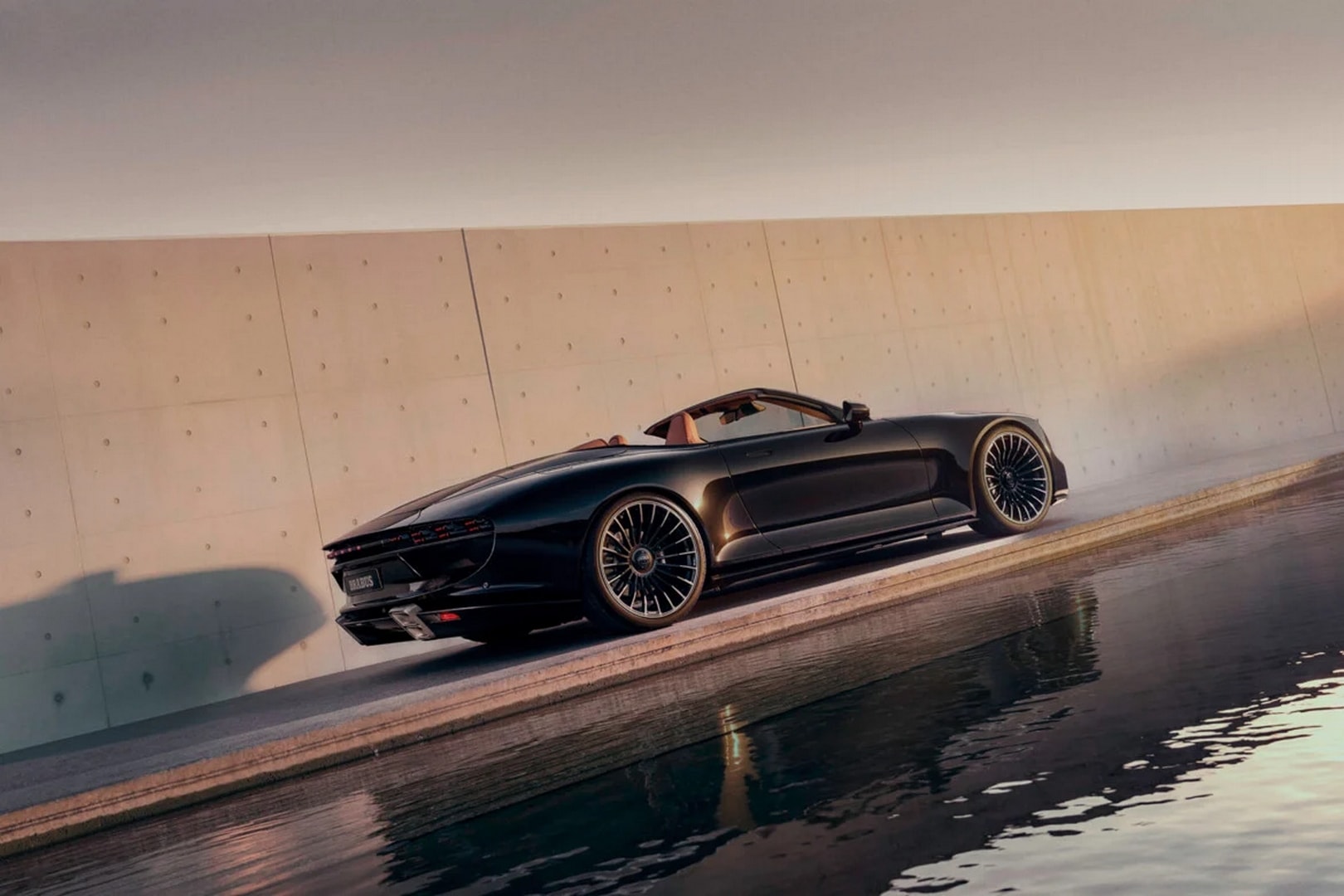
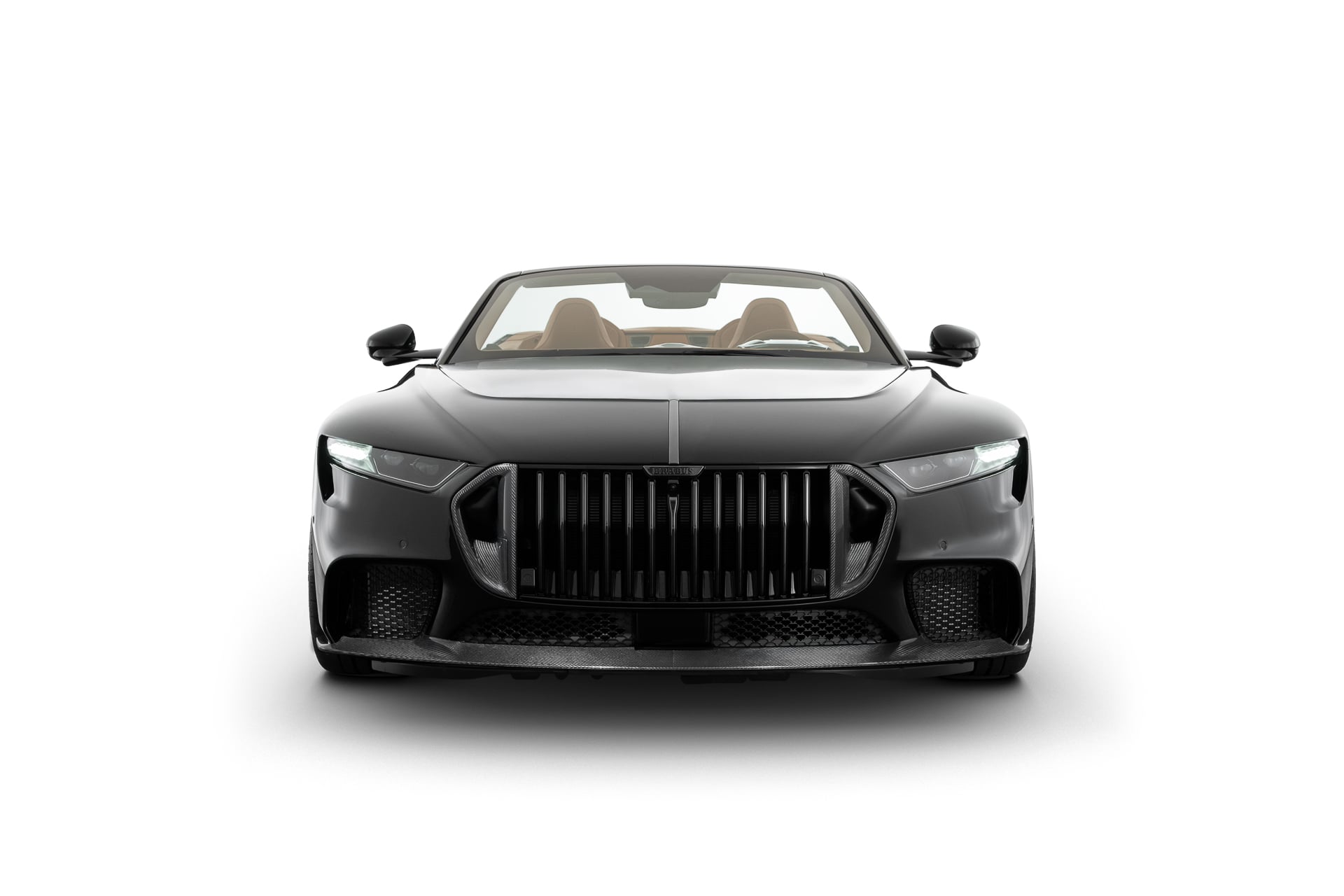
Look closely at the fabric. Brabus didn’t screen-print its logo onto the soft top of the Bodo Cabriolet, and it didn’t sew on a patch either. The inverted “77” is woven into the Jacquard structure of the two-tone black-and-gray roof — part of the cloth rather than something sitting on top of it. Somebody set up a loom for a car that will be built seventy-seven times. That one decision explains this machine better than the four-digit number on its spec sheet does.
A tuner learning to be a coachbuilder
Brabus opened in Bottrop, Germany in 1977, and for most of the last five decades the business model was beautifully simple: take a Mercedes, add everything. Scroll the company’s own supercar catalog today and it is still largely Mercedes underneath — the 750 Bodo Buschmann Edition is an AMG SL 63 4MATIC+, and the Rocket 1000 is an AMG GT four-door with a substantial turbocharger bill. Brabus has also put its badge on a full-size motorhome, because naturally it has.
The Bodo line breaks that pattern. Brabus describes the bodywork as coachbuilt carbon fiber, meaning every exterior panel is its own, and the hardware beneath it did not come from Stuttgart. The company never names a donor vehicle in any of its materials, but it publishes enough specifics to make the identification straightforward: 5,204 cc twin-turbo V12, eight-speed automatic with a torque converter, rear-wheel drive, double wishbones up front, multi-link rear. Exactly one automaker currently sells that combination, and Aston Martin lists it as an “all-alloy quad overhead cam, 48 valve, 5.2 litre bi-turbo V12” paired to a ZF eight-speed in the Vanquish.
The name carries the weight here. Bodo Buschmann founded the company and led it until his death in 2018 at 62; his son Constantin has run it since. The inverted 77 badge beneath the rear glass marks the founding year, and the signature embroidered into the door panels is his father’s.
The horsepower asterisk nobody prints
Brabus quotes output as 735 kW / 1,000 PS. That is metric horsepower — Pferdestärke — and 735 kW works out to roughly 986 bhp in the SAE terms an American buyer actually sees. Fourteen horsepower is a rounding error on a car that costs more than most houses, but if you’re spending seven figures on bragging rights, know which units you’re bragging in.
Torque is the more revealing figure anyway: 1,200 Nm, or 885 lb-ft, and Brabus says it’s on tap from 2,900 to 5,000 rpm. Aston Martin publishes 835 PS and 1,000 Nm for the Vanquish. So Brabus located about 165 PS and 200 Nm more — and, more importantly, spread that torque across a 2,100-rpm plateau instead of spiking it. That is a boost-and-calibration program aimed at drivability, not a dyno-chart stunt.
Twenty percent more power, ten more mph
This is where physics sends its invoice. Aston Martin quotes 214 mph for the Vanquish. Brabus quotes 360 km/h — 224 mph, electronically limited. Roughly twenty percent more power purchased about four and a half percent more speed.
That isn’t Brabus falling short. Aerodynamic drag climbs with the square of velocity, and the power needed to overcome it climbs with the cube. Every mile per hour past 200 costs dramatically more than the one before it, and this shape carries a fabric roof and a spoiler that rises out of the decklid. The figure that actually showcases the engine’s work is 0-300 km/h in 23.9 seconds — 186 mph in less time than most people need to parallel park.
The shorter sprints read 3.0 seconds to 100 km/h and 8.5 seconds to 200 km/h. On a rear-drive car making 885 lb-ft through an electronically controlled differential that locks up to 100 percent, a launch like that is a traction-management problem first and a power problem a distant second.
The coupe and the convertible tell on each other
Set Brabus’s two spec pages side by side and the droptop’s penalty shows up in numbers the company was obligated to publish. The Bodo coupe: 13.7 l/100 km combined, 312 g/km of CO2. The Cabriolet: 14.1 l/100 km, 321 g/km, CO2 class G. Same engine, same gearing, 2.9 percent more fuel. That gap is the arithmetic fingerprint of extra mass and a slightly dirtier shape — and in European markets where registration and circulation taxes scale with CO2, it is a line item rather than a trivia answer.
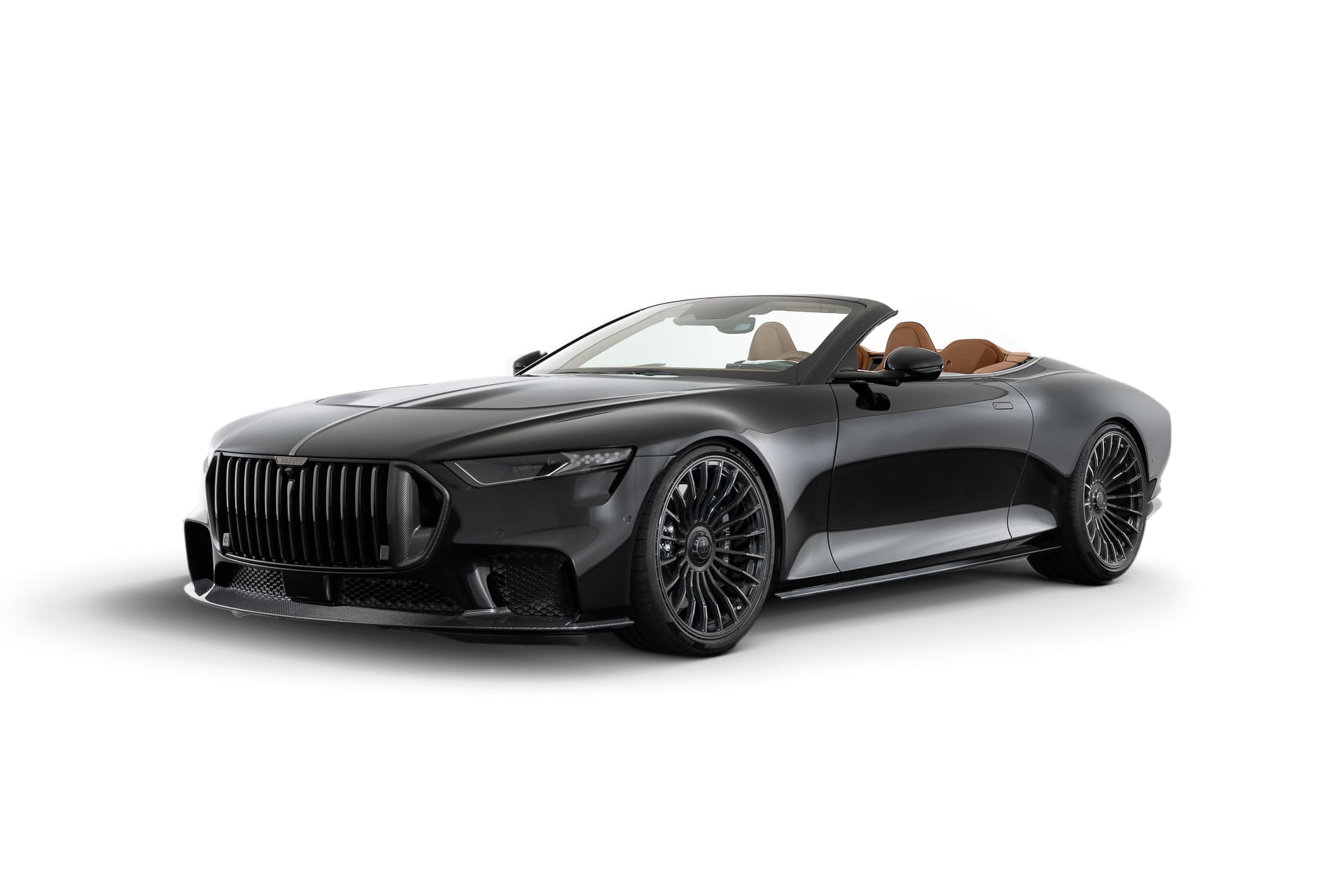
The rolling stock changed too, and this one lands on whoever ends up owning the car. The coupe rides on 21-inch Monoblock Z-GT forged wheels in Shadow Edition finish wrapped in Continental SportContact 7 Force tires, 275/35 front and 325/30 rear. The Cabriolet steps up to 22-inch Platinum Edition wheels on Pirelli P Zeros — 285/30 ZR22 and 335/25 ZR22.
Wider contact patch, shorter sidewall, more unsprung mass, different tire supplier. On a convertible already carrying more weight than the coupe, that is a ride-quality trade and a pothole-risk trade at once. A 335/25 ZR22 in a bespoke compound is not something you source on a Saturday afternoon, and replacement sets will price like the exotic they are. Budget for it before the first track day, not after.
An air brake that works at speeds you can legally reach
The rear spoiler is carbon fiber, deploys in stages, and above 140 km/h it can pivot to vertical and act as an air brake. That threshold is 87 mph — fast, but not track-only-fantasy fast, particularly on a derestricted stretch of autobahn.
The obvious payoff is drag-assisted deceleration. The subtler one is thermal. Every joule the air absorbs is a joule that never reaches the carbon-ceramic discs, which are squeezed by six-piston front and four-piston rear fixed calipers. Carbon-ceramics resist fade brilliantly and cost a fortune to replace, so anything that lightens their workload is a maintenance-cost feature wearing an aerodynamics costume. Planting a vertical wing at the back of a rear-drive convertible under hard braking also stabilizes the light end of the car, which is the part a driver would actually feel.
What ownership looks like
Brabus has not published a price for either Bodo; both are listed as price on request. For scale, Aston Martin’s own Valhalla turned up on a Dubai showroom floor at $1.4 million, and the $1.5 million Valour shows what a limited-run V12 Aston commands once the coachbuilding department gets involved. Cars like the Valkyrie LM sit further up the ladder still.
Insurance is the conversation that matters. With 77 cars in existence there is no book value, which pushes an owner toward an agreed-value policy negotiated before delivery rather than a standard stated-value one — and the carbon bodywork needs to be named explicitly in it. Coachbuilt panels do not sit on a shelf in a regional parts warehouse. A scraped fender becomes a lead-time problem rather than a body-shop problem, the same math that makes low-volume conversions like Mansory’s creations slow and expensive to put right.
Working in the owner’s favor at resale: every car ships with a blockchain-based Digital Product Passport issued through the Aura Blockchain Consortium, the authentication platform the luxury goods houses use. Provenance disputes are a genuine problem at this price point — ask anyone who has shopped for a decade-old Pagani — and a verifiable build record turns into real money when the second owner starts asking questions.
The bottom line
The Cabriolet broke cover on August 14 during Monterey Car Week, alongside the company’s debut at The Quail and a stand at the Pebble Beach Concours d’Elegance running August 13-16.
For nearly half a century, Brabus answered every question with “more.” More boost, more carbon, more diamond-stitched leather. The Bodo Cabriolet is the first time the company has to be judged on a shape it drew itself instead of a dyno chart — and its response was to weave the logo into a roof most buyers will never think to inspect. That isn’t a tuner move. That is what coachbuilders do.
About the Author