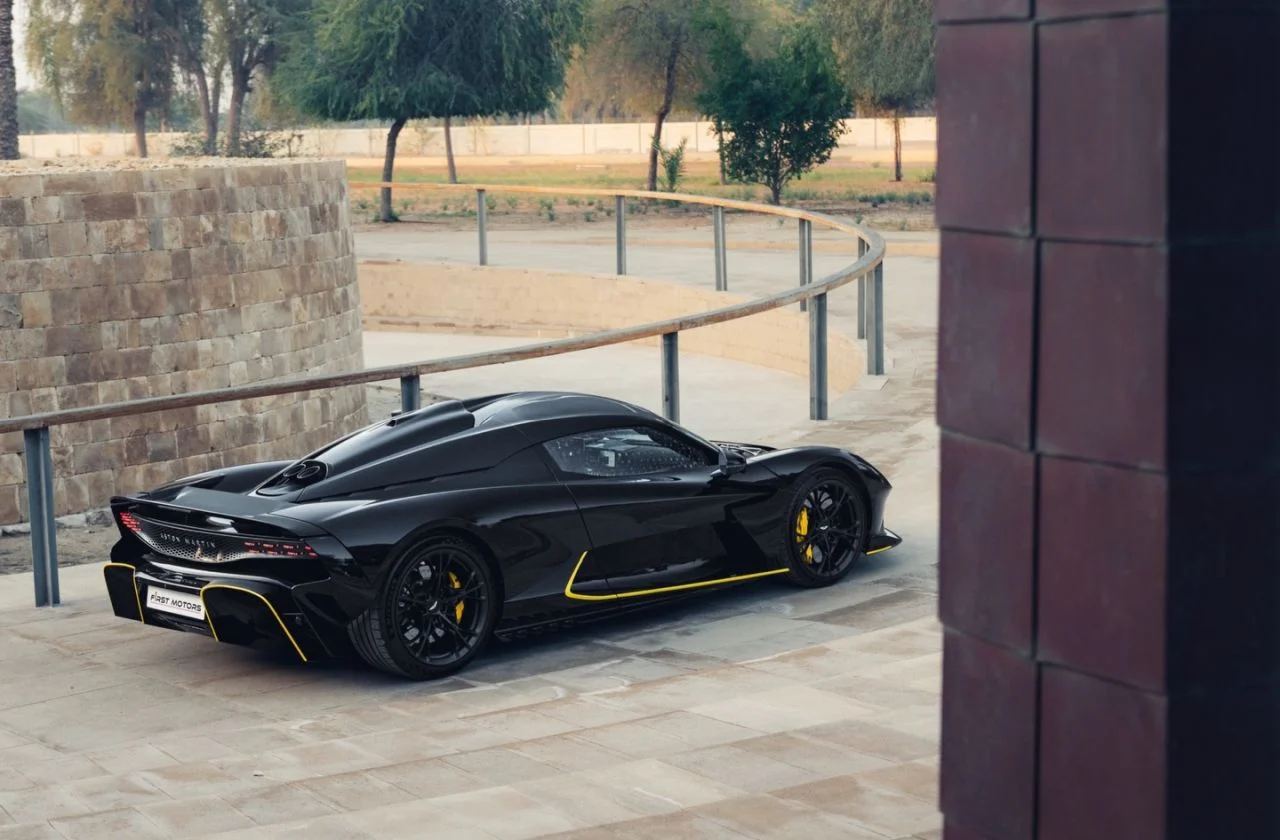
There’s already a problem if you were hoping to casually pick up Aston Martin’s newest supercar. The Valhalla has barely started making real-world appearances, and somehow one is already sitting in Dubai with a price tag that’s pushing well beyond expectations. Not outrageous, not yet. But definitely heading in that direction.
A Zero-Mile Car Already Marked Up
And that’s where things start to shift. A European-spec Aston Martin Valhalla has surfaced at F1rst Motors in Dubai, listed at around $1.4 million. This isn’t some heavily used early delivery car or a flipped press unit. It’s showing zero miles. Brand new, untouched, basically frozen in time from the moment it left the factory. That alone changes the conversation.
From the factory, depending on how it’s spec’d, a Valhalla lands somewhere around the $1 million mark. So yes, this is a markup. But compared to what typically happens with cars like this, it’s almost restrained. That’s the surprising part. Usually, the moment something rare and hyped hits the secondary market, the price jumps into absurd territory. Here, it hasn’t fully exploded yet. But it’s leaning that way.
Reviews Are Backing Up the Hype
The timing matters too. Reviews of the Valhalla have been pouring in, and they’ve been unusually strong. Not just polite praise or brand loyalty talking. People who’ve driven it on track and on real roads are calling it one of the best cars Aston Martin has ever built. That’s not a small statement for a company with decades of heavy hitters behind it.
It’s also not as extreme as the Valkyrie. That car exists in its own world, borderline race car, barely road-legal in spirit. The Valhalla is different. It’s still wild, still fast, but you can actually live with it. You can drive it without feeling like you need a pit crew on standby.
1,065 Horsepower From a Hybrid V8
This particular car isn’t subtle either. It’s finished in gloss black with yellow accents, which sounds simple until you picture it in person: black wheels, yellow brake calipers, dark interior with Alcantara and gloss trim. It leans into that stealthy, aggressive look without trying too hard. And underneath all of that is where things get serious.
The Valhalla isn’t just another V8 supercar with some branding flair. It’s Aston Martin’s first real step into series-production hybrid performance. The setup is complicated, and that’s putting it lightly. A 4.0-liter twin-turbo flat-plane V8 sits at the core, pushing out 817 horsepower on its own. Then come the electric motors. Three of them. Together, they add another 248 horsepower into the mix. Combined output lands at 1,065 horsepower and 811 lb-ft of torque. That’s not just fast on paper. That’s the kind of number that puts it deep into hypercar territory, even if Aston doesn’t officially label it that way.
Why This Isn’t Just Collector Money
And that’s where it gets complicated. Because once a car delivers that level of performance and still manages to be usable, it hits a different kind of demand. It’s not just collectors chasing it. It’s drivers. People who actually want to use the thing, not just store it under a cover. That changes pricing behavior.
Now layer in the production numbers. Aston Martin plans to build 999 units. That’s not ultra-rare by hypercar standards, but it’s far from common. And here’s the part that matters. Finding one available immediately, with no miles, no waiting list, no allocation games, that’s rare. That’s what buyers are really paying for.
Why Dubai Prices Often Predict the Market
Right now, $1.4 million feels like a step up, but not a leap. If the early driving impressions keep holding up, and if deliveries stay limited, there’s a real chance this number starts looking like the entry point instead of the peak. Dubai is usually a preview of that trend. Cars land there early, prices get tested, and then the rest of the market follows. Not always, but often enough to pay attention.
For now, this Dubai example is just one car with a high price tag. But it’s also an early signal. Demand is building, supply is controlled, and the product itself is getting real praise, not just marketing hype. Put those together, and the trajectory is pretty clear. If you want one at anything close to factory pricing, that window might already be closing.
Source
About the Author