Zagato Built Alfa Romeo’s Centenary Car Out of a Dodge Viper — And Meant To
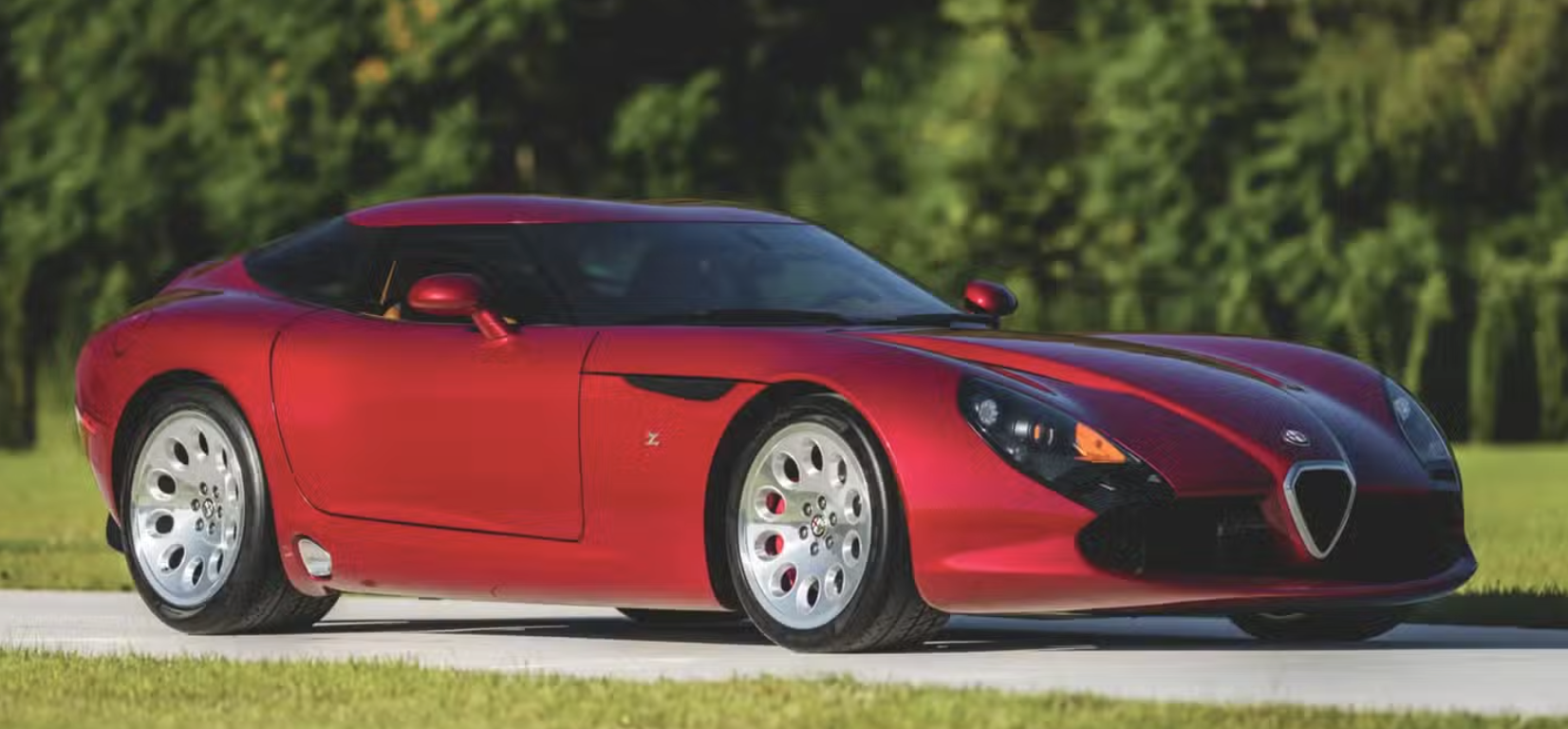
Every so often the car world coughs up a machine engineered to make purists reach for the smelling salts, and the Alfa Romeo TZ3 Stradale is a hall-of-famer. It reads like a lost 1960s Zagato racer redrawn for the modern age: covered headlamps, a chopped Kamm tail, a body hand-laid in carbon. Underneath that Italian sculpture is a Dodge Viper. Not “Viper-influenced.” A Viper.
Before we go further, let’s kill the version of this story that usually gets told. This was not Alfa Romeo the automaker realizing it lacked a proper engine and phoning Detroit for a bailout. The TZ3 Stradale is a Zagato Atelier commission — the Milanese coachbuilder’s own limited creation, built on the rolling chassis of a Dodge Viper ACR and produced in a run of just nine cars. It wears an Alfa badge because Zagato and Alfa Romeo have been partners since 1919, not because Alfa’s engineering department blessed a pushrod V10.
The timeline gets mangled too. There were two TZ3s. Zagato files the road-going Stradale as “Phase II” of what it called the TZ3 Programme — the sequel to an earlier one-off track car, the TZ3 Corsa, which used an Alfa V8 and was a different animal entirely. If you’ve seen the V10 street car dated to 2010, that’s the Corsa’s year stapled onto the wrong machine; the Stradale broke cover in 2011.
The engine, and a myth worth deleting
Under that long hood lives the Viper’s 8.4-liter all-aluminum V10. In the ACR-tuned example it sold, RM Sotheby’s catalogued it at up to 640 bhp with 560 lb-ft of torque, spinning through the Viper’s Tremec TR6060 six-speed manual. And no, whatever you’ve read, this is the Viper’s engine, full stop — not some exotic Italian unit hiding behind valve covers that happen to say “TZ3.” Worth noting, too: Zagato never published official acceleration or top-speed numbers, so anyone quoting exact figures for the TZ3 is really quoting the donor Viper ACR.
Related Articles
- This Carbon-Bodied ‘1968 Charger’ Is Actually a 2023 Hellcat—And It Just Proved How Fast Custom Mopar Money Evaporates
- Kyle Busch Invitational: 51 Legends Cars Pack Bowman Gray’s Quarter-Mile
That donor relationship is the whole key to living with one.
Why it matters that it’s basically a Viper
Because the Stradale is a rebodied Viper, it essentially is a Viper wherever paperwork is concerned. The car RM sold came with the original Dodge Viper owner’s manuals and a Viper-format chassis number. For a buyer that cuts in two directions.
On maintenance, it’s a genuine gift. The suspension, the StopTech/Brembo brake hardware, the gearbox and that big V10 are all standard Viper ACR components. A competent Viper specialist can service the mechanical bits without inventing anything — no bespoke-hypercar tax on a set of brake pads. The unobtainium is the carbon bodywork designed by Zagato’s Norihiko Harada. Damage a panel and you’re not ordering from a catalog; you’re negotiating with a coachbuilder. Insurers price that reality accordingly. This is agreed-value, specialist-policy territory, not a car you slot onto a generic exotic quote.
The money is its own lesson
Here’s where the TZ3 teaches you how coachbuilt cars actually depreciate. Zagato sold these quietly, through its U.S. ambassador, for over a million dollars apiece when new. A decade later, at RM Sotheby’s Elkhart Collection sale, the sixth of the nine cars — showing barely 200 miles — sold for $489,000. Call it half.
Rarity alone won’t defend a seven-figure valuation when the hardware beneath is a known, mass-produced quantity. Nine examples pushes the number up; a donor car built in the thousands drags it back down. That tension is why the TZ3 sits in a strange market pocket: too special to be cheap, too Viper-based to be a blue-chip Zagato.
So is it a “real” Alfa?
Zagato never pretended otherwise. Andrea Zagato openly called it history’s first “American” Alfa Romeo, crediting the Fiat-Chrysler tie-up for making an Alfa-badged Viper possible at all. He wasn’t wrong about the plumbing, either — the same corporate lineage that slid a Dodge V10 under an Alfa shield in 2011 is the one that eventually became Stellantis, where Alfa Romeo and Dodge are corporate roommates today.
Related Articles
- Waymo’s Robotaxis Keep Getting Stuck in San Francisco, and Washington Just Ran Out of Patience
- Vasseur Takes Aim at Stewards Over Hamilton Penalty at Belgian GP
Whether that makes it an Alfa depends on how much weight you put on badges versus bloodlines. What it undeniably is: one of nine hand-built Zagato bodies, stunning from any angle, riding on the running gear of one of the most uncompromising American track cars ever sold — with the service manual to match. For the right enthusiast, that contradiction isn’t the flaw. It’s the entire appeal.
Images Via: RM Sothebys
About the Author