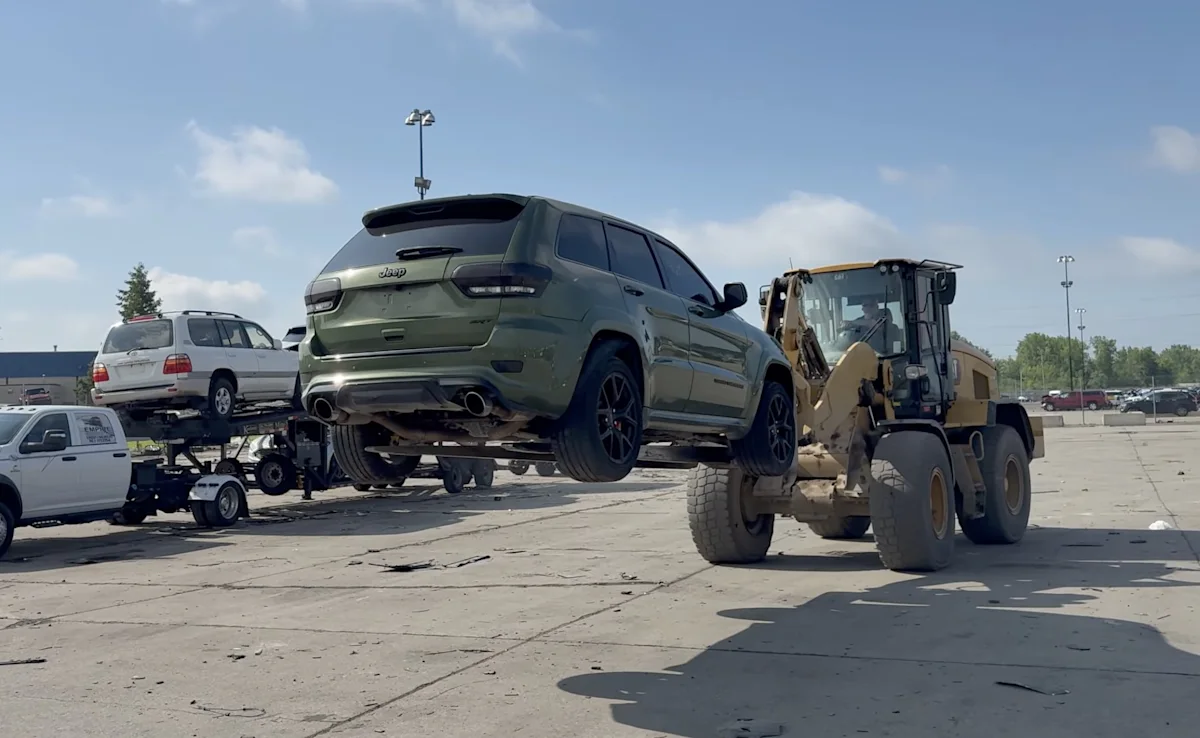
Khal_SRT has crawled through enough wrecked Mopars to know a yellow engine block doesn’t belong under the hood of a Jeep Grand Cherokee. So when he walked a Copart lot in Detroit and popped the hood on a battered SRT with no keys and a sagging front bumper, one look told him the auction description was selling this thing way short.
Khal_SRT runs an SRT-focused repair shop and has built a following swapping Hellcat and Demon powertrains into cars Dodge and Jeep never built that way, including, based on a pinned note under his own video, a Chrysler 300 currently getting a custom hood to cover its own Demon 170 transplant. When he says a block is real, it carries weight with an audience of more than 300,000 subscribers.
The Color That Gives It Away
Every Grand Cherokee SRT left Jeep’s Jefferson North plant in Detroit with a 6.4-liter HEMI V8 rated at 475 horsepower and 470 pound-feet, wearing the same red-orange paint Dodge and Jeep have used on SRT HEMIs for years. That’s not what was sitting in this engine bay. The block underneath this hood was yellow, a color Dodge reserved for exactly one engine: the supercharged 6.2-liter HEMI built for the 2023 Challenger SRT Demon 170, chosen specifically to set it apart from the red-blocked Hellcat and Redeye engines sharing the same basic architecture.
On E85 fuel, Dodge certified the Demon 170 at 1,025 horsepower and 945 pound-feet, good for a 1.66-second sprint to 60 mph and a quarter-mile pass of 8.91 seconds at 151 mph, numbers that made it the quickest and most powerful muscle car Dodge had ever sold. Only 3,000 were built before Dodge ended V8 Challenger production, which is exactly why finding one’s engine somewhere else is worth stopping for.
There are only two realistic ways a Demon 170 engine ends up in a Jeep. It either came out of a wrecked or parted 2023 Challenger Demon 170, or it started life as a Direct Connection crate engine, Mopar’s own supercharged 6.2-liter long block, cataloged at roughly $28,500 and built to the same 1,025-horsepower, 945-pound-foot spec as the factory car. Either way, whoever built this truck wasn’t working with cheap parts, even if the finished product currently looks held together with zip ties.
Nobody Tuned It
Here’s the detail that should make any buyer nervous: the swapped engine is still running on the Jeep’s stock powertrain control module. Nothing about the truck’s computer has been recalibrated for an engine that’s roughly double the output the chassis was originally engineered around. A PCM tuned for a naturally aspirated 6.4-liter HEMI doesn’t have the fueling tables to manage boost and isn’t watching for the failure modes a supercharged engine actually produces. Driving it hard before a proper tune and supporting fuel system work go in is how a six-figure powertrain turns into a very expensive paperweight.
A Kill Switch, Not a Dead Battery
Getting the truck running at all took longer than expected. It arrived with no keys, so a fob had to be programmed at the shop, and the closest match on hand was a Hellcat key, since a proper Grand Cherokee Trackhawk fob wasn’t sitting on the shelf. When it still wouldn’t fire, the first guess was a supercharged HEMI that had simply sat too long. The real problem was underneath: a hidden kill switch wired directly into the RF hub, cutting power to the push-button start circuit. Whoever had this truck before it reached Copart didn’t want it started by anyone who didn’t know exactly where that switch was hidden.
That’s a meaningful detail on a vehicle sold through a stolen-recovery salvage title. A wiring harness deliberately modified to disable ignition isn’t the kind of thing an insurance adjuster documents on a total-loss worksheet, it only surfaces once a technician starts tracing circuits by hand. In this case, that meant following power through a fuel pump controller jumped straight to the battery, chasing grounds back to the power distribution center, and ultimately deciding to bypass the tampered wiring entirely rather than trust it.
What a Stolen-Recovery Title Actually Means for a Buyer
Vehicles that are stolen and later recovered, sometimes intact, often stripped or rewired, get written off by whichever insurer paid the theft claim, and the title gets branded before the car ever reaches an auction platform like Copart. That branding tells a buyer the loss history, not what’s actually bolted, spliced, or hidden inside. A stolen car stop in Kansas City made that same point from the recovery side of the process, since what a vehicle is on paper and what it actually contains once someone finally opens it up can be two very different things.
Salvage titles are also only as trustworthy as the person certifying them. A Michigan detective who was the only officer signing off on salvage titles in his own town spent 90 days in jail for faking those inspections, a good reminder that a title’s branding is a legal certification, not a guarantee of what a mechanic will actually find once the hood comes up.
That uncertainty is the entire appeal, and the entire risk, of buying at a Copart or IAA sale. Sometimes the reward is a genuine Demon engine hiding under yellow paint; sometimes it’s a burned-out McLaren shell someone is still trying to flip for parts money. Even when the sheet metal is real, salvage-market values for Mopar’s biggest HEMIs are a moving target, and a supposedly numbers-matching Hellcat swap recently proved just how fast a modified Mopar’s resale value can evaporate once buyers start asking what’s actually underneath the panels.
Durango Seats and a Sun-Baked Dash
Inside, the Jeep isn’t running Grand Cherokee Trackhawk buckets, it has Dodge Durango captain’s chairs instead, a straightforward swap since the Durango shares its unibody and much of its interior mounting hardware with the Grand Cherokee under Stellantis’ WK2 platform. Less charming is the dashboard, which has bubbled and cracked along the top edge, a known weak point on this generation’s leather-wrapped dash that gets accelerated by baking in direct sun on an auction lot. Fixing it means sourcing a used dash from a donor vehicle and swapping the wiring harness that runs through it, not a bolt-in fix.
Damage That Never Shows Up in Auction Photos
The front end tells its own story. There are no bumper brackets, which is why the bumper never sat flush, and pulling the bumper at some point also unplugged the proximity sensors and left the adaptive cruise module unprogrammed. The airbag warning light is on because the impact sensors aren’t communicating, and the steering column’s shaft was bent hard enough in whatever hit this truck took that the shop sourced an entire replacement column, motor, power tilt, and all, rather than attempt a repair. None of that shows up in an auction listing’s photos, and all of it becomes the buyer’s problem the moment the gavel falls.
What’s Still Left to Finish
The build isn’t done. Plans call for reinstalling the front bumper, badging the front fenders to correctly identify the engine as a Demon 170 rather than let anyone mistake it for a Trackhawk’s supercharged 6.2-liter, and swapping the stock wheels for gloss-black five-spokes running a staggered 275-front, 305-rear tire setup that actually suits the power on tap. A Borla exhaust was already installed by whoever built this truck before it went to auction, one of the few upgrades that arrived already sorted.
For anyone shopping salvage auctions for the next weird sleeper build, this is the realistic version of that dream: a genuine six-figure powertrain wrapped around somebody else’s unfinished, undocumented, occasionally cigarette-scented project. It runs. Whether it runs safely, legally, and for very long before that stock PCM gets a proper tune is still an open question, and that’s true of nearly every stolen-recovery salvage title with a story too good to leave sitting on the lot.
About the Author