Drag racers obsess over the things that can kill a pass: a lazy converter, a hungry turbo, a gust of crosswind, a track temp ten degrees off the tune-up. Brett LaSala’s Sunday at Bradenton Motorsports Park was undone by something that never shows up on a datalog: a hand tool.
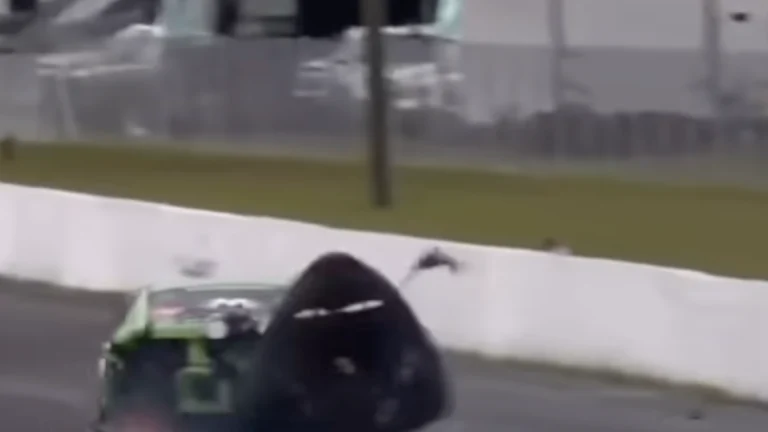
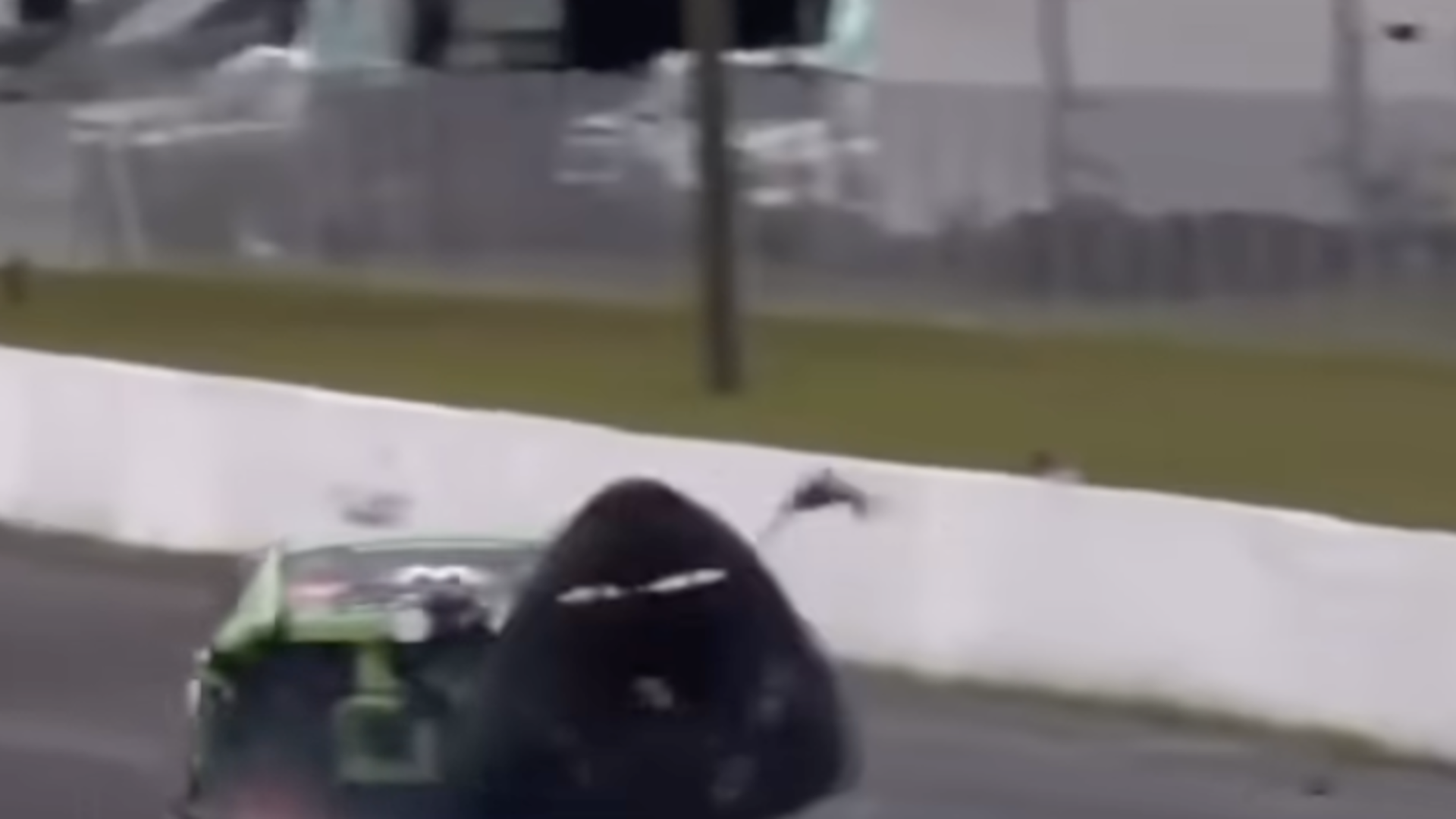
LaSala’s bright green “Snot Rocket” Mustang was racing in eliminations at FL2K26, the October 1–4 street-car gathering in Bradenton, Florida, when its left-rear corner came apart near the top end. In his own post afterward, LaSala called it his first race-car crash and put the speed at 228 mph. Team co-owner Doug Cook said on Facebook that a tool left in the engine bay was the likely cause. He pointedly declined to name whoever left it there, which is either good leadership or a sign that a very awkward shop meeting is coming.
LaSala walked away. The Mustang’s quarter panel, door skin and rear bodywork weren’t so lucky.
How a wrench becomes a projectile
Here’s the part most people miss: a tire doesn’t run over debris so much as pick it up.
The tread at the contact patch is momentarily stationary relative to the ground. That’s how rolling works. But the top of the tire moves at roughly twice the car’s speed relative to the pavement. Anything that wedges into the tread or gets caught between tire and fender is grabbed at near-zero relative speed and then whipped around the arc of the tire. At 228 mph, the top of that tire is covering ground at something like 450 mph.
Related Articles
- George Foreman’s $6 Million Texas Estate Has an 11,000-Square-Foot Garage. The Cars Already Got Auctioned
- Travis Barker Thinks His LS3-Swapped ’59 Impala Makes 495 HP. Chevy Rates the Base LS3 at 430
FL2K’s stick-shift rules cap radials at 275/60/15. That’s a tire roughly 28 inches tall. At 228 mph it’s spinning about 2,700 times a minute, and anything metal it catches gets thrown into the wheel tub at roughly car speed. Sheetmetal designed to hold off rain and road grit doesn’t stand a chance.
Aviation has a name for this: FOD, or foreign object debris. Airlines and the military run FOD walks across ramps because a single loose bolt can wreck a jet engine. Drag racing borrowed much of its safety culture from aviation and NHRA tech inspections, but the last-minute engine-bay check between rounds is still mostly a matter of human discipline.
The irony of the diaper rule
FL2K requires every car to run an engine diaper or catch pan to pass tech. The point is containment: if an engine lets go, oil stays in the car instead of coating 1,320 feet of prepped surface and stalling the event.
Diapers and pans are built to catch fluid and engine shrapnel, not a socket wrench resting on a strut tower. A tool dropping off a cowl or out from under the hood can easily fall outside them. The rule works for what it was designed to do. It just can’t stop a crew member from forgetting where they set something down.
The class adds pressure
This wasn’t a slick-tired tube-chassis car. FL2K’s Outlaw Stick Shift class requires an H-pattern transmission, a clutch worked by the driver’s foot, no air or electric shifters, and no full tube chassis. The cars are built from production shells, so there’s no full-length tube frame or acre of chromoly framing the rear wheels to absorb a hit.
The Outlaw class paid $10,000 to win. That’s real money, but elimination rounds come fast, and turnaround time is where checklists get skipped.
The repair bill
A corner that violent rarely stops at the body panels. Once a tire delaminates or a wheel is struck at speed, a competent team will want to inspect:
- Rear suspension pickups and four-link mounts, which can bend or crack without obvious signs
- The axle housing and axle, checking for bending or runout
- Wheelie bars and parachute mounts, which take secondary hits
- Fuel, brake and wiring lines routed along the rear tub
- Chassis alignment, because a car that looks straight can be measurably twisted
Paint and composite panels are the cheap part. Hours of measuring and remounting suspension are where the real cost lives.
Related Articles
- Watch: Stolen Car Flees Houston Officer, Hits a Curb, Flies Over a Parked Vehicle Into a Building — Driver Now Faces Three Charges
- 5 Underrated Muscle Cars, Led by a 1-of-164 Buick GS Stage 1 Convertible That Sold $14,400 Under Estimate
Insurance usually doesn’t help. Standard personal auto policies commonly exclude racing, timed events and anything at a drag strip. Racers who want coverage typically buy separate race-car physical-damage policies, and many simply self-insure and absorb the cost.
What every garage can take from this
You don’t need a 200-mph Mustang to learn the lesson:
- Count your tools before closing the hood. Shadow boards and foam drawer liners exist for a reason.
- Make one person responsible for the final engine-bay sweep before every pass or drive.
- Never set tools on cowls, fender tops or strut towers. Those are the spots where they get forgotten and later shaken loose.
- After any wheel-area impact, inspect the suspension, not just the body.
The most sophisticated engine in the pits still has to get past the cheapest failure mode in motorsport: human memory. On Sunday in Bradenton, that failure cost one team a corner of their car. The driver walking away is what matters most.
Images Via: Billy Mack Builds on Youtube
About the Author