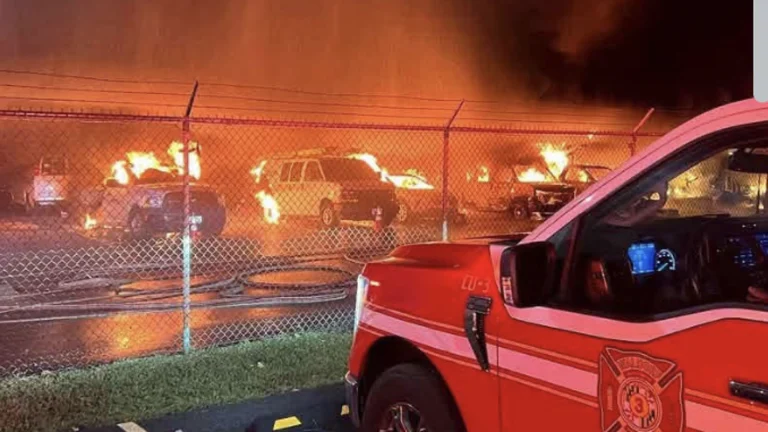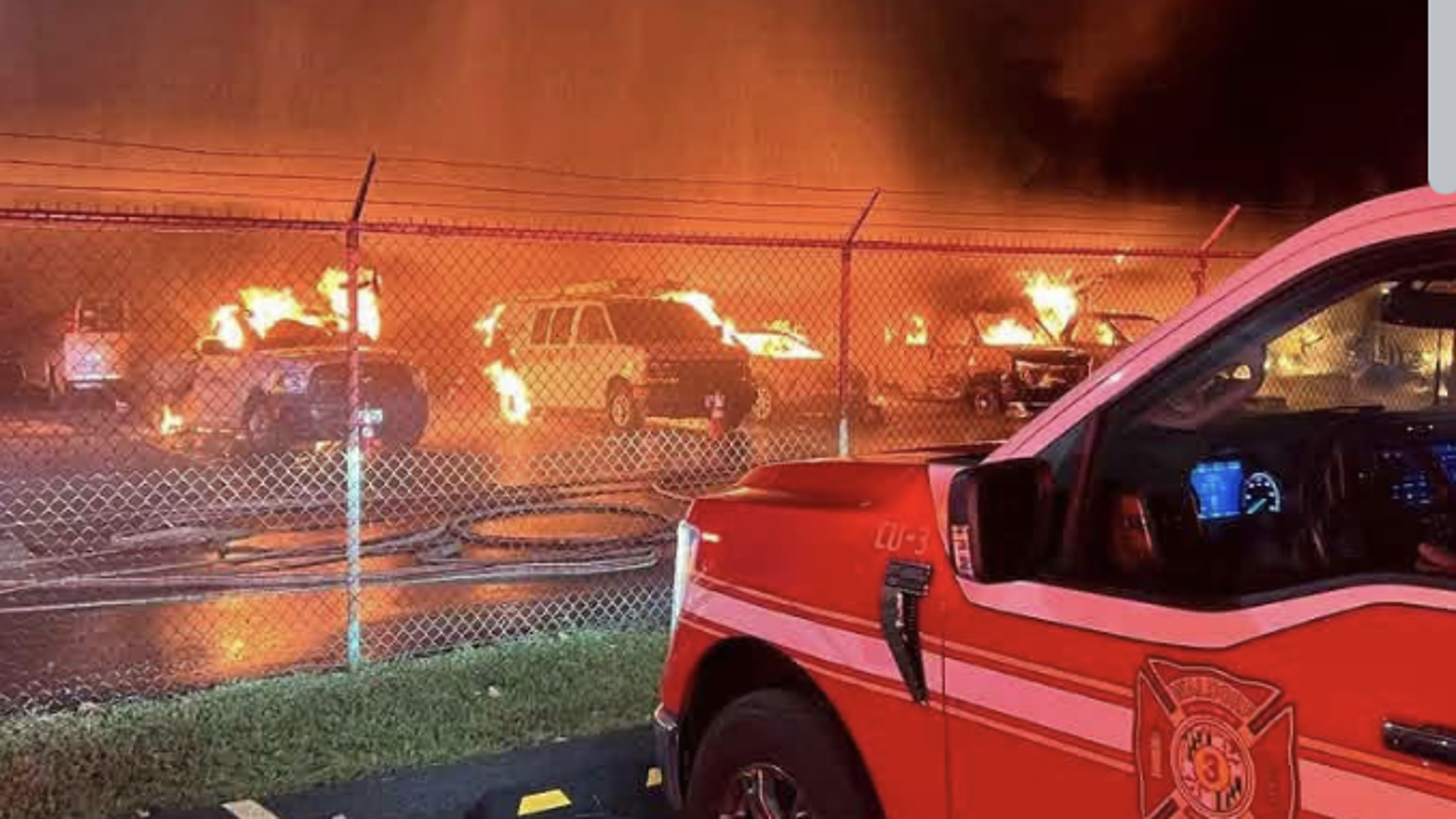
One fire, one covered lot, 27 work trucks. The blaze behind a Verizon-occupied building in Waldorf, Maryland, early Sunday morning took out a whole fleet.
A passerby spotted flames at 3:09 a.m. on October 18 in the rear parking area at 3 Industrial Park Drive. That’s according to the Maryland State Fire Marshal’s notice of investigation. By the time it was over, 27 commercial vehicles, everything inside them, and the roof over their parking area were damaged or destroyed. The marshal’s office puts the loss at $3.8 million. No one was hurt, and both the cause and the exact starting point are still under investigation.
A Two-Alarm Night
The Charles County volunteer fire association’s incident update says Waldorf Volunteer Fire Department units arrived in under five minutes. They found numerous utility vehicles heavily involved in fire beneath a covered parking structure next to the building. Crews focused on stopping the spread and keeping the fire out of the building itself.
The call went to two alarms. About 100 firefighters responded, and the state fire marshal’s notice says it took roughly 60 minutes to bring the fire under control.
Read the Fine Print on That Dollar Figure
The total is less useful than the breakdown. The fire marshal splits its estimate into $3.5 million for “structure” and $300,000 for “contents.”
In Maryland’s vehicle-fire notices, the “structure” line usually covers the vehicles themselves. A 2017 vehicle fire on the same street, involving a Nissan Altima and a Chevrolet Camaro, listed the cars as structure loss and their contents separately.
Related Articles
- Charlie Wiggins’ Gold and Glory Race Car Turned Up in an Ohio Barn. Now It’s on Display in Tacoma
- Watch: A Phoenix Raceway Fan Says a Burst Suite Pipe Made It Rain ‘Sewer’ on the Grandstand
Read the same way, $3.5 million spread across 27 work vehicles works out to as much as roughly $130,000 per vehicle, less whatever the parking canopy cost. That isn’t a lot full of base-model pickups. It’s what equipped utility trucks cost once you add service bodies, ladder racks, cable reels, inverters, and the rest of the gear a telecom crew needs. The $300,000 contents line covers the tools and supplies inside.
Why One Fire Becomes 27
Investigators haven’t said where the fire started. A state fire marshal spokesperson told local press that part of the work is figuring out whether it began in one vehicle and spread to the rest. Fire science explains why that’s plausible.
Modern vehicles burn hot and long. Bumpers, interior trim, wiring insulation, tires, and fluids are all fuel. Park vehicles a few feet apart in rows and one burning truck heats its neighbors until they ignite too. Cover those rows with a roof and it gets worse: the canopy traps heat and smoke and sends radiant heat back down onto the vehicles below. Fleet lots are built to pack in as many trucks as possible, so they’re laid out for exactly this kind of chain reaction.
Work trucks also carry their own risks. Battery-powered tools left on chargers, auxiliary batteries, inverters, and aftermarket wiring for lights and equipment are all common on utility vehicles. They’re also common places for electrical faults to start. Whether any of that played a role here is for the investigators to decide, and the fire marshal has named no cause.
The Real Cost Is the Downtime
For Verizon, or whoever owns these trucks (the fire marshal’s notice doesn’t say), the cash loss may be the easy part. Big fleets often self-insure physical damage or carry large deductibles. The harder problem is downtime.
Upfitted work trucks aren’t sitting on dealer lots. Each one needs a chassis, a body installer, and an equipment fit-out, and that can take months. In the meantime, crews borrow from other depots, rent, or fall behind on installs and repairs.
If you run a few trucks, the $300,000 contents line is the one to study. Standard commercial auto policies generally cover the vehicle, not the tools inside it. Tools and equipment usually need separate coverage, often called inland marine or tools-and-equipment insurance. If your work van carries $20,000 in gear, find out today which policy pays when the van burns.
If You Park Work Trucks in Rows
Space vehicles out where you can. Even a few extra feet between them can buy firefighters time.
Related Articles
- Hyundai’s Crater Concept Gets to Go Off-Roading. Virtually, in The Crew Motorfest
- Oshawa’s Nuisance Bylaw Has Cost the Canadian Automotive Museum $2,750 in Three Weeks
Look carefully at overnight charging. Tool batteries, jump packs, and battery maintainers left unattended in vehicles are an easy risk to reduce.
Inspect aftermarket wiring. Light bars, inverters, and upfitter circuits should be fused, routed properly, and checked at service time.
Light the lot and put cameras on it. This fire was found by a passerby at 3 a.m. Earlier detection, by a person or a camera, is often the difference between losing one truck and losing 27.
The investigation is ongoing. Anyone with information can contact the State Fire Marshal’s Southern Regional Office at 410-414-3600.
If you run trucks out of a covered lot, how far apart are they parked tonight, and does your policy cover the tools inside them?
Images Via: Waldorf Volunteer Fire Department on Facebook
About the Author