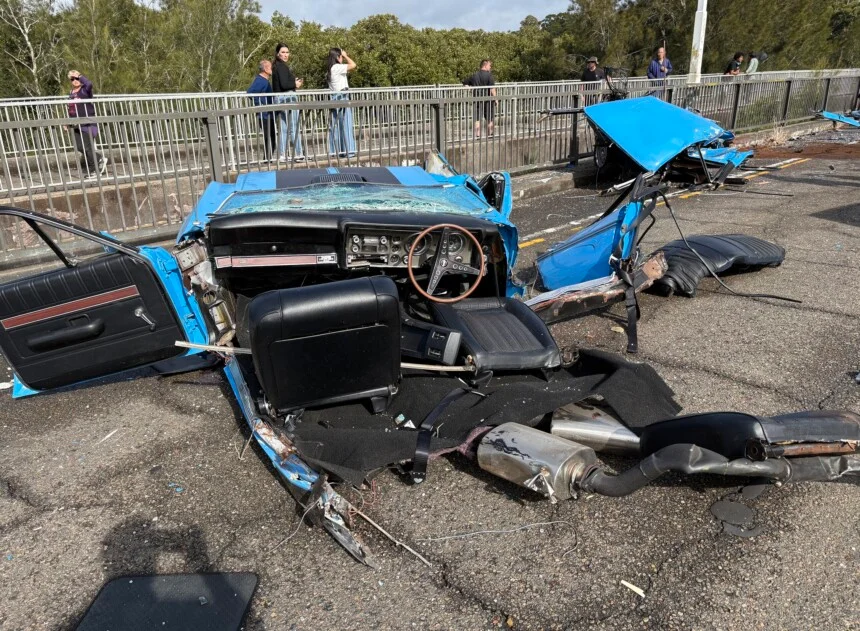
A legendary Australian muscle car was torn apart in one of the most violent crashes Sydney has seen in years, yet somehow the driver survived.
A Crash That Looked Unsurvivable
A 1971 Ford Falcon GT was completely ripped in half after a horrific collision on Henry Lawson Drive near the Salt Pan Creek Bridge in Sydney’s southwest. The destruction was so severe that emergency crews arriving at the scene reportedly expected a fatality. Instead, they found survivors suffering only scrapes and bruises. Photos from the scene show the Falcon separated into two distinct sections, with the rear half torn away completely while the mangled front section sat across the roadway. Even the driver’s seatback sheared off during the impact, a detail that reveals just how brutal the collision really was.
Despite the car being split in half, the driver survived with only minor injuries. Emergency responders reportedly feared the worst as they approached the wreckage, a reaction that makes complete sense given the condition of the vehicle — the structural damage looked unsurvivable. But somehow, against every expectation, the occupants escaped alive. That detail matters because crashes involving classic muscle cars often end very differently. Cars from the early 1970s were built in a completely different era of automotive engineering, before modern crumple zones, advanced occupant protection systems, airbags, and reinforced passenger safety structures existed in anything like their current form. The Falcon GT may have been a powerhouse in its day, but it came from an era where raw performance mattered more than modern crash survivability, which makes this outcome even harder to process.
Not Just Any Old Car
The Ford Falcon GT isn’t just transportation — it represents an entire chapter of Australian car culture. These cars became symbols of local manufacturing pride and V8 performance during the golden age of muscle cars and remain some of the most sought-after collector vehicles in the country. Losing one in a crash like this feels almost personal to many fans, and there’s an uncomfortable truth sitting underneath that emotional reaction: cars can be rebuilt, but not always, and a life lost in a crash like this would have turned the story into something much darker very quickly.
A Hard Lesson About Vintage Performance Cars
Classic muscle cars deliver an experience modern vehicles simply can’t replicate. The sound, the feel, the rawness, and the connection between driver and machine are exactly why people keep chasing them decades later. But older performance cars also come with limitations that modern vehicles have spent generations engineering away, and this crash is a brutal reminder of that reality. The impact was violent enough to shear the vehicle apart completely, and even the driver’s seatback failed during the collision. Modern enthusiasts sometimes romanticize older cars as tougher or more solidly built than today’s vehicles, but crashes like this reveal a harsher truth: heavy steel and old-school construction don’t automatically equal occupant protection. In many cases, modern engineering sacrifices the car itself to save the person inside it, which is exactly why the outcome here feels so astonishing — the level of destruction suggests the margin between survival and tragedy was incredibly small.
The location adds another layer to the story. Henry Lawson Drive has long been known as a busy corridor in Sydney’s southwest, and incidents involving high-speed impacts and oncoming lanes aren’t uncommon there; according to early reports, that appears to be part of what happened here. Once a vehicle enters oncoming lanes, the potential consequences rise immediately.
A Painful Reality for the Collector Car World
The Falcon’s destruction also highlights a painful reality facing the collector car world. These vehicles are becoming increasingly valuable, increasingly rare, and increasingly difficult to replace, and every time one is destroyed, another piece of automotive history disappears with it. For collectors, restorers, and enthusiasts, that loss hits hard. But even with the heartbreak surrounding the destroyed Falcon GT, the story ultimately comes back to one thing: survival. Emergency crews reportedly arrived expecting fatalities, and instead the people inside walked away with minor injuries — in a wreck where the car itself ceased to exist as a single piece, that outcome borders on unbelievable.
Maybe that’s the real story here: not just the destruction of an Australian muscle car icon, but the razor-thin line between tragedy and survival. One moment turned a prized classic into scrap metal. Somehow, the people inside still made it home alive, and for anyone who has ever driven, restored, or admired a classic muscle car, that reality lands harder than the wreckage itself.
About the Author