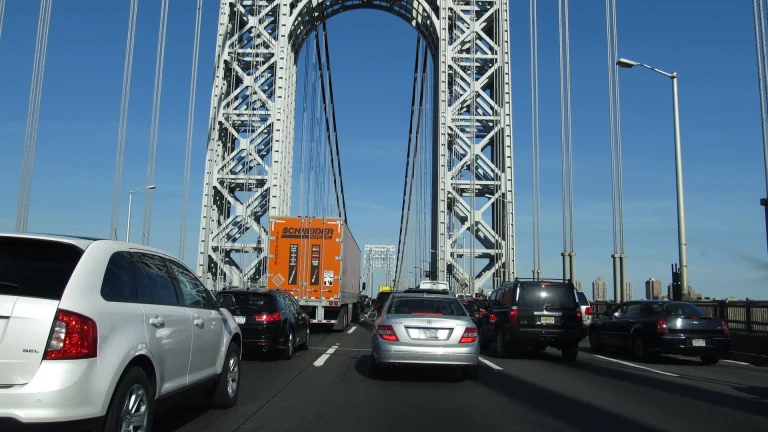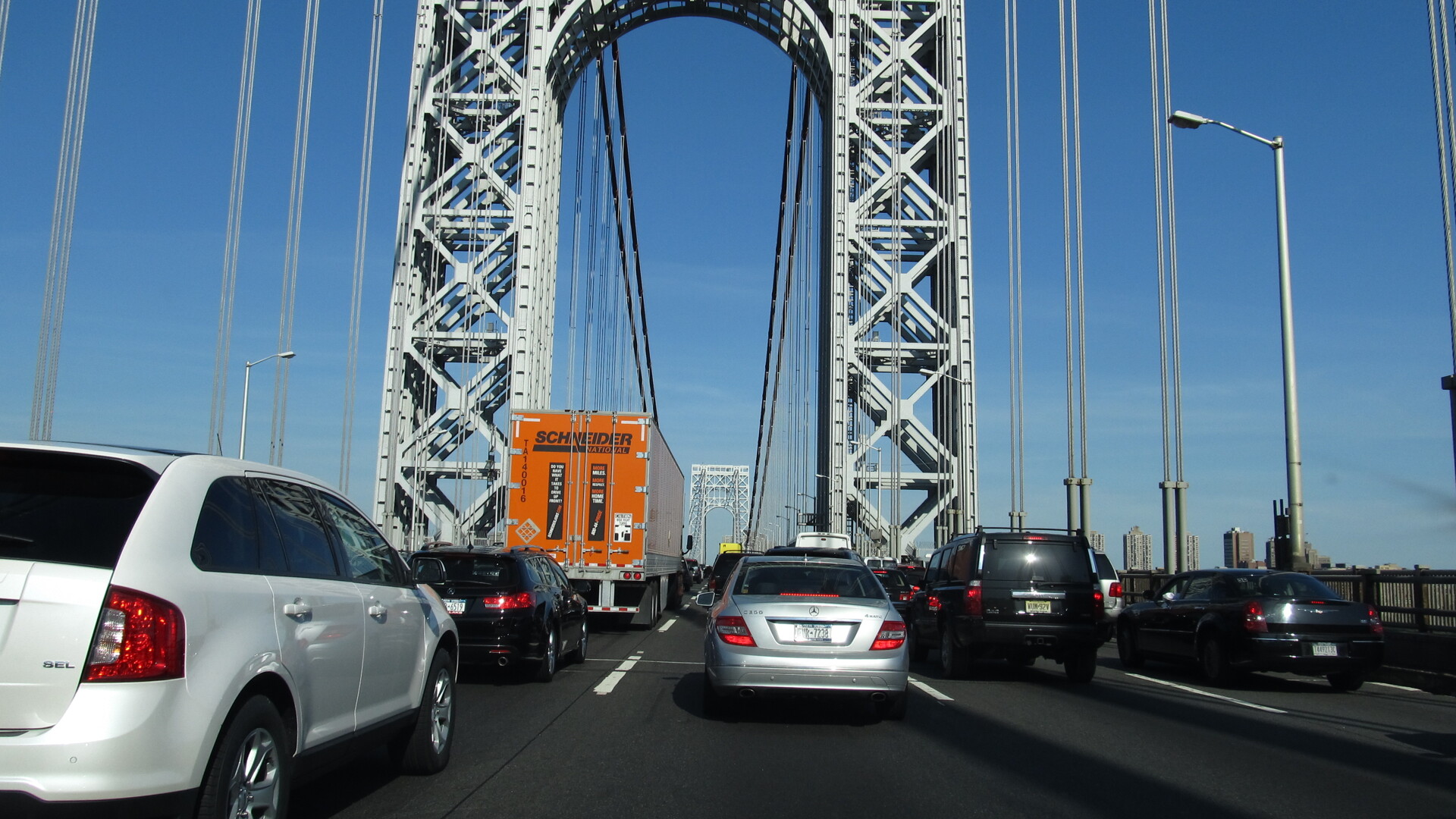
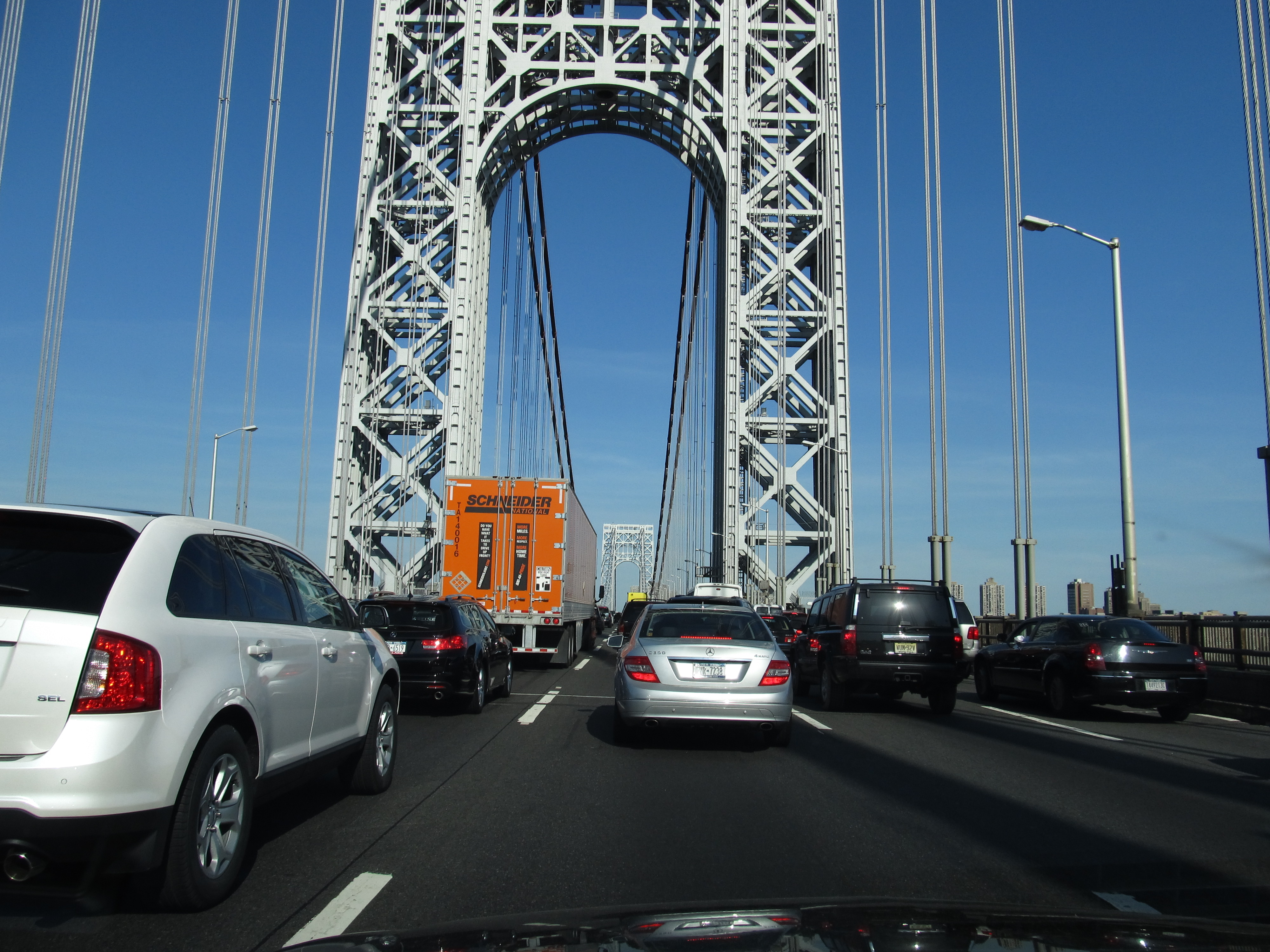
Traffic on the George Washington Bridge. Photo: Ken Lund / Wikimedia Commons (CC BY-SA 2.0)
A retired NYPD detective is being held on $1 million bail after Manhattan prosecutors said he fired one shot into a car on the upper level of the George Washington Bridge around 7 p.m. last Tuesday, killing Koran Irvine, a 46-year-old Con Edison employee on his way home to Rockland County. Victor Romero, 62, was arrested on a murder charge Wednesday. By Thursday’s arraignment in Manhattan criminal court, the charge on the paperwork was first-degree manslaughter, and he pleaded not guilty, ABC News reported.
Romero is presumed innocent, and a grand jury has not yet voted on an indictment. The shooting prosecutors described in court is the same under either charge. What changes is what a jury would have to find about his intent, and under New York law that gap is worth the difference between 5 to 25 years and a life sentence.
What prosecutors say the video shows
According to the prosecutor at the arraignment, Assistant District Attorney Matt Sears, surveillance video shows Irvine’s car and Romero’s nearly colliding as both approached the bridge from 179th Street. Sears said Romero’s car then followed Irvine’s aggressively, and a few minutes later Romero fired from the driver’s seat, Gothamist reported. The bullet went through the rear passenger window and hit Irvine behind his right shoulder, according to NY1’s account of the proceeding.
Police told ABC News that Irvine’s blue Volkswagen Golf slowed, drifted right and stopped in traffic after the shot, and that Romero’s black Range Rover then passed it on the left at high speed. Irvine’s car crossed four lanes and hit the median. Prosecutors said Romero drove on into New Jersey without stopping. NBC New York reported that all lanes of the bridge reopened around 1 a.m.
Investigators found the Range Rover through a license plate visible on the surveillance video, NY1 reported. The SUV is registered to a company where Romero works as a driver, according to ABC News,. Police took him into custody Wednesday; the outlets differ on whether he was arrested at work or surrendered at the 33rd Precinct in upper Manhattan. He handed over a loaded revolver that he said he carries every day, and prosecutors said two more handguns were recovered from his home. All three are undergoing forensic processing, and a bullet fragment recovered from Irvine’s car is being analyzed. No ballistics result had been reported as of Friday.
Why the charge changed between arrest and arraignment
The NYPD charged Romero with murder after he was brought in. At arraignment, before Judge Kevin McGrath, the Manhattan District Attorney’s office proceeded on manslaughter in the first degree, per NY1’s reporting that the DA’s office downgraded the charge. I could not find a public statement from the DA’s office explaining the change.
The two offenses turn on one element. Under Penal Law 125.25, second-degree murder requires intent to cause the death of another person, and it is a class A-I felony. Under Penal Law 125.20, first-degree manslaughter covers a defendant who, intending to cause serious physical injury, causes a death. It is a class B violent felony carrying 5 to 25 years in prison. A class A-I murder sentence is life, with a minimum term of 15 to 25 years set by the court. A single shot through a rear window at a car in traffic is the kind of act where a jury could read either intent, and prosecutors have to pick the count they believe they can prove.
The grand jury, which the DA’s office will present the case to, is not bound to the arraignment charge. It votes on what, if anything, to indict.
The bail fight and the clock on the indictment
The judge set bail at $1 million, the amount prosecutors requested, over the objection of the Irvine family’s attorney, Keith White, who called the decision a travesty. The family had asked that Romero be held without bail, citing flight risk. Romero’s attorney, Alan Abramson, described his client as a police officer with a “sterling record” who was shot during an earlier shootout, and said he has a wife and four children. ABC News, citing law enforcement sources, reported that Romero was shot off duty during an armed robbery at his family’s Brooklyn laundromat the year before he retired from the department in 2001. Romero did not speak in court.
Because he is in custody, a state deadline applies. Criminal Procedure Law 180.80 requires release of a held defendant after more than 120 hours without an indictment or a started hearing on the felony complaint, extended to 144 hours when a weekend or holiday falls in the period. Romero was taken into custody Wednesday, so by Backfire News’s count that window runs out around Oct. 27, so a grand jury vote on the final charge, or a release decision, falls close to that date unless prosecutors show good cause or the defense consents.
Guns, permits and an employer’s vehicle
Two questions are still open. An attorney for the Irvine family told WABC that, given the circumstances of Romero’s earlier shooting, he should not have had a carry permit. Prosecutors and police have not described his permit status in the reports I reviewed, so that remains the family’s assertion. The family is also investigating a lawsuit against Romero and the security company it believes he worked for, Gothamist reported, which would put an employer’s role in a driver’s behavior in front of a civil court. The Range Rover’s registration to a company where Romero works is a documented fact; what that company knew or approved is not.
The next markers are the grand jury vote and the results of the forensic testing on three handguns and the bullet fragment. Romero remains in custody on the $1 million bail, and a GoFundMe for the Irvine family had raised more than $190,000 as of Thursday, according to ABC News. Backfire News has also covered a Georgia driver charged with aggravated assault after pointing what looked like a gun at a motorcyclist.
Was Manhattan prosecutors’ decision to go forward on first-degree manslaughter instead of murder the right call for one shot fired in traffic, or should the murder charge have stood until a grand jury weighed it?
About the Author