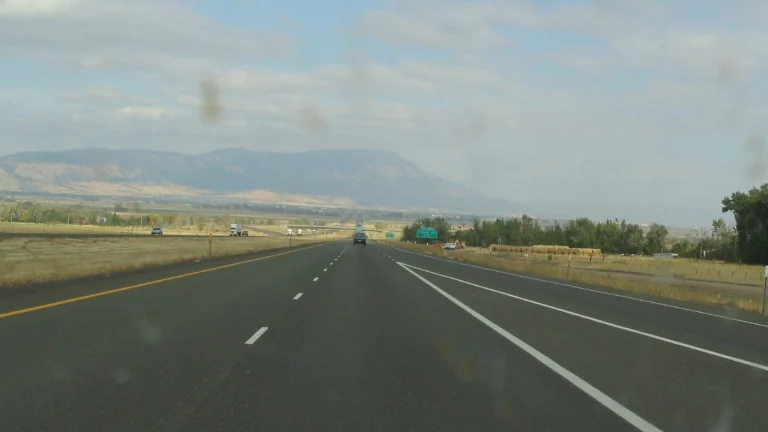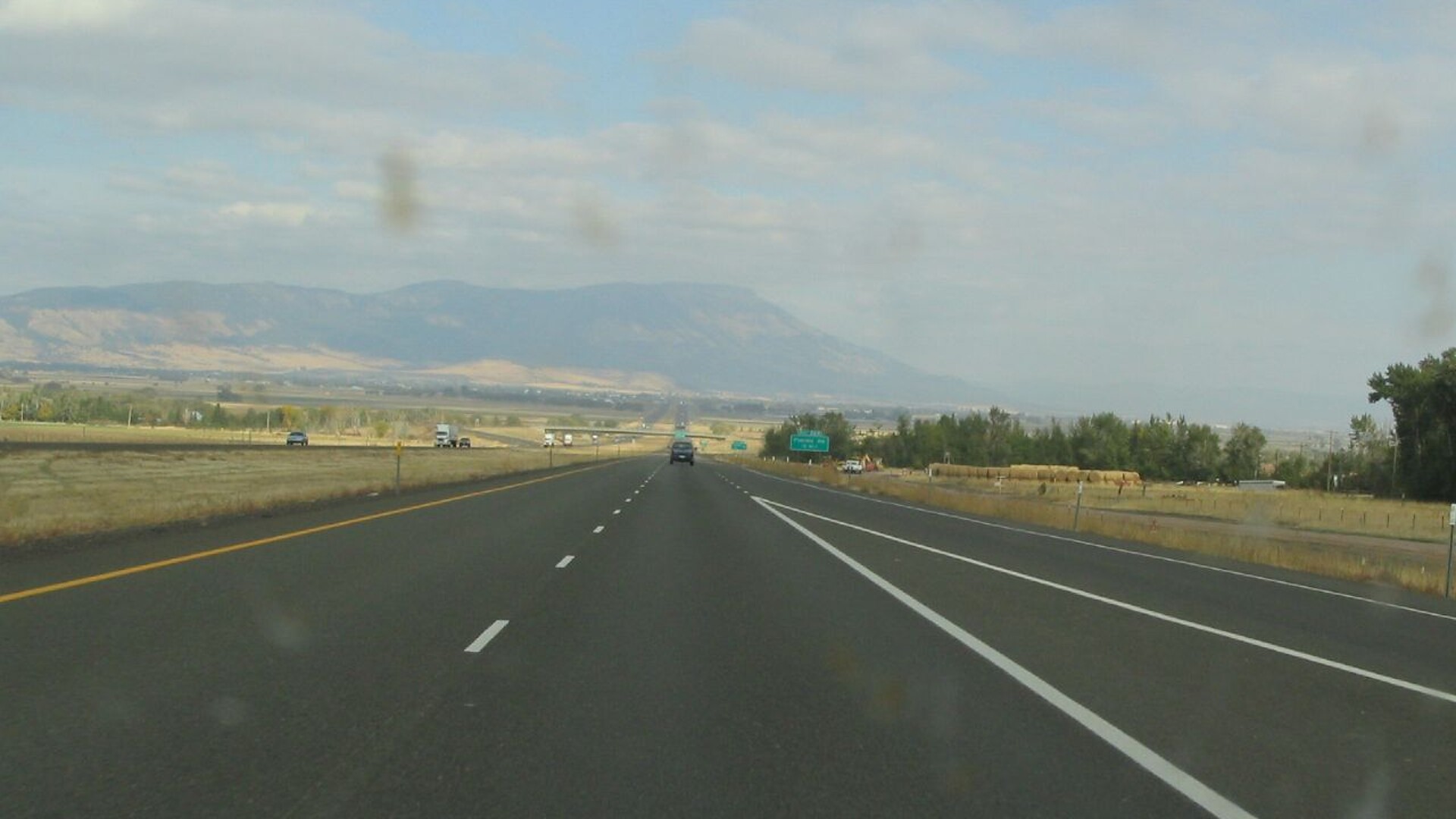
Interstate 84 in eastern Oregon, near La Grande. (Ken Lund/Wikimedia Commons, CC BY-SA 2.0)
Terry Rowan, the Umatilla County sheriff in Oregon, lost his state law enforcement certification for three years on Oct. 22, when the Board on Public Safety Standards and Training voted unanimously to revoke it, the East Oregonian reported. He keeps the certification for now. Rowan told the Department of Public Safety Standards and Training in September that he would appeal, and the revocation is not final until a state administrative law judge hears the case.
The board acted on its consent agenda with no discussion, the East Oregonian reported, adopting a recommendation its Police Policy Committee made Aug. 20. The criminal case against Rowan ended in a diversion dismissal. The certification case did not, and the committee’s findings rest as much on what Rowan told a Gilliam County sergeant at the roadside as on how he was driving.
The stop on Interstate 84
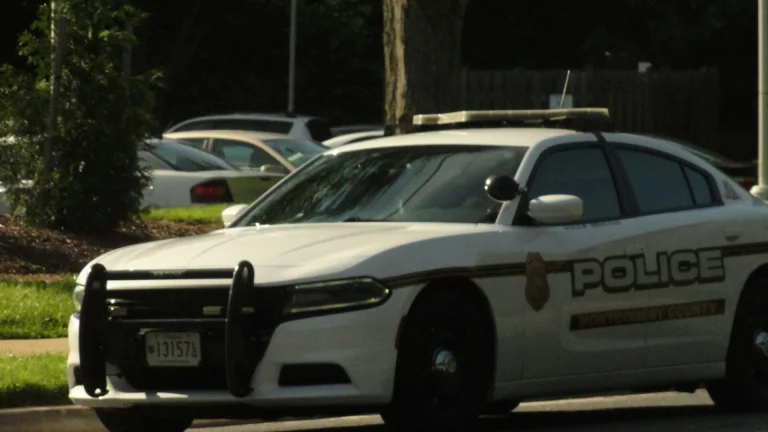
According to the East Oregonian, Gilliam County Sgt. Anthony Redden-Pickett stopped Rowan’s pickup on May 16, 2025, after clocking it at 91 mph eastbound on I-84. Rowan told deputies he was “completely sober,” a statement recorded in the committee’s draft minutes. A blood-alcohol test more than an hour later registered 0.19 percent, the East Oregonian reported, more than twice the 0.08 percent at which Oregon law makes driving under the influence an offense.
The committee’s aggravating factors read like a case file. Multiple 9-1-1 callers reported the driving, Rowan failed to maintain his lane and nearly hit a guardrail, and he was in a county-owned vehicle. The minutes also record his explanation that he had set the cruise control at 70 mph and did not know he was going over 90.
Charges dismissed, certification case still open
Rowan pleaded no contest to DUII and reckless driving and was granted diversion, which he completed, the East Oregonian reported from court records. The reckless driving charge was dismissed in March and the DUII charge in June, after he attended a Mothers Against Drunk Driving victim impact panel and installed an ignition interlock device. Oregon’s diversion statute requires a plea of guilty or no contest in the petition (ORS 813.200(4)(a)), and a defendant who finishes the program can ask for an order dismissing the charge “with prejudice” (ORS 813.250(1)). The diversion sections I read cover the charge and the driver’s operating record. I found nothing in them about professional certification.
That is the territory of OAR 259-008-0300, which lets the board review conduct tied to an arrest and criminal dispositions that are not convictions. Offenses punishable as a felony, or by more than a year in prison, trigger mandatory revocation. Everything else, including Rowan’s case, goes through discretionary review by the policy committee and then the board. A conviction at 0.15 percent or higher carries a $2,000 minimum fine under ORS 813.010(6)(e)(A). Rowan’s charges were dismissed, so that fine never came into play. The certification case did.
What the policy committee found
Per the draft minutes, the committee voted 8-0 to affirm findings of dishonesty and misconduct, 8-0 to take board action against Rowan’s certification, and 8-0 on a three-year period of ineligibility. It dropped a misuse-of-authority finding. The rule defines dishonesty as “intentional conduct that includes untruthfulness,” and the committee found Rowan intentionally dishonest when he said he was “completely sober.” The misconduct finding rests on his no-contest pleas, on its conclusion that driving recklessly while intoxicated threatened people and property, and on the effect of the arrest, his absences to complete court orders and the press coverage on the credibility and operations of the sheriff’s office.
The committee also weighed mitigation: his participation in diversion, a letter from his sponsor, treatment designed for first responders and nearly four decades as a public safety officer. The East Oregonian reported that Rowan told the committee in August he was “deeply ashamed,” that his statements that night were inaccurate, and that they were not a calculated effort to mislead officers. He said his emergency lights during the stop could have been misunderstood but were not meant to invoke his authority. Rowan did not return the East Oregonian’s messages seeking comment, and its report included no statement from an attorney.
Why three years, and why it is not final yet
DPSST says the policy committee sets ineligibility in discretionary cases anywhere from three years to a lifetime, so three years is the shortest period available. The agency also says a revocation “is not finalized until all contested case processes have been exhausted.” DPSST notified Rowan of the planned action Sept. 18, and he told the agency Sept. 24 he would appeal, Elkhorn Media Group reported.
After the vote, DPSST asks the Oregon Department of Justice for help and the case goes to the Office of Administrative Hearings, which assigns an administrative law judge. Per Elkhorn Media Group’s account of the process, hearings usually take several months to schedule, the judge issues a proposed order, either side has 30 days to file exceptions, and DPSST then issues a final order. DPSST’s own estimate: “The whole process can take around a year.” DPSST spokesperson Sam Tenney told the East Oregonian the appeal could take at least a year.
Whether he can stay sheriff
Oregon law ties the office to certification. ORS 206.015(3) says the county governing body “shall declare the office of sheriff vacant” when the person serving as sheriff is not certified as a police officer within one year after taking office. That sentence addresses sheriffs who never got certified. I found nothing in the statute’s text, or in any public statement from the county, on how it applies to a sheriff whose certification is revoked mid-term. OPB reported in August that the committee’s recommendation would require Rowan to vacate his seat after a year, and the East Oregonian reported that at least two candidates have announced runs for 2028, when his term ends. Rowan began at the Umatilla County Sheriff’s Office in 1989 and was elected sheriff in 2013, then re-elected in 2016, 2020 and 2024.
His fellow sheriffs did not wait. The Oregon State Sheriffs’ Association board voted unanimously Sept. 14 to remove Rowan permanently, according to executive director Tim Svenson, and rejected his offer to suspend his membership voluntarily while the board’s ruling was pending. Rowan is a former president of the association. Backfire News has covered a Colorado House Republican leader who resigned after dashcam footage of his DUI arrest surfaced. In Oregon, the next step is a hearing date at the Office of Administrative Hearings, and none has been reported.
Should an elected sheriff keep running the office while he appeals a revoked certification, or should the county act as soon as the board has voted?
About the Author