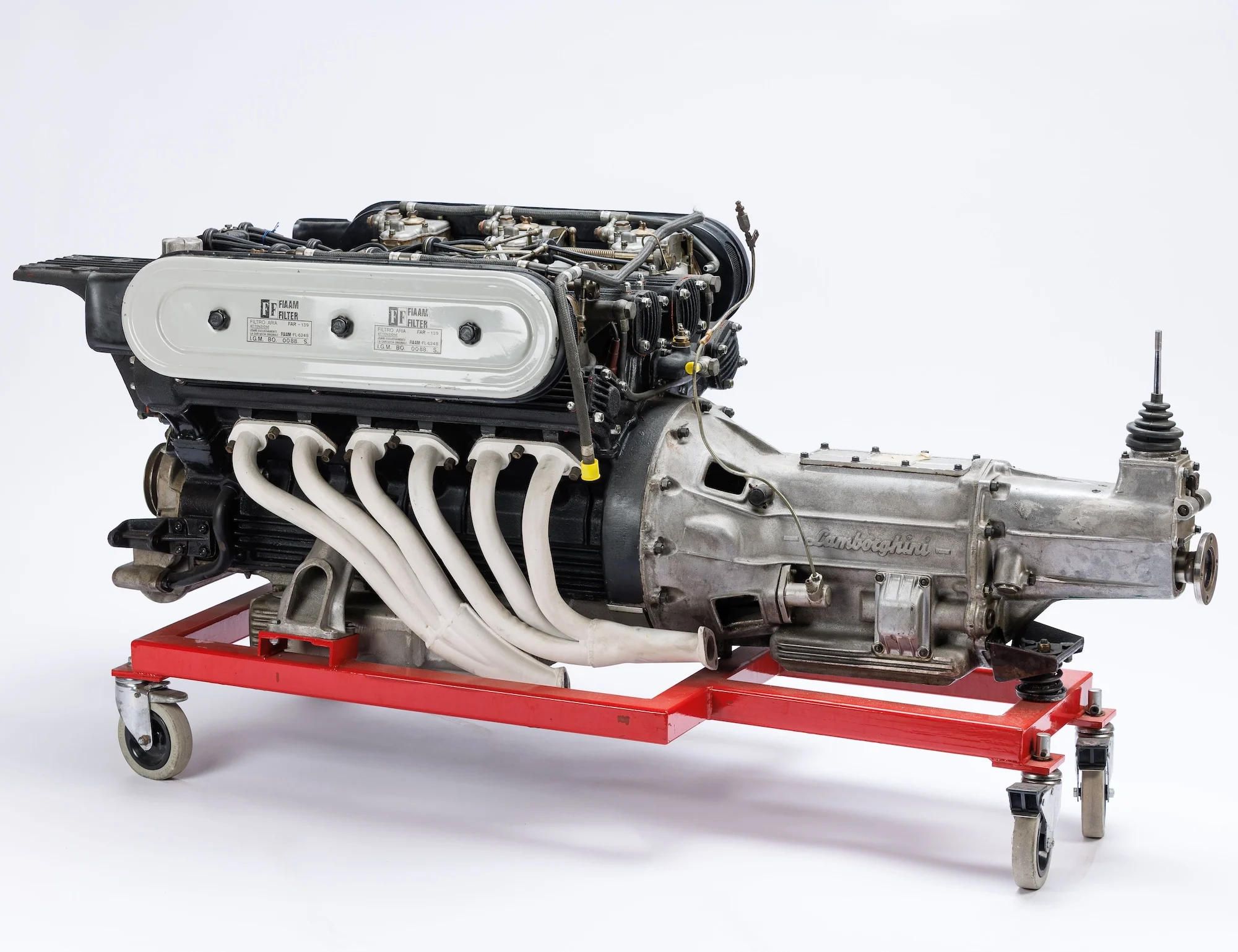
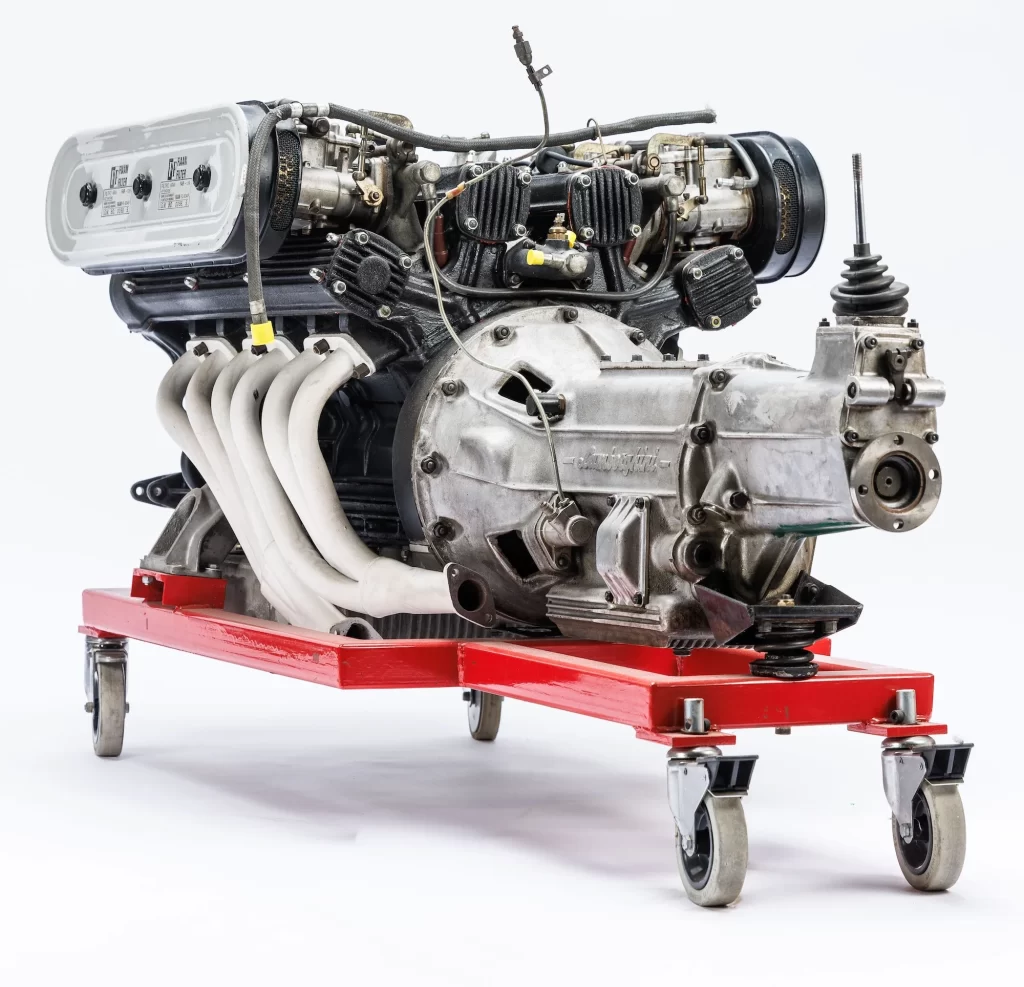
A Lamborghini Espada V12 engine paired with its original five-speed manual gearbox is heading to auction, giving collectors and restorers a rare shot at a complete, matching powertrain from one of Lamborghini’s most distinctive four-seat grand tourers.
A Complete, Numbered Assembly
Auction house Artcurial is handling the sale, with bidding scheduled for mid-March and a pre-sale estimate of €20,000 to €30,000, or roughly $23,800 to $35,700. The lot includes the complete 3.9-liter V12 pulled from an Espada, the matching five-speed gearbox, and the wheeled stand the drivetrain currently sits on. The listing identifies the engine as unit number 0577 and notes it retains its original induction system, including six Weber 40 DCOE twin carburetors — a fully assembled example of Lamborghini’s early production V12 in its factory configuration.
In Espada trim, this V12 displaced 3,929cc and made up to 350 brake horsepower at 7,500 rpm, enough to push the Espada to roughly 150 mph and make it the fastest four-seat Lamborghini available at the time. The Espada itself stood apart from Lamborghini’s mid-engine supercars by offering real grand-touring practicality with genuine four-seat capacity, styled by Marcello Gandini at Bertone with a wedge-shaped profile and expansive glass area that made it one of the most recognizable Lamborghini designs of the late 1960s and 1970s. Its name, Spanish for “sword,” followed Lamborghini’s tradition of naming models after elements tied to bullfighting.
The Engine’s Story Goes Back To Lamborghini’s Founding
This particular engine’s real significance goes beyond the Espada itself. The Lamborghini V12 became one of the longest-running production engines ever built, remaining in use in various forms from 1963 through 2010 — nearly half a century.
Its origins trace back to the founding of Automobili Lamborghini itself. Ferruccio Lamborghini, already a successful tractor manufacturer and a Ferrari owner, decided to build his own sports car company and assembled a team capable of developing a completely new high-performance engine from scratch. Engineer Giotto Bizzarrini, who had previously worked at Alfa Romeo and Ferrari, took the lead on that design after joining Lamborghini’s new venture, building a clean-sheet V12 with aluminum alloy construction for both the block and cylinder heads and dual overhead camshafts on each bank.
Bizzarrini’s early prototypes reportedly reached as much as 370 horsepower at very high engine speeds, and he pushed for even more ambitious targets, developing versions capable of spinning to roughly 9,000 rpm with sights set on 400 horsepower. The version Lamborghini ultimately put into road cars was tuned toward a more practical balance of performance, durability, and everyday drivability — the version that would go on to define the brand for decades.
From 3.5 Liters To The Murciélago’s 6.5
Displacement grew steadily over the engine’s five-decade production run, expanding from the earliest 3.5-liter versions into progressively larger variants while the fundamental architecture stayed remarkably intact — a testament to how strong Bizzarrini’s original design really was. Production finally ended in 2010, with the final evolution appearing in the Lamborghini Murciélago LP 670-4 SuperVeloce, where the same basic engine architecture had grown to 6.5 liters and 661 horsepower.
The Espada unit heading to auction represents a mid-period example of that lineage: a 3.9-liter configuration from the era when Lamborghini had already refined the V12 for stronger output while still relying on the carbureted induction that defines the character of classic Italian performance engines.
Why This Is A Rare Find
The listing offers limited detail on the engine’s running condition or service history, but the presence of the original Weber carburetors and matching manual transmission adds real appeal for collectors seeking an authentic, period-correct drivetrain. Complete Lamborghini engine-and-gearbox assemblies with matching hardware rarely surface on the open market, and the wheeled stand included in the sale suggests this unit has been stored or displayed as a standalone mechanical piece rather than pulled fresh from a running car.
Units like this typically get snapped up for restoration projects, static museum-style displays, or as period-correct spare powerplants for Espada rebuilds. At a €20,000 to €30,000 estimate, it’s a relatively accessible entry point for anyone looking to own a genuine piece of one of the longest-lived V12 platforms ever put into production — an engine that powered Lamborghini’s flagship cars for nearly fifty years and helped define the sound of the brand itself.
About the Author