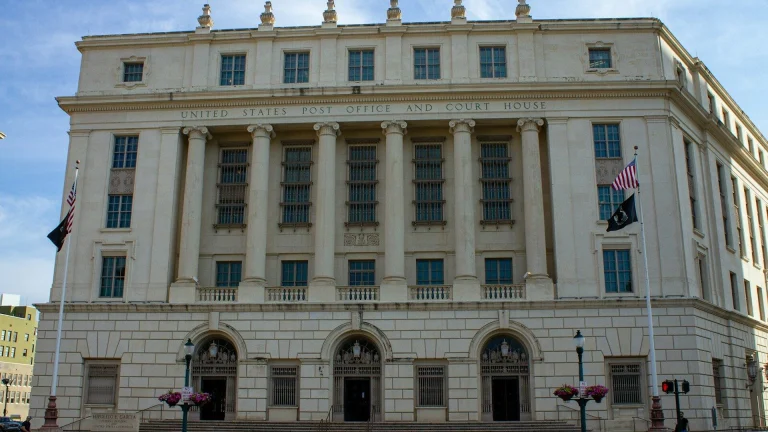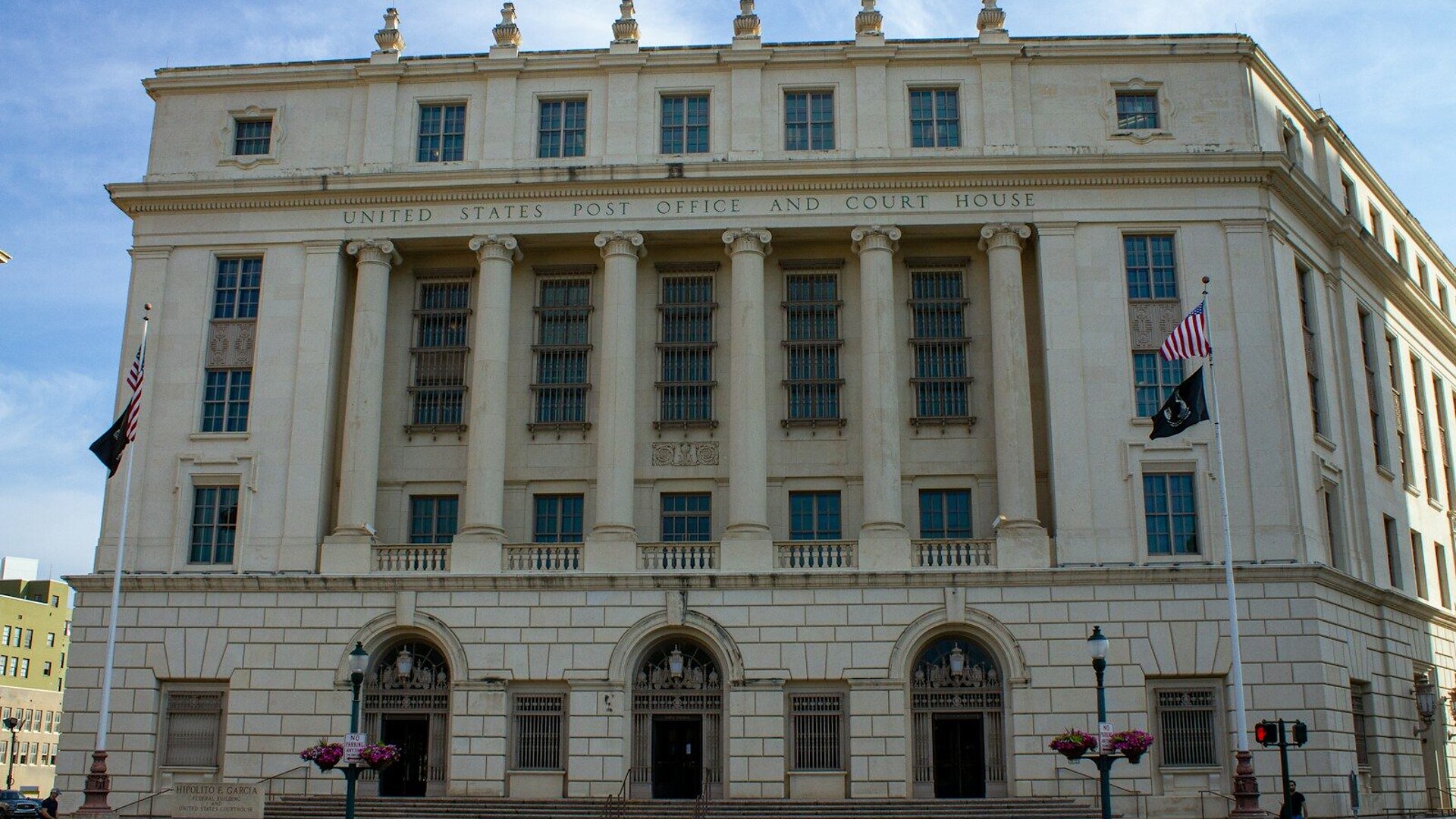
Stock image of a federal courthouse. Photo: Joshua J. Cotten/Unsplash
A federal judge in Philadelphia sentenced Mikal McCracken, 24, to life in prison plus 138 years for a carjacking that killed a former Marine on Feb. 6, 2022, for conspiring to murder the locksmith who cut a replacement key for the stolen car six days later, and for 19 other armed carjackings. The U.S. Attorney’s Office for the Eastern District of Pennsylvania laid out the sentences in an Oct. 30 release that was updated Nov. 2.
Four co-defendants got their own terms from U.S. District Judge John F. Murphy: Amin Muse, 24, life plus 55 years; Aleem Abdul-Hakim, 23, life plus 28 years; Dean Fosque, 28, 86 years; and Kavon Coleman, 24, 35 years. A jury convicted all five in March after an eight-week trial with more than 100 witnesses. Prosecutors said the group worked in rotating crews between October 2021 and October 2022, sometimes hitting several drivers in one night, and carried out about 60 carjackings, roughly half of them charged.
What the jury found and what each man got
The release ties McCracken, Muse and Abdul-Hakim to the carjacking that ended in a death, and it says McCracken fired the shot. The crew left without the victim’s key fob, so it hired a locksmith to cut a replacement. Prosecutors said the group later killed that locksmith because they feared he would identify them. Jonathan Akubu, who is charged in a separate case, is the man prosecutors say carried out that killing.
The other counts drew fewer headlines and still carry plenty of years. Fosque was convicted over 10 armed carjackings, three of them shootings. Coleman was convicted over four, including one in which the victim, who the release says had been carjacked and shot in the same leg about a month earlier, was shot in the leg again. Most of the attacks happened in Southwest and Northeast Philadelphia, with others in Yeadon, Millbourne, Lower Southampton and King of Prussia.
A pattern of newer-model Toyota SUVs
The Toyota detail comes from court records, not the press release. In an Oct. 30, 2025 opinion, Murphy wrote that many of the attacks happened in one part of the city and that many targeted “newer-model Toyota SUVs.” According to the opinion, investigators used that pattern, the area, armed groups and ballistic links to conclude that one group was behind a run of carjackings. That conclusion is what supported probable cause for the phone warrants described below.
I read the release and the opinion for a model name and did not find one. They also do not say which vehicles the overseas buyers wanted. What the record does establish is that the stolen cars were sold to buyers who shipped them to Africa for resale, and that several were found in shipping containers bound for other countries, with help from Customs and Border Protection and Homeland Security Investigations. Backfire News looked at the receiving side of that trade in its coverage of Kenya’s import grace period and stolen car exports.
Tower dumps and the question the judge left open
Investigators did not only chase cars. On Feb. 15, 2022, they obtained a warrant for T-Mobile records covering towers that served 20 locations tied to 12 of the carjackings, each for a window of 20 to 30 minutes. According to the opinion, the returns included phone numbers, device identifiers and the numbers those phones contacted, but no call content and no subscriber names. A second warrant sought devices within 0.2, 0.3 or 0.5 miles of the same spots, and two more covered historical cell-site records for two devices from Sept. 1, 2021 to Feb. 22, 2022.
McCracken moved to suppress all of it, and co-defendants joined. Murphy denied the motion without deciding the constitutional question. He did not rule on whether a tower dump or geofence is a Fourth Amendment search. He found the affidavits supplied probable cause, that the time and place limits met the particularity requirement, and that even if the warrants were flawed the good-faith exception would apply. T-Mobile had drawn a square where the warrant asked for a circle and produced some extra records; the defense put the error rate at 3% to 9% at the first five locations, and the judge called the mistakes honest ones.
The law underneath is unsettled. The Supreme Court held in Carpenter v. United States in 2018 that seven days of historical cell-site records were a search, but called its ruling narrow and did not address tower dumps. Murphy’s opinion cites the Seventh Circuit’s Adkinson decision, which said Carpenter did not invalidate warrantless tower dumps, and a Rhode Island federal court that treated a tower dump as mass surveillance, a decision later reversed on other grounds. So a driver whose phone sat near one of those 20 spots during a 30-minute window shows up in the carrier’s return as a bare number. A name took another warrant.
Why a death moves a carjacking to life in prison
The federal carjacking statute, 18 U.S.C. § 2119, covers taking a motor vehicle that has moved in interstate or foreign commerce from another person by force, violence or intimidation, with intent to cause death or serious bodily harm. That describes nearly any car on a dealer lot. The base penalty is up to 15 years, the range rises to 25 years if serious bodily injury results, and if death results the court can impose any term of years up to life, or death. The three life terms track the jury’s findings of carjacking resulting in death, and the additional years stack the other counts on top. Federal prisoners do not get parole, so a life sentence is a life sentence.
The export leg and what Customs requires
Moving a car out of the country is supposed to leave a paper trail. A federal rule, 19 C.F.R. § 192.2, requires exporters of used self-propelled vehicles to give Customs the vehicle identification number and proof of ownership, such as the title, at least 72 hours before export by vessel. The release does not say which checkpoint caught the cars in this case. The same gap between a stolen car and a clean-looking title shows up in a Pennsylvania exotic-car fraud case we covered earlier.
What happens next
Murphy rejected the defendants’ post-trial motions on Sept. 1, 2026. McCracken, Muse, Coleman and Fosque had sought new trials, arguing among other things that prosecutors disclosed an agent’s summary slides too late, and Coleman also sought acquittal on some counts. I did not find a defense statement in the records I reviewed. Two other defendants, Amadou Moussa and Davon Squire, were to be tried separately, according to the March release, and I did not find a later ruling in their case. Any appeal by the sentenced men would go to the Third Circuit.
Should police be able to pull every phone number near a string of crime scenes with a single warrant, or should a judge require a named suspect first?
About the Author