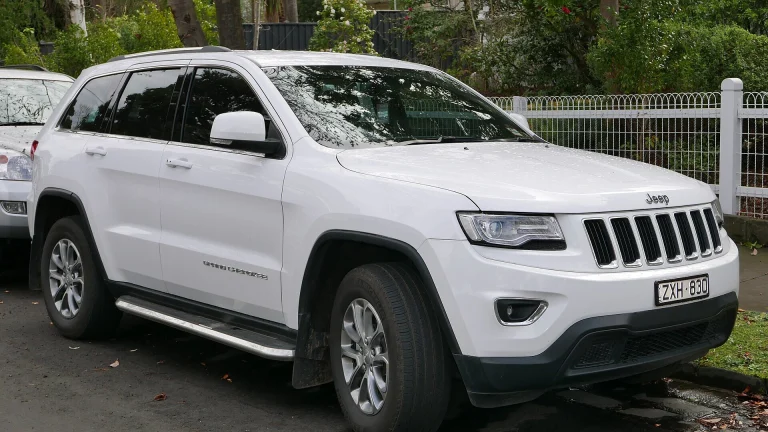
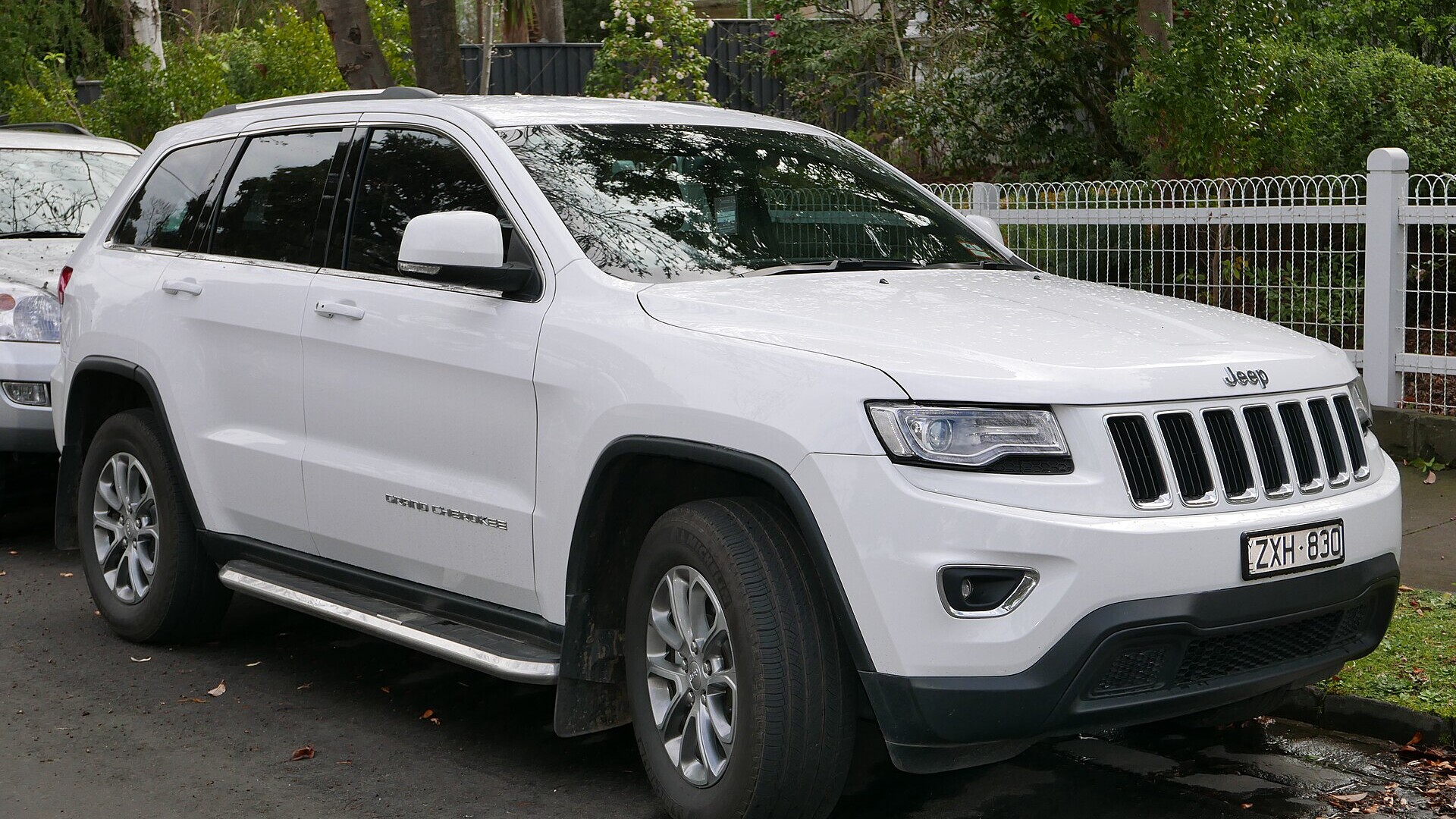
File photo of a same-generation Jeep Grand Cherokee; not the vehicle in this case.
A Facebook Marketplace ad promised a 2015 Jeep Grand Cherokee free of mechanical issues. A state form filled out the same day, police say, noted “motor issues.” Now Pennsylvania State Police have charged the Leesport used-car dealer who sold it.
The Troop L Vehicle Fraud Investigation Unit filed summary charges under the state’s Board of Vehicles Act against Osiris Baez Jr., of Reading, who owns 61 Bros Auto Sales in Leesport and holds a license as a vehicle salesperson, according to a state police release reported by Berks Weekly. The charges were filed through Magisterial District Court 23-2-01, and police did not list the individual counts. Baez acknowledged selling the Jeep but disputed the buyer’s account of the price, of what he disclosed about the mechanical condition and of the dealership’s role in the sale. None of it has been decided in court.
Summary offenses sit below misdemeanors in Pennsylvania, and this is one SUV and one buyer. But the sale, as police describe it, ran into nearly every rule Pennsylvania rewrote in 2024 to protect used-car buyers.
What police say happened between Centre Avenue and the notary
The buyer, a Schuylkill County woman, complained to state police on Oct. 19. She told investigators the Marketplace ad described the Jeep as in good condition, ready to drive and free of mechanical issues, and that nothing in it named 61 Bros Auto Sales or said the seller was a dealer.
On June 23 she met Baez at an address on Centre Avenue in Reading, looked the Jeep over and drove it. The paperwork and title transfer were done at a notary on Lancaster Avenue. She says she paid $5,200 in cash and that Baez left once he had the money, without going over the documents with her.
Shortly after she drove away from the notary, the Jeep overheated and the engine failed, and she couldn’t reach Baez afterward. When she read the paperwork, she found the bill of sale named 61 Bros Auto Sales as the seller, listed the price as $1,000, described the Jeep as sold “AS-IS” and rated its condition fair. The PennDOT fair-market-value form completed by the notary noted the motor problems. Investigators concluded the bill of sale did not disclose the known mechanical defects in writing, as state law requires. It’s the latest dealer case since a Lake Worth Beach dealer’s odometer-fraud arrest.
Pennsylvania’s 2024 rule: “as is” no longer covers known defects
Police have not said which provision they believe the bill of sale violated. The obvious candidate is the Attorney General’s automotive trade-practices regulation, amended in 2024 and in effect since Aug. 19, 2024. Under 37 Pa. Code § 301.2(5), any vehicle offered for sale is treated as a representation that it is roadworthy, and the seller must disclose in writing, before the sale, six conditions it knows or should know about, including a cracked engine block or head and a transmission or differential bad enough to need replacement.
The amendments added two things that matter here. A dealer may not advertise or offer a vehicle until a certified inspection mechanic has checked it for those six conditions within 30 days of its entering inventory, with another check if it racks up 500 or more miles on the lot. That removes the “I didn’t know” defense, because the inspection is how a dealer is supposed to know. And under § 301.4(a)(9.1), writing “as is” on the contract no longer satisfies the disclosure when the car is not roadworthy; the contract has to list the condition.
An older line in the same regulation applies to the ad itself. Section 301.2(7) makes it a deceptive practice for a dealer to advertise a vehicle without disclosing the business name and address or the word “dealer.” A Marketplace post from a personal profile that never mentions the dealership is the kind of ad that rule describes.
“Motor issues” is vaguer than anything on the regulation’s list. An engine that overheats and fails can trace to a cracked head, which is listed, or to a failed water pump or radiator, which is not. Police described the defects as known and undisclosed. The court record, not the release, will have to say which.
A $1,000 bill of sale for a $5,200 Jeep
The price on the bill of sale has a consequence the buyer may not have anticipated. Pennsylvania can collect sales tax on a used car’s fair market value instead of the price on the paperwork, and the Department of Revenue’s Motor Vehicle Understated Value Program reviews sales where the reported price is far below market. If the buyer can’t document the lower price, Revenue bills her for tax on fair market value, plus penalty and interest. At the 6 percent rate that applies in Schuylkill County, tax on $1,000 is $60. On $5,200 it is $312.
Police have not alleged any tax violation, and Baez disputes the $5,200 figure. But the same transaction produced an ad that said no mechanical problems and a state form that noted motor problems. State police have seen this paperwork before. In October, troopers in Cambria County charged a Cresson man who, they said, completed 54 vehicle sales this year without a dealer license. In nine of them, the buyer told troopers the price on the fair-market-value form was not what was paid.
A dealer plate on a test drive
Police said Baez acknowledged letting the buyer test-drive the Jeep on a dealer registration plate issued to 61 Bros Auto Sales, at a spot separate from the dealership’s licensed premises. That puts the dealership on the transaction from the start: the car moved under 61 Bros’ registration while the ad presented it as an ordinary private listing. PennDOT’s sanctions schedule for dealer registrants lists unlawful use of a vehicle or its plates, with a one-month suspension for a first violation, three months for a second and revocation for a third. That penalty is administrative and separate from the criminal case.
Why a licensed dealer faces a $1,000 fine
The penalty section of the Board of Vehicles Act makes a violation a summary offense with a $1,000 fine on conviction, which is less than the $4,200 gap between what the buyer says she paid and the bill of sale price. A fine paid to the commonwealth does nothing to fix her Jeep. Getting money back would take a civil claim or a settlement.
The Cambria case shows the other end of the scale. That seller faced two felony counts of theft by deception, a felony count of deceptive or fraudulent business practices, five misdemeanor counts of false application for a title or registration, 11 counts of unsworn falsification and 57 summary violations, and was released on $50,000 unsecured bail. The Leesport case, as police have described it so far, is one sale by a licensed dealer charged under the licensing law. Whether the State Board of Vehicles takes up his license is a separate question the criminal case does not settle.
Federal rules don’t close the gap. The FTC’s Used Car Rule applies to anyone who sells or offers more than five used vehicles in 12 months and requires a Buyers Guide on each vehicle before it is displayed for sale, but the FTC’s dealer guidance describes posting it on the vehicle itself and says nothing about online listings.
What happens next
State police advised buyers to confirm who the seller is and whether a dealership is involved, get an independent mechanical inspection and read every sales and title document before signing. In practice that means asking a Marketplace seller directly whether he owns or works for a dealership, because if the answer is yes the 2024 disclosure and inspection rules apply. It also means making sure the price on the bill of sale matches the cash that changed hands, since the buyer is the one Revenue bills if it doesn’t, and reading anything a notary or tag agent fills out, since that form goes to the state with the buyer’s name on it.
The next things to watch are the hearing schedule at Magisterial District Court 23-2-01 and whether the State Board of Vehicles opens a licensing case against 61 Bros.
Ever answered a Marketplace listing and realized halfway through the test drive that the “private seller” was a dealer? What tipped you off?
About the Author