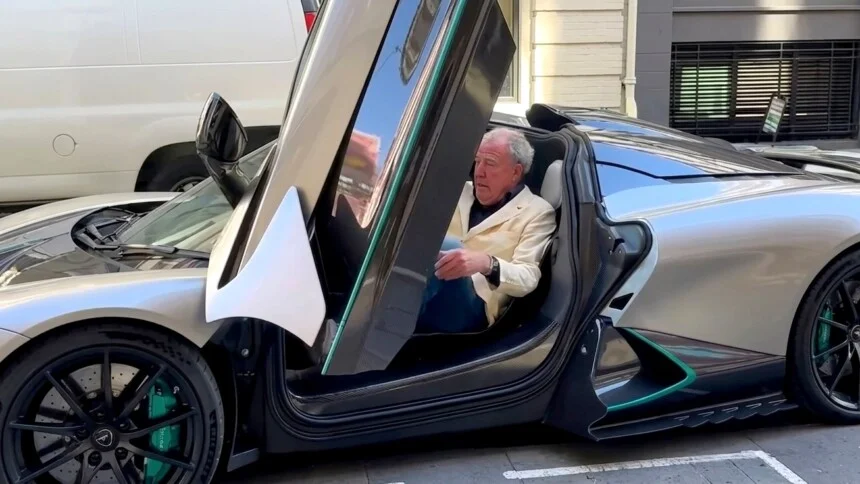
Jeremy Clarkson has spent decades mocking bad cars, praising great ones, and becoming one of the most recognizable faces in automotive culture. So when the former Top Gear and Grand Tour host gets spotted climbing into a 1,000-horsepower Aston Martin hypercar on a London street, enthusiasts notice immediately.
A video posted by Instagram user aaronspotz captured Clarkson getting into an Aston Martin Valhalla in public, and the sighting quickly grabbed attention online. This wasn’t Clarkson hopping into another luxury SUV or grand tourer. The Valhalla sits at the absolute top of Aston Martin’s performance lineup, combining massive power with hybrid technology in a way that shows just how far modern hypercars have evolved.
More Stories Like This
- The $2 Million Tractor That’s Causing a Stir: Inside Lamborghini’s Most Controversial Centenario Creation
- The Real Story Behind Greg Biffle Crash Lawsuits: $25 Million Fight Erupts as Troubling Flight Failures Surface
- Adria (Force) Hight, Daughter of NHRA Legend John Force, Dies at 56 After Lifelong Role in Building Racing Dynasty
And honestly, it feels like the exact type of machine Clarkson would have criticized years ago before secretly loving every second behind the wheel.
The Aston Martin Valhalla is not subtle. The mid-engined all-wheel-drive hypercar uses a Mercedes-AMG-sourced 4.0-liter twin-turbocharged V8 paired with two electric motors. Combined output stands at 1,064 horsepower and 1,100 Nm of torque. Those numbers put it deep into elite hypercar territory alongside some of the fastest and most technologically advanced performance cars on the planet.
That’s where things change for a lot of enthusiasts.
For years, hybrid systems in performance cars were treated with suspicion by traditional petrolheads. Extra weight, added complexity, and the fear of losing emotional connection made many drivers resistant to electrified supercars. But cars like the Valhalla have forced that conversation to shift because the performance numbers are impossible to ignore.
Clarkson himself became famous partly because he represented old-school enthusiast thinking. Loud engines mattered. Simplicity mattered. Cars were supposed to feel alive and slightly dangerous. His style on Top Gear turned automotive journalism into entertainment because viewers felt like he was speaking honestly instead of delivering sanitized corporate talking points.
That personality helped build an audience spanning generations.
Even people who never cared about horsepower figures or Nürburgring lap times recognized Clarkson’s sarcastic delivery and willingness to openly ridicule cars he disliked. He wasn’t afraid to upset manufacturers or challenge automotive trends that felt forced. That made him relatable to drivers frustrated by increasingly corporate messaging around modern vehicles.
So seeing him associated with the Aston Martin Valhalla carries weight beyond a random celebrity sighting.
The Valhalla itself represents a major moment for Aston Martin. This is not simply another fast exotic built for wealthy collectors. It’s a statement vehicle from a brand trying to prove it can compete in a hypercar world now dominated by hybrid technology, electrification, and astronomical power outputs.
And Aston Martin needed that statement.
Related Incidents
- Ferrari Feud Turns Criminal as ‘Below Deck’ Jeweler Accused of Pulling Gun in Miami Garage Standoff
- $22 Million Koenigsegg One:1 Disappears After Threats, Interpol Launches Global Hunt
The performance car market has become brutally competitive. Ferrari, Lamborghini, McLaren, and Porsche continue pushing deeper into electrified performance territory while maintaining the drama buyers expect from six-figure and seven-figure machinery. Traditional V8 muscle alone no longer dominates the conversation at this level. Technology now matters just as much as engine noise.
That detail matters because many enthusiasts still feel conflicted about where performance cars are headed.
On one side, there’s undeniable excitement surrounding machines capable of producing over 1,000 horsepower while using advanced hybrid systems to improve acceleration and drivability. On the other side, there’s growing concern that modern supercars are becoming overly digital, overly complicated, and increasingly disconnected from the raw driving experiences enthusiasts fell in love with decades ago.
The Valhalla lands directly in the middle of that argument.
Its Mercedes-AMG-derived V8 gives it legitimate combustion-engine credibility while the electric motors deliver the kind of instant torque modern hypercars now rely on. Aston Martin is clearly attempting to bridge the gap between old-school emotional performance and the industry’s unavoidable shift toward electrification.
And Clarkson getting seen with one feels symbolic whether intended or not.
His own car collection has long reflected traditional enthusiast tastes. The collection includes a 2005 Ford GT, a Range Rover Classic, a Bentley Continental GT, and a Lamborghini Gallardo Spyder among others. These are vehicles rooted heavily in character, noise, and analog driving emotion rather than software-driven performance management.
The Valhalla is something very different.
This is where the story becomes bigger than one celebrity getting spotted in London. Enthusiasts are watching the automotive world transition in real time. Hypercars once defined by displacement and naturally aspirated engines are increasingly relying on hybrid systems and electric assistance to chase impossible performance targets.
Manufacturers are adapting because regulations, competition, and consumer expectations are changing simultaneously.
Yet despite all the technological complexity, the industry still desperately wants validation from recognizable enthusiast figures like Clarkson. Automakers understand that credibility among car fans matters. A machine can have incredible specs on paper, but enthusiasts still look toward personalities they trust to decide whether a car actually feels special.
You Should Read This Next
- Texas Chop Shop Busted After Traffic Stop Unravels Network of Stolen Vehicles
- Pickup Truck Climbs Over $250K Lamborghini in Florida Gym Parking Lot
That’s why moments like this spread so quickly online.
It also says something about Aston Martin’s positioning right now. The Valhalla is not trying to be a quiet transition into electrification. It’s loud, aggressive, visually dramatic, and massively powerful. The company clearly understands that performance buyers still want theater even as drivetrains evolve.
Here’s the part that matters.
Most drivers will never own a Valhalla. Most enthusiasts will never even see one in person. But hypercars influence the entire performance car industry because the technology eventually trickles downward. Hybrid systems, electric torque delivery, and advanced all-wheel-drive setups developed for halo cars eventually shape sports cars and performance sedans that reach broader audiences.
That means cars like the Valhalla matter beyond their tiny production numbers.
Clarkson’s public appearance with the hypercar also highlights something many automakers are struggling with today. Drivers still crave personality. They still want machines that feel exciting, rebellious, and emotional rather than clinically efficient transportation appliances wrapped in marketing language.
The danger for the industry is obvious.
As automakers race toward electrification and digital integration, they risk stripping away the very characteristics that created enthusiast culture in the first place. Cars became cultural icons because they felt loud, mechanical, and alive. If future performance vehicles lose that emotional edge, no amount of horsepower will completely replace it.
Aston Martin seems aware of that balancing act with the Valhalla. And seeing Clarkson connected to the car, even briefly, reinforces the idea that the company still wants enthusiasts to believe there’s room for passion in the next generation of hypercars.
Because if even Jeremy Clarkson is willing to climb into a hybrid-assisted 1,064-horsepower Aston Martin and smile about it, the automotive world may already be further into this new era than many enthusiasts want to admit.
Continue Reading: $5,000 Time Capsule: Massive Hot Rod Magazine Collection Surfaces After 25-Year Hunt
About the Author