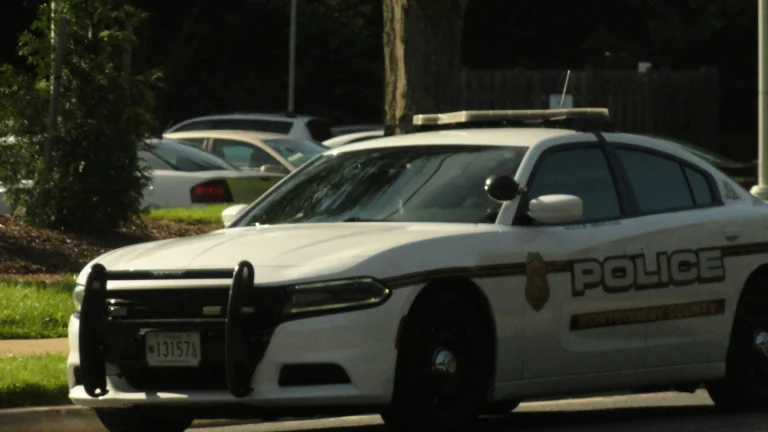
A routine speeding stop on a Florida highway turned into something Florida Highway Patrol troopers almost never see: a fleeing driver who stopped trying to simply outrun police and instead tried to use a police tactic against them.
A Traffic Stop That Went Sideways Immediately
Dashcam footage shows a trooper clocking a Chevrolet Silverado at nearly 98 mph in a 55 mph zone. Lights and sirens went on, and rather than slow down, the driver accelerated, weaving through traffic as a second patrol car moved in to help box in the truck.
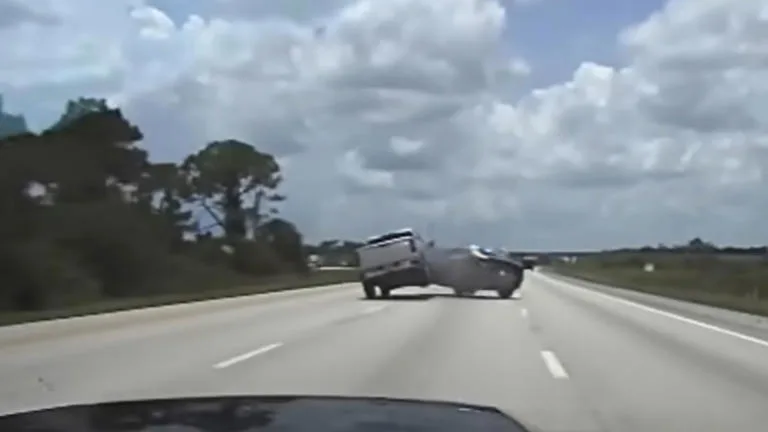
That’s when the pursuit took an unusual turn. Instead of just running, the Silverado driver began making sharp lateral jabs toward the cruisers, sideswiping one patrol car hard enough to mangle its push bar. Moments later, he steered directly into the rear quarter panel of the pursuing Charger — the same contact point officers use to execute a Precision Immobilization Technique, or PIT maneuver, to end a chase safely. This time it was aimed the other way, and it worked: the patrol car, not the truck, spun out.
A Reversal That Didn’t Last
Turning a police tactic back on the police is rare enough to stop most pursuits in their tracks, at least for a moment. But it came at an immediate cost to the truck itself. The Silverado sustained major damage in the collision, and footage shows the passenger-side front wheel tearing completely off on impact.
The driver kept going anyway. Sparks poured out from underneath the truck as bare metal dragged across the pavement at highway speed — a sign of a broken suspension and a damaged axle, the kind of mechanical failure that typically ends in a catastrophic crash or a fire. He still didn’t stop.
It finally ended when an unmarked Dodge Charger joined the chase, slotted in behind the crippled pickup, and executed a clean, properly aimed PIT strike to the rear quarter panel. The Silverado spun to a stop, and officers took the driver into custody. Despite the earlier spin-out, the trooper involved wasn’t seriously hurt — a better outcome than the speeds and vehicle weights involved might suggest.
Why Ramming A Cruiser Is A Losing Bet
A full-size pickup like a Silverado significantly outweighs a patrol sedan, which is exactly why a driver attempting to ram a cruiser at speed is playing with far more risk than they’re likely accounting for in the moment. High-speed pursuits already carry enormous momentum, and a small steering input at those speeds can send any vehicle into an uncontrollable spin. Add a driver deliberately initiating contact, and the physics stack against everyone on the road, not just the two vehicles involved.
Once the truck lost a wheel, the driver was operating a vehicle with compromised steering and a damaged axle at highway speed — conditions that make a rollover or a fire far more likely with each additional mile. That single decision to keep driving after losing a wheel arguably created more danger than the ramming attempt itself.
What Investigators Found Afterward
A search of the truck after the arrest turned up empty liquor bottles and used marijuana products. Toxicology results weren’t immediately available, but investigators suspect impairment played a role in the driver’s decision-making throughout the chase. Combined with a documented attempt to ram law enforcement vehicles, that detail is likely to weigh heavily if the case moves toward more serious charges beyond the underlying speeding and fleeing violations.
The moment where the truck flipped the script on pursuing officers made for dramatic footage, but the ending was the same as almost every pursuit like it: the suspect in cuffs, a wrecked vehicle, and a reminder that treating a multi-ton truck as a weapon on a public highway leaves almost no margin for error.
About the Author