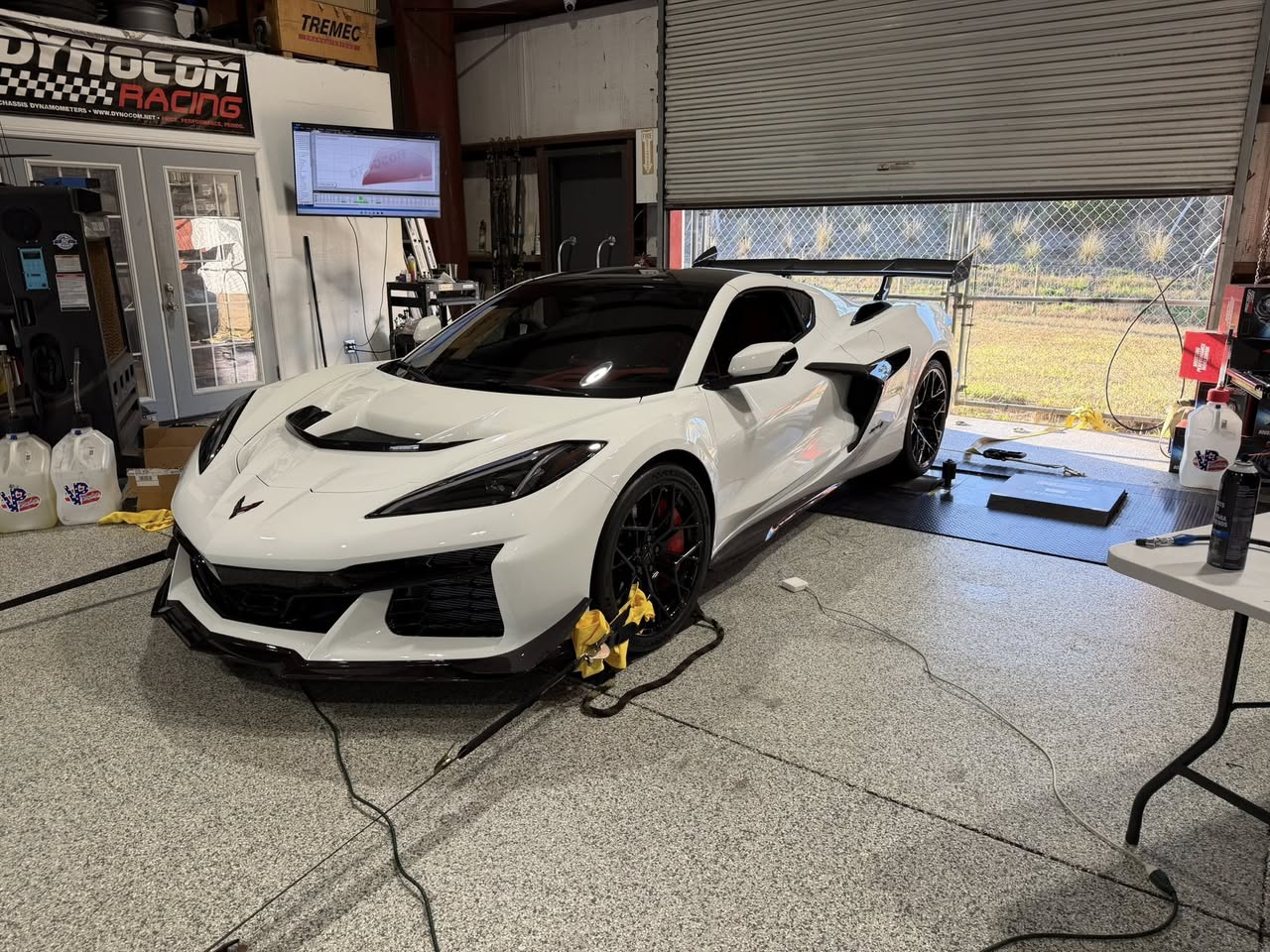
The Chevrolet Corvette C8 ZR1 was already one of the most dominant performance cars sold in America, holding official track records at five U.S. circuits and topping Car and Driver’s 2026 Lightning Lap. Now it’s set a new benchmark on the dyno: after HP Tuners unlocked the car’s ECU, Cleetus McFarland ran it through recalibration and pulled 1,180 horsepower and 1,094 lb-ft of torque at the wheels, without opening the engine.
How McFarland Got There Without Touching the Bottom End
The gains came entirely from calibration and supporting hardware, not internal engine work. Revised tuning, upgraded downpipes, and MS109 race fuel were enough to let the ZR1’s factory turbochargers run more efficiently, especially once the higher-octane fuel allowed for more aggressive ignition timing. That combination took a car rated at 1,064 horsepower from the factory up to 1,180 at the wheels, and since wheel horsepower already accounts for drivetrain loss, the actual crank output is higher still.
Keep in mind this is a car that can be ordered from a Chevrolet dealer with a factory warranty still attached. Seeing a showroom-stock ZR1 clear four-digit wheel horsepower on nothing more than a tune, downpipes, and race gas says a lot about how far factory forced induction has come.
Why an Official ECU Unlock Is the Bigger Story
The dyno number is the headline, but the more significant development is that this tune was possible at all through sanctioned channels. HP Tuners’ official ECU unlock support means shops and tuners no longer have to reverse-engineer an encrypted system to make changes, they can work within a defined, supported framework instead. That shift reduces risk and uncertainty for owners chasing calibration changes and signals a broader move toward manufacturers and aftermarket tuners coexisting rather than playing cat-and-mouse over ECU security.
That said, easier access doesn’t mean consequence-free access. Pushing boost and power up through calibration changes still carries real mechanical and financial stakes, since those decisions directly affect engine longevity, driveline stress, and long-term reliability. The hardware clearly has the headroom for this kind of output, but how well it holds up long-term still comes down to the choices made in the tuning software, not just what the parts are capable of on a single dyno pull.
What This Means Going Forward
With official unlock support now available, McFarland’s 1,180-horsepower pull is unlikely to be the last word on ZR1 tuning potential. The car in question is still fundamentally stock under the valve covers, the engine hasn’t been opened, and the entire jump from factory output to four-digit wheel horsepower came down to a calibration file, a set of downpipes, and race fuel. The C8 ZR1 was already a genuinely fast factory car. Now it’s clear it’s a programmable one too, and that changes what owners can reasonably expect to extract from it going forward.
About the Author