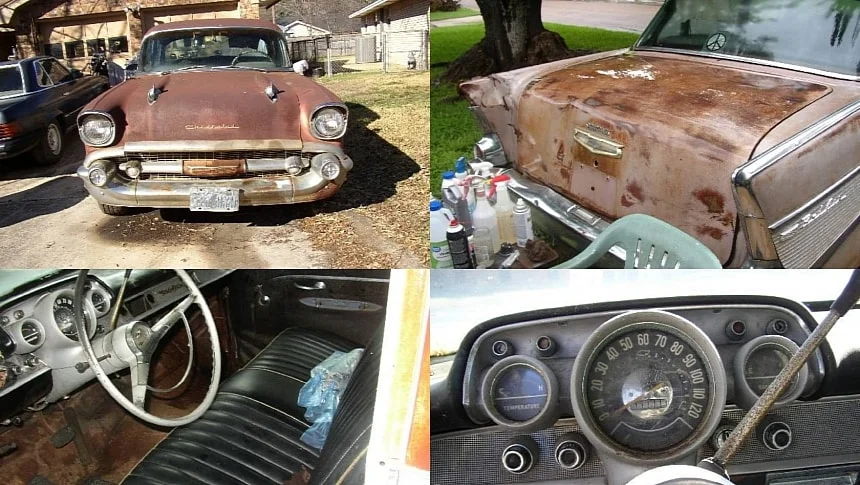
A 1957 Chevrolet Bel Air is hitting the market for just $4,500, but the story behind it is what stops you. This isn’t a flipper cashing in or a collector downsizing. This is an 87-year-old owner stepping away because he can no longer keep the car on the road, and that changes how you look at this sale immediately.
The Car Behind the Listing
The car sits in Temple, and it isn’t a polished showpiece. It’s a project that needs work before it can even think about returning to the road. The owner has made it clear why it’s being sold: age has caught up, and the kind of hands-on effort required to keep a classic like this alive is no longer possible. That detail matters more than any spec sheet.
The 1957 model year carries serious weight in Chevrolet history. It marked the final chapter of the Tri-Five era and a turning point where the brand leaned heavily into V8 performance, with the introduction of the 283 Turbo Fire engine helping define that moment and giving Chevrolet a reputation that still carries today. But this particular Bel Air doesn’t follow that headline path. It originally came with a 235 six-cylinder engine, a setup that was still available even as V8 power took center stage. That engine is no longer in the car — in its place sits a 1958 version of the 235, a slightly improved iteration with better efficiency and smoother low-end performance. That swap isn’t necessarily a negative; the later engine is considered more refined. But for buyers chasing originality, it means this car has already drifted away from factory-correct territory.
A Project With Gaps You Can’t Ignore
This Bel Air isn’t being sold as a turn-key driver, and the photos back that up. The metal appears solid at a glance, but there’s no clear picture of what’s hiding underneath, so anyone serious about buying it will need to get it on a lift and look closely. The interior tells a similar story — the seats are there and appear usable, but the cabin is incomplete. The radio is gone, the glove box back panel is missing, and the keys aren’t included. Those aren’t small details; they’re the kind of issues that turn a simple refresh into a deeper restoration project. At least some parts are included, with the trunk holding additional components like a radiator, fans, and a horn, which helps, but doesn’t erase the fact that this car needs time, effort, and money before it becomes something you can actually enjoy on the road.
What the $4,500 Price Actually Reflects
The price tag isn’t random. It reflects exactly what this car is and what it isn’t. Four-door Bel Airs have never carried the same demand as two-door models, and that gap only gets wider when the car isn’t in finished condition. Even in strong shape, four-door examples sit lower in the market, and adding in missing parts, unknown rust, and the need for restoration, the number starts to make sense quickly. The seller has made it clear the price is firm, a decision that signals this isn’t a listing built around negotiation games — it’s a straightforward attempt to pass the car on to someone willing to take over where the current owner cannot continue.
The Part That Hits Harder Than the Specs
It’s easy to focus on engines, trim levels, and production numbers, but this story lands somewhere else. An owner held onto this Bel Air long enough to see it become a true classic, and now, the reason it’s leaving his hands has nothing to do with market timing or profit. It comes down to a simple reality: he can no longer maintain it. That’s a side of car ownership that doesn’t get much attention. Enthusiasts love to talk about buying, restoring, and driving. They don’t talk as much about the point where keeping a car becomes physically impossible, and that’s exactly what’s happening here.
Why This Matters to Buyers
For the next owner, this is an opportunity with clear trade-offs. The entry price is low for a 1957 Bel Air, and that alone will attract attention, but the real cost sits in the work required to bring it back. Missing components, mechanical uncertainty, and the need for transport all stack up quickly. This isn’t a car you buy and drive home — it will need to be hauled, inspected, and rebuilt in stages, and anyone stepping in needs to be realistic about that, since the initial purchase is just the beginning. At the same time, there’s something appealing about taking on a car like this. It isn’t over-restored, and it hasn’t been stripped of its history. It’s a project in the truest sense, waiting for someone to decide what it becomes next.
The Bigger Picture Behind This Sale
This Bel Air reflects something happening across the classic car world. Cars are lasting longer, and owners are holding onto them for decades. Eventually, those owners reach a point where they can’t continue the work, and when that happens, projects like this re-enter the market, often unfinished and priced accordingly. That cycle is becoming more common, creating opportunities for new buyers while also raising questions about preservation: how many of these cars get completed, and how many stall again under new ownership?
The next chapter for this Bel Air depends entirely on who steps up. It could be restored carefully, brought back to life piece by piece, and returned to the road, or it could sit again, waiting for another owner with the time and resources to finish the job. That uncertainty is part of the deal. But the bigger takeaway sits outside the car itself. When an owner is forced to let go not because he wants to, but because he has to, it puts the entire idea of long-term ownership into perspective. For anyone looking at this $4,500 Bel Air, the real question isn’t just whether it’s worth the money. It’s whether they’re ready to take responsibility for a project someone else could no longer carry forward.
About the Author