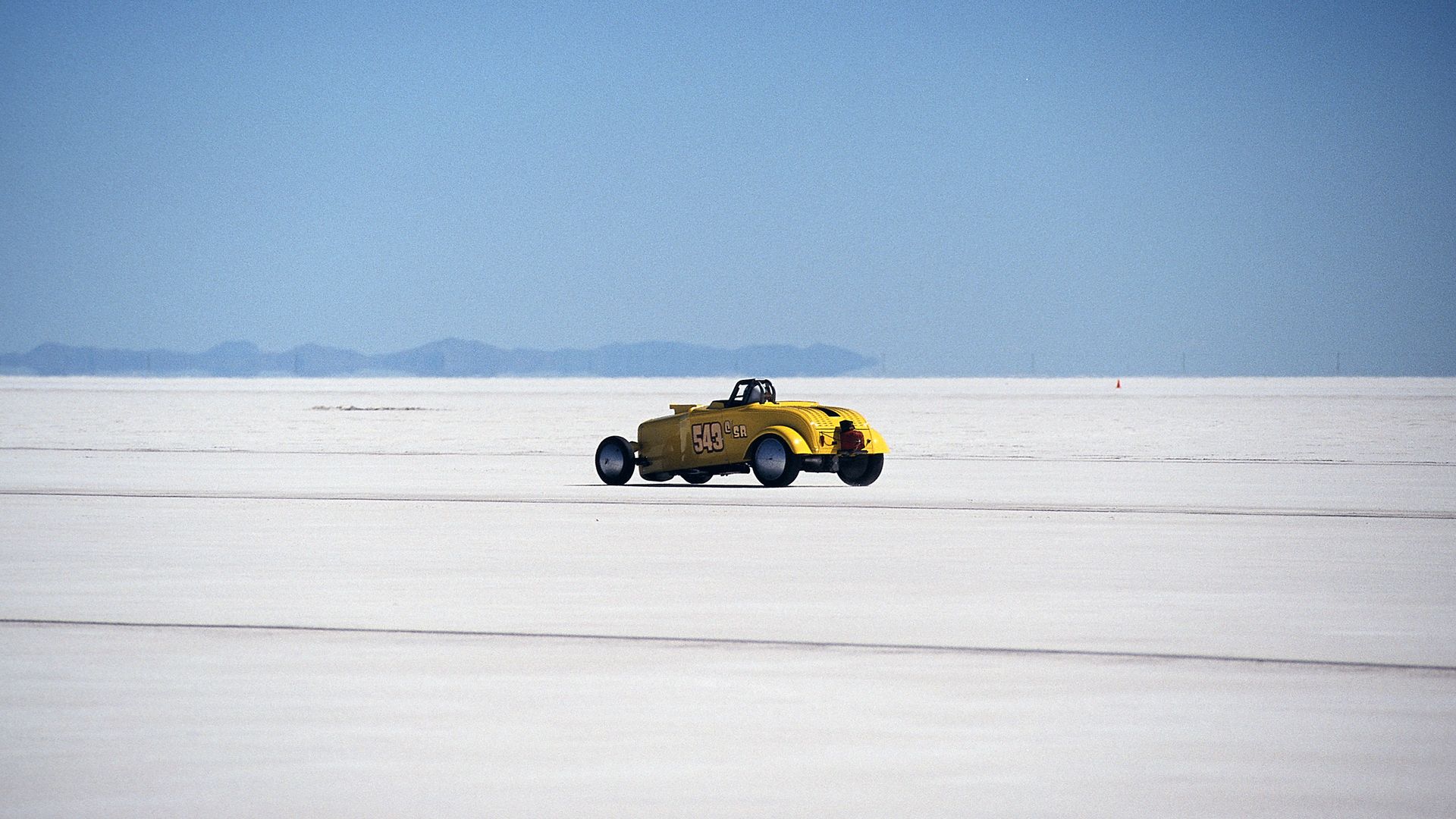
Photo by mysurrogateband on Pexels
One of the strangest record holders in American motorsports history is about to change hands. The Steamin’ Demon, the steam-powered streamliner that hit 145.607 mph at Bonneville in 1985 while losing a door and catching fire, is being sold at auction in mid-June with no reserve. The National Automobile Museum in Reno, Nevada, is letting it go as part of a sell-off of its inventory. If you’re interested in other classic American car collectibles going to auction, this historic steam car is far from the only exciting vehicle on the market. Here’s the part that matters for buyers: the Lear Vapor Generator and Vapor Turbine that made the car famous have been removed.
A Record Nobody Bothered to Break
To understand why this car matters, you have to go back to January 26, 1906. That day, Fred Marriott drove the Stanley Motor Carriage Company’s Rocket, a canoe-shaped machine three feet wide and sixteen feet long, to 127.659 mph on the sands of Ormond Beach, Florida. It was the outright land speed record for any car at the time, and it earned Stanley the Dewar Trophy.
Marriott came back the next year to beat his own mark. At an estimated 140 to 150 mph, the car hit a rut, went airborne and broke apart. Marriott survived but was badly injured and never raced again. The Stanley brothers walked away from competition for good. The steam record sat untouched for the better part of eight decades, not because it was unbeatable, but because nobody cared enough to try.
A Failed Bus Program Builds a Race Car
The Steamin’ Demon owes its existence to smog. In the late 1960s, concern over urban air pollution, particularly in the Los Angeles basin, pushed California regulators to look at alternative powertrains for transit. William Powell Lear, the founder of Lear Jet and developer of the 8-track cartridge, jumped in. He formed Lear Motors Corp. in 1968 and started building steam turbine engines at the old Stead Air Force Base outside Reno.
By 1972, Lear had a working Vapor Turbine system installed in a General Motors bus for testing by San Francisco’s Muni system under a federally sponsored program. A California steam-bus initiative from 1973 to 1974 put more demonstration vehicles in Los Angeles, Sacramento and San Diego. The steam systems ran quieter and cleaner than diesel, but they burned roughly twice the fuel, cost too much to build and were too complex for daily service. The program was shelved, and Lear moved on before his death in 1978.
That should have been the end of it. Instead, steam enthusiast Jim Crank bought the remaining Lear Motors inventory after the company went bankrupt, turbine included. In 1977 he bolted it all together using a fiberglass body with gullwing doors donated by kit car maker Fiberfab, a Volkswagen-based chassis and a Cadillac Eldorado transmission. The mission was simple: kill the Stanley record.
The Hardware Was Not Subtle
The numbers on this thing are absurd. The single-stage Lear turbine measured just 5.4 inches in diameter and spun between 20,000 and more than 60,000 rpm, with some accounts claiming peak efficiency required up to 85,000 rpm, producing 250 bhp at 65,000 rpm. A 20:1 reduction gear fed that to the Eldorado transmission and rear differential.
Steam came from a pancake-shaped Vapor Generator packed with 600 feet of finned tubing. It weighed around 600 pounds and could vaporize 5,500 pounds of water per hour using 56 gallons of kerosene, delivering steam at 1,200 psi and 1,100 degrees Fahrenheit. Total thermal output ran about 8.5 million BTU per hour, enough to heat a mid-sized office building. Because the car only needed to survive short record runs, Crank skipped condensers entirely and carried just ten minutes’ worth of water and kerosene.
The Run That Almost Fell Apart
Crank never got the speeds he needed, and in 1982 he sold the car to Robert E. Barber, co-founder of Barber-Nichols Engineering in Arvada, Colorado, a firm specializing in custom turbomachinery for aerospace, defense, cryogenic and energy work. Exactly the right resume for this machine. Three years of development followed.
On August 19, 1985, Barber drove the Steamin’ Demon to 145.607 mph at Bonneville, finally toppling a record that had stood 79 years. The run nearly came undone in real time. One gullwing door tore off at speed, costing an estimated 10 mph in added drag. Then the Vapor Generator caught fire and scorched the rear bodywork. The car crossed the timing traps anyway.
And that’s where it gets complicated. Guinness recognizes the run as the fastest non-FIA steam car record, but Barber made a single-direction pass. FIA rules, instituted in 1910, require two opposing runs within an hour. So the governing body never ratified it. Barber may have beaten the Stanley under the same conditions Marriott faced, but the rulebook had moved on. The official FIA steam record finally fell in August 2009, when the British car Inspiration ran 139.843 mph over a measured mile at Edwards Air Force Base, followed a day later by a 148.308 mph measured-kilometer run.
Battle Scars Included, Turbine Not
The museum has preserved the car exactly as it finished that 1985 run, scorched paint and missing door intact, which is exactly how it should be. But whoever wins the auction gets the body, the chassis and the history without the powertrain that made all of it possible. A no-reserve sale means this piece of land speed history goes to whoever shows up willing to pay. The question is whether the next owner treats it like the record holder it is, or just another fiberglass shell with a good story. For other rare and historic cars heading to auction, see our coverage of Carroll Shelby’s personal 1967 GT500.
Source: Silodrome
About the Author