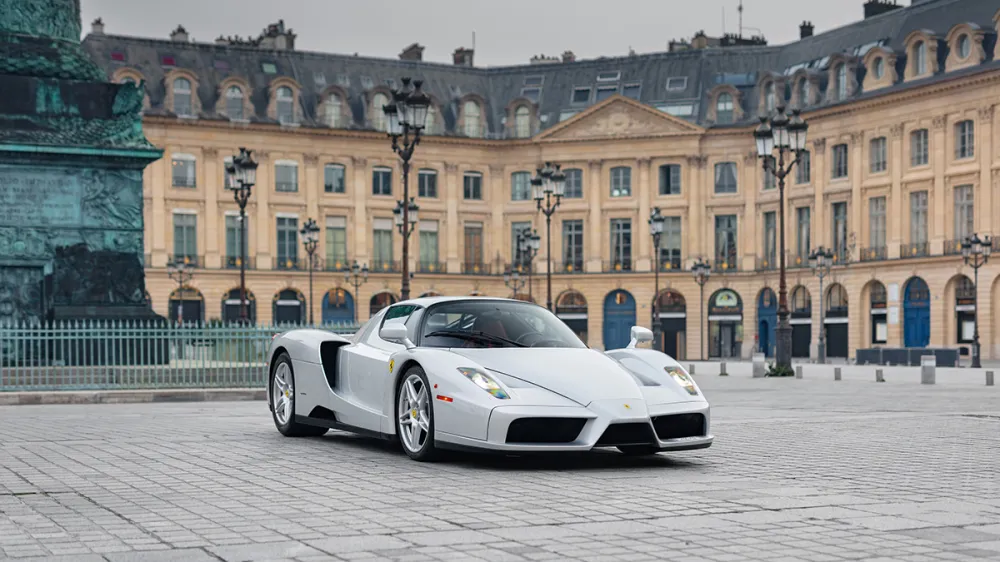
There are rare cars, and then there are cars like this. A Ferrari Enzo is already the kind of machine most people will never see in person, let alone own. But when one shows up in silver, not red, not yellow, not black, that’s when even seasoned collectors stop and pay attention.
Now one of those cars is about to change hands. And it won’t be quiet about it.
One of Only Nine Silver Enzos Ever Built
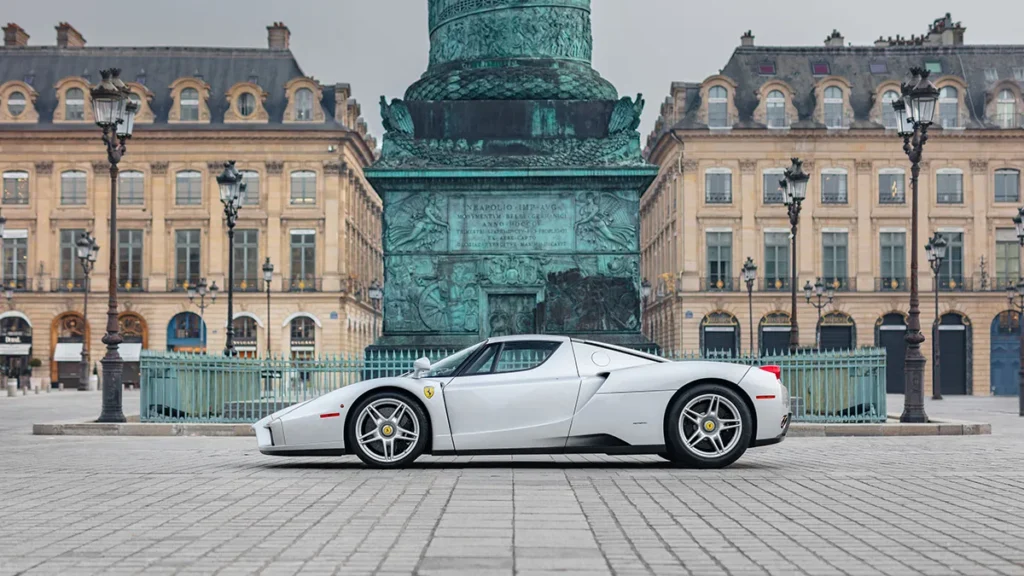
RM Sotheby’s is preparing to auction off an Argento Nürburgring Ferrari Enzo later this month in Monaco. That might sound like just another high-end sale, but it isn’t. Ferrari only built 399 Enzos for customers, and just nine of them left the factory in this specific silver finish. That alone puts this car in a completely different category.
Here’s the part that matters. This isn’t just one of nine. It’s the only silver Enzo that was originally delivered to the United Kingdom. That kind of detail might seem small to outsiders, but in the collector world, it changes everything. Provenance, origin, spec, it all stacks up, and this one checks some very specific boxes.
The Fourth Halo Car, and the Last of Its Kind
Step back for a second and look at what the Enzo actually represents. This wasn’t just another Ferrari when it launched. It was the fourth halo car in a lineage that includes the 288 GTO, F40, and F50. Each one pushed boundaries in its era, and the Enzo followed that same formula, just with early 2000s technology.
It also landed at a very specific moment in Ferrari history. This was before hybrids, before electrification started creeping into performance cars. The Enzo is raw in a way modern hypercars simply aren’t anymore. No battery assistance. No silent startup. Just a naturally aspirated V12 sitting right behind the driver.
And that’s where things change. Because today, cars like this don’t exist anymore. Ferrari’s current flagship makes nearly double the power and leans heavily on hybrid systems to get there. The Enzo doesn’t. It relies entirely on displacement, revs, and mechanical force. That alone makes it one of the last of its kind.
A 6.0-Liter V12 With No Electric Assistance
Under the rear deck sits a 6.0 liter V12 producing 650 horsepower and 485 lb ft of torque. Those numbers might not sound outrageous compared to today’s hypercars, but context matters. This car could hit 62 miles per hour in just 3.6 seconds and push all the way to 217 mph. And it did it without any kind of electrified boost.
Power goes through a Formula 1 inspired automated manual transmission, which was cutting edge at the time. It’s not smooth by modern standards, but that’s part of the appeal. It feels mechanical. Direct. A little aggressive, even.
The design follows the same philosophy. Pininfarina shaped the Enzo with clear inspiration from Formula 1 cars, giving it that sharp, almost jet-like appearance. It still looks futuristic today, which says a lot considering how quickly design trends usually age.
Chassis 37754: One of Just Five With Red Leather
But rarity is really what pushes this specific car into another tier. Ferrari gave Enzo buyers a limited palette. Most cars left the factory in Rosso Corsa, with a smaller number in yellow or black. Going outside that required extra effort and extra money. Only a handful of buyers went that route, and even fewer chose this particular shade of silver.
This example, chassis 37754, stands out even further once you look inside. It’s one of just five silver Enzos paired with red leather upholstery. That combination alone makes it incredibly distinct, especially in a car where most interiors leaned toward darker, more subdued finishes.
And thankfully, the cabin hasn’t been cluttered with modern distractions. No oversized screens. No layered menus. Just physical controls, exposed carbon fiber, and a layout that puts the driver at the center of everything. That’s part of the appeal people chase now. Not just speed, but simplicity. The feeling that you’re actually driving something, not managing software.
A $5.5 to $6 Million Estimate
Of course, none of this comes cheap. The car is scheduled to cross the auction block on April 25 as part of RM Sotheby’s Monaco sale, and expectations are already high. The estimate sits between $5.5 million and $6 million, which feels right given the rarity and specification.
And that’s where it gets complicated. Because with cars like this, the number isn’t just about performance or condition. It’s about how many exist, where they came from, and how often they actually become available. Nine silver Enzos. One delivered to the U.K. That’s the kind of math collectors pay attention to.
It also raises a bigger question about where the market is heading. Analog supercars from this era have been gaining momentum for years now. People are starting to look backward instead of forward, especially as new cars become more digital and less mechanical. That shift is part of why demand for cars like this keeps climbing. Whoever ends up with this car isn’t just buying a Ferrari. They’re buying a moment in time, a snapshot of what performance looked like before everything changed. Before hybrid systems, before software updates, before cars started doing half the work for you.
That’s why this matters. Because once cars like this disappear into collections, they rarely come back out. And when they do, the price usually tells the story.
Six million dollars might sound extreme. But for one of nine, with this kind of history and spec, it starts to make sense. Not practical. Not reasonable. But in this world, that was never the point.
Images via Kevin Van Campenhout/RM Sotheby’s
About the Author