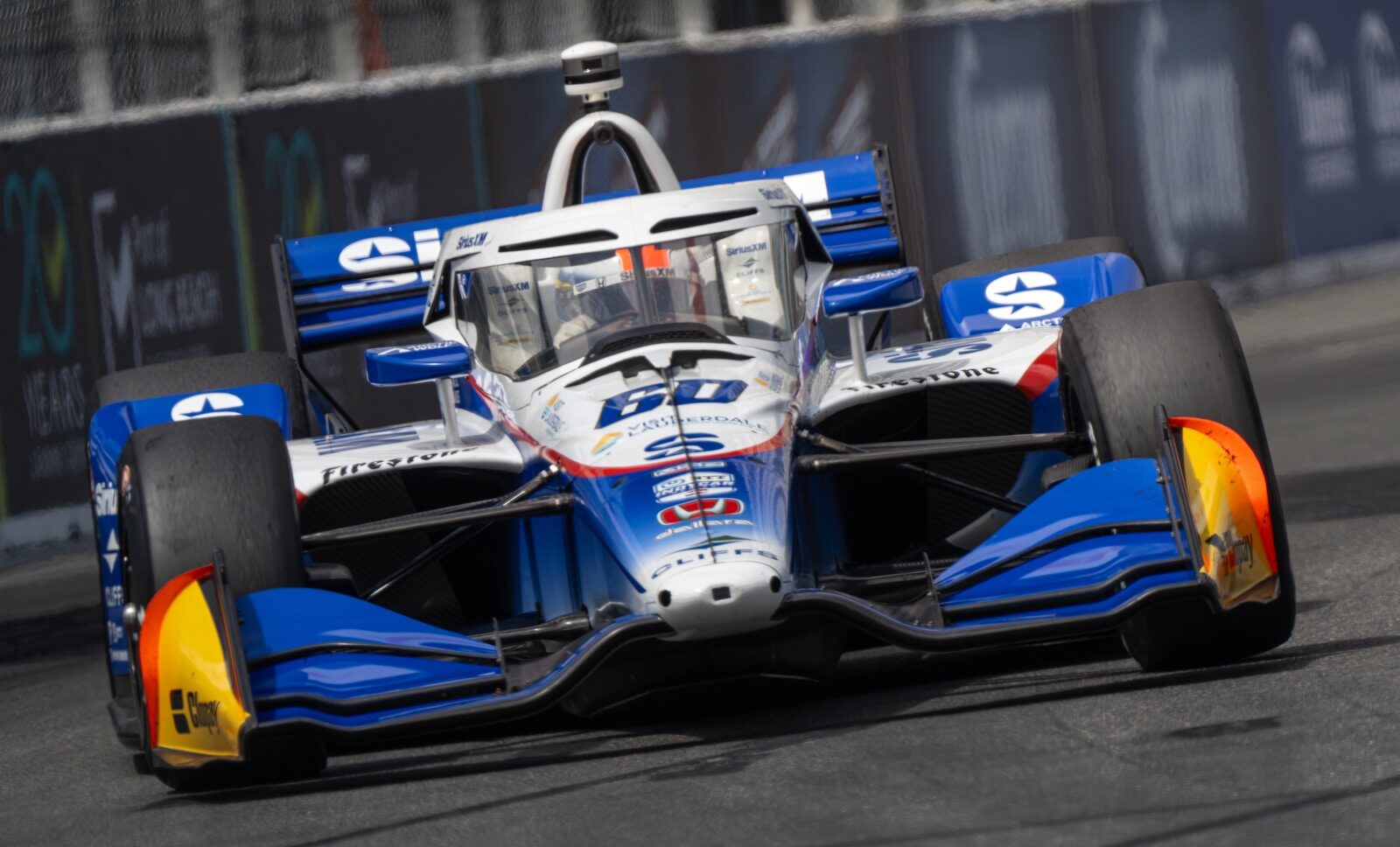
Fox bolted a camera to the observation level of the Washington Monument, hung another one off a 70-foot crane, and scattered roughly 90 cameras around the National Mall for what the network billed as the most ambitious live motorsports production it has ever attempted. The payoff arrived Tuesday: the Freedom 250 Grand Prix averaged 3,282,000 viewers, peaking at 3,482,000 between 2:30 and 2:45 p.m. ET. That is the largest audience any NTT INDYCAR SERIES race has pulled outside the Indianapolis 500 since Champ Car and the IRL finally stopped bleeding each other out in 2008.
Congratulations are in order. So is a second look at the arithmetic.
One race, twice the growth
Four days before the green flag, IndyCar published its season-to-date figure through 14 races: 1,731,000 viewers per race, up 16 percent on 2025 and 53 percent on NBC’s final season in 2024. After Washington, the same metric through 15 races reads 1,875,000 — up 32 percent and 70 percent respectively.
Read that again. A single Sunday doubled the series’ reported year-over-year growth rate. That isn’t a rising tide. That’s one wave hitting a shallow denominator.
Related Articles
- Ferrari Patents a Taillight That Doubles as a Spoiler
- Rivian Is Baking Waze’s Cop and Speed Camera Alerts Straight Into the Dashboard
The week before D.C., the inaugural Markham race in Ontario averaged 913,000 viewers. Washington drew roughly three and a half times that. And the season’s other headline number — Road America drew 1,803,000 in June — was manufactured by scheduling the race directly behind a World Cup group-stage match, which is a legitimate programming tactic and also a rented audience that went home when the tournament did. Through 10 races the season average sat at 2,033,000. Four races later it had fallen to 1,731,000.
So the honest summary is this: IndyCar has proven twice this year that it can borrow an enormous crowd. It has not yet proven it can keep one. The Milwaukee Mile doubleheader this Saturday and Sunday, with no soccer, no monuments, and no motorcade, is the actual test.
The race existed because of a permitting shortcut
Here’s the part most of the coverage skipped, and it’s the most instructive thing about the whole weekend.
The Freedom 250 was created by Executive Order 14381, signed January 30 and published in the Federal Register on February 4. Section 2 gave the Secretaries of the Interior and Transportation 14 days to designate a route. Section 3 is where the real machinery lives: it instructs Interior to consider treating the race as a “special event” under 36 C.F.R. 7.96(g) — the National Capital Region special-events regulation — as amended by a temporary America250 rule at 90 Fed. Reg. 25498. It directs Transportation to spend available funds facilitating the race. It tells the FAA to make room for permitted aerial photography over some of the most restricted airspace in the country.
And then there’s the line that should interest anyone who has ever hit a pothole on Constitution Avenue. The order requires Interior and Transportation, coordinating with the D.C. mayor’s office, to ensure any roads and bridges used in the course are “properly maintained and capable of being used in such a manner.”
Translation: the federal government had to certify that downtown Washington’s pavement could survive open-wheel cars at 180 mph. Street circuits punish surfaces in ways ordinary traffic never does. Ground-effect cars run ride heights measured in millimeters, so utility covers get welded or plated, expansion joints get ground flat, and crowned road profiles that shed rainwater perfectly well will pitch a race car’s aero platform into the wall. The Metropolitan Police Department’s traffic advisory shows the work in phases: overnight 8 p.m.–6 a.m. closures on individual course segments through the first two weeks of August, one street at a time — 9th, then 7th, then 3rd, then Pennsylvania Avenue three nights running, then Independence.
That’s a genuine, if temporary, gift to the District. Whoever drives 7th Street next month is driving fresher asphalt than they did in June.
What it cost the city that isn’t measured in Nielsen
The same advisory lays out the other side of the ledger. Emergency No Parking on 3rd and 7th Streets from July 12 through September 15. Fourth Street, Madison Drive, and Jefferson Drive closed from July 20 through September 3. Pennsylvania Avenue between 9th and 3rd shut to traffic from August 14 through August 26. Total lockdown from 3 a.m. Friday, August 21 until midnight Sunday.
Roughly two months of downtown disruption for a three-hour broadcast and a seven-turn circuit measuring 1.7 miles with a four-tenths-of-a-mile front straight down Pennsylvania Avenue. Two-day attendance came in at 215,000 with free general admission. Whether that math works is a question every city council flirting with a street race should be asking, because the D.C. version had a federal thumb on the scale that Nashville, Detroit, and Long Beach never got.
Why Fox cares more than a normal broadcaster would
Fox Corporation isn’t just selling ad inventory here. In July 2025 it acquired a one-third interest in Penske Entertainment — the parent of both IndyCar and Indianapolis Motor Speedway — alongside a multi-year media rights extension. When Fox spends money on a Washington Monument camera mount, it is spending it on an asset it partly owns.
Related Articles
- Yamaha’s 155cc Retro Standard Is Headed to American Dealers
- The MotoGP Movie Faces Problems No Racing Film Has Solved
That matters because of what’s coming. The IR-28 arrives in 2028: a clean-sheet chassis with a 2.4-liter twin-turbo V6 making up to 760 horsepower, an evolved low-voltage hybrid system about 20 pounds lighter than the current power unit, and — the interesting bit for anyone who has watched a modern open-wheel car try to follow another through a corner — an aerodynamic architecture designed from the start to manage its own wake and cut outwash. IndyCar says it’s the safest monocoque the series has built, with a wider cockpit and reworked side-impact structures.
New cars are enormously expensive, and teams pay for them. A series with a 1.9-million-viewer average has a very different conversation with sponsors than a series with a 1.4-million-viewer average. Sunday’s number, outlier or not, gets waved around in every one of those meetings between now and 2028.
The race itself, briefly
Kyle Kirkwood led 128 of 147 laps from second on the grid and won by 3.0906 seconds in the No. 27 Sam’s Club Honda, a margin flattered by a late caution — he was up 16 seconds before the field bunched. Christian Lundgaard took second for Arrow McLaren, with Will Power and Marcus Ericsson third and fourth to give Andretti Global three of the top four.
The championship implication is the durable story. Alex Palou’s day fell apart in stages: a drive-through penalty on Lap 43 for clipping a wheel sitting in Mick Schumacher’s pit box, a slow stop, then a Turn 4 crash on Lap 123 traced to a toe link broken by earlier wall contact. He finished 20th. Kirkwood cut the gap from 133 points to 91 with three races left.
Historical context worth knowing before you get excited: since reunification in 2008, the biggest deficit anyone has overturned with four races remaining is 59 points, by Dario Franchitti in 2010. Kirkwood needs to beat that with one fewer race to work with.
Palou can still close it out at Milwaukee. If he does, the season’s most-watched non-500 race will have been the moment the title fight briefly looked alive — and Fox will have a very different set of numbers to explain in September.
About the Author