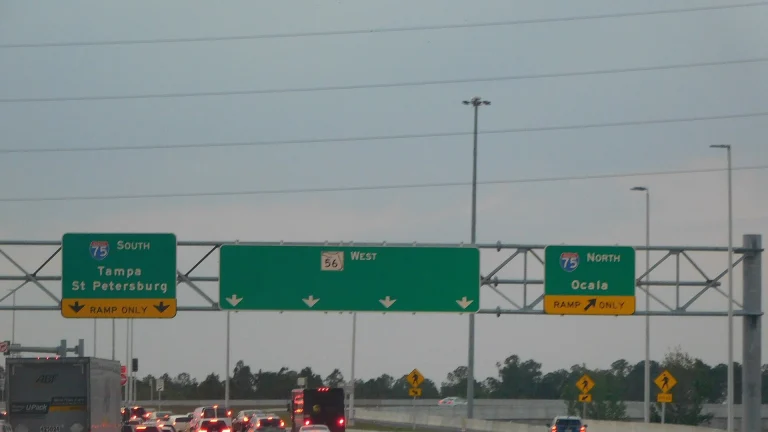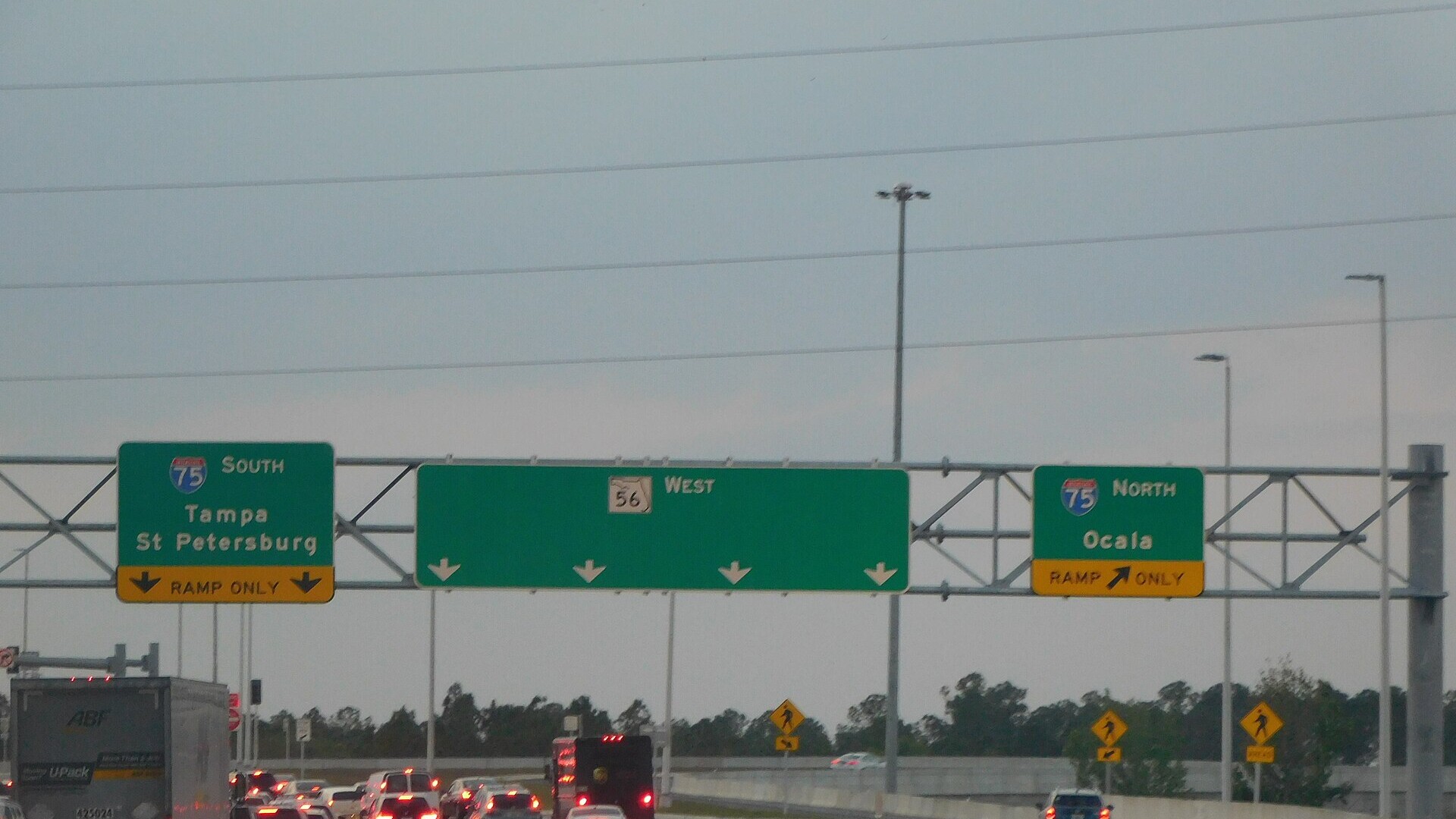
State Road 56 at I-75 in Wesley Chapel, near where the Corvette pursuit ended. File photo from 2023 (eastbound view). Photo: Markkos1992 via Wikimedia Commons, CC BY-SA 4.0.
Florida law already classifies the black Corvette that troopers say left Interstate 275 at about 130 mph near Wesley Chapel. Under section 316.1935(7) of the state’s fleeing statute, any vehicle used in a fleeing violation “is deemed to be contraband,” and law enforcement may seize it for forfeiture.
The Florida Highway Patrol arrested Yaseen Algmaiee, 19, of Zephyrhills shortly after midnight on Sunday, Oct. 11, on charges of aggravated fleeing to elude and leaving the scene of a crash involving property damage. Those charges come from his FHP arrest affidavit as reported by WTVT and WFTS, and Miami’s WSVN carried the same charges a day later. He is presumed innocent. We laid out the pursuit itself, from mile marker 47 to the PIT on State Road 56, on Oct. 16.
Nothing released since then says whether FHP kept the Corvette, whose name is on its title or what model year it is. Under Florida’s forfeiture law, the title question decides whether the state can keep the car at all.
Whose name is on the title
The Florida Contraband Forfeiture Act allows a seizure only if the owner is arrested for the crime that makes the property contraband, according to section 932.703(1)(a). If Algmaiee holds the title, his arrest satisfies that.
If someone else holds it, the state has to show that owner had “actual knowledge of the criminal activity.” The statute names one way to prove that: a written notice from police, acknowledged in writing by the owner, that the same driver had used the same car in a forfeiture-eligible violation before. Short of that, a parent or relative who handed over the keys keeps the car unless the agency can show they knew.
Financed and leased cars get their own carve-outs. A bona fide lienholder, such as the bank holding a car loan, gets its own knowledge test, and a leased vehicle can’t be forfeited unless the agency shows the lessor had actual knowledge when it leased the car.

The deadlines after a seizure
If FHP did hold the car, section 932.703 puts the agency on a clock:
- Within 5 working days of the seizure, notice by certified mail to the owner of the right to an adversarial preliminary hearing.
- Within 10 business days, an application to a court for a probable-cause finding.
- Within 15 days of receiving the notice, the owner can request the hearing in writing, and it must be held within 10 days of the request or as soon as practicable.
- Within 45 days of the seizure (60 with a judge’s extension for good cause), forfeiture proceedings must begin, or the owner can sue to get the car back.
What the state has to prove
The forfeiture case runs separately from the criminal one, and the procedure section, 932.704, contains no requirement that Algmaiee be convicted first. It borrows the criminal standard instead. A jury decides unless the claimant waives it, and the agency has to prove beyond a reasonable doubt that the car was used in the violation.
Filing costs the agency too. It pays at least $1,000 to file the complaint and posts a $1,500 bond that goes to the claimant if the claimant wins. If a judge finds no probable cause at the preliminary hearing, the owner can recover up to $2,000 in attorney’s fees and costs.
A forfeited car doesn’t always disappear quietly. Louisville police seized a Charger at a 2024 street takeover and are feeding it to a monster truck two years later.
If FHP took the Corvette at the arrest, its 10-business-day window to ask a judge for a probable-cause finding closes around the end of this week. That filing, if there is one, would be the first court record showing whether the state is going after the car.
Should Florida be able to keep a car used to run from troopers at 130 mph even when the driver doesn’t own it?
Sources: Florida Highway Patrol arrest affidavit as reported by WTVT, WFTS and WSVN; Florida Statutes 316.1935, 932.703 and 932.704.
Lead image: Markkos1992 via Wikimedia Commons, CC BY-SA 4.0
About the Author