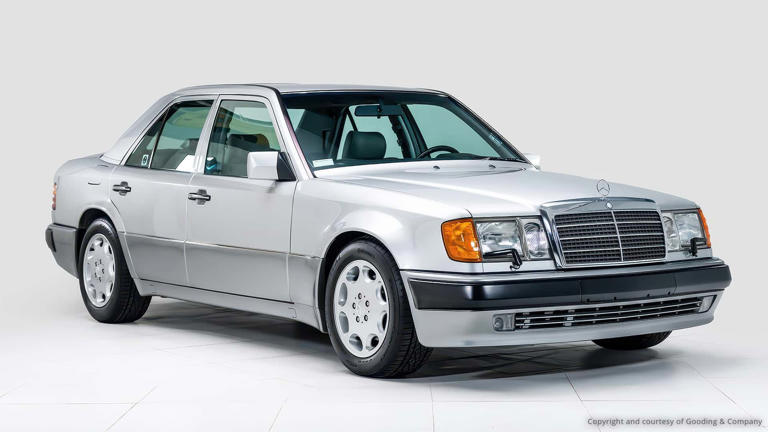
A four-door Mercedes-Benz sedan just sold for $357,000, and it’s forcing collectors to rethink everything they thought they knew about the market. The car isn’t a rare Ferrari or a one-off hypercar. It’s a 1992 Mercedes-Benz 500E that once belonged to Jerry Seinfeld—and the price it commanded has instantly reset expectations for the model.
The sale took place at the 2026 Amelia Island Auctions, where bidding escalated quickly and decisively. What started as a high-value estimate turned into a full-blown auction fight, ending in a number that didn’t just beat the record for the model—it obliterated it.
The Car at the Center of the Storm
At its core, the Mercedes-Benz 500E is already a respected performance sedan. Built on the W124 platform, it was designed to deliver serious performance without the flash typically associated with high-end sports cars. Under the hood sits a 5.0-liter M119 V8 producing about 326 horsepower, paired with a four-speed automatic sending power to the rear wheels.
For its time, that combination delivered impressive performance. It offered speed and composure in a package that looked more like an executive commuter than a performance machine. That understated approach is exactly why enthusiasts have long referred to it as a “wolf in sheep’s clothing.”
But this specific example takes things further. Originally delivered in 1992, it shows just 2,335 miles on the odometer. That level of preservation effectively turns the car into a time capsule, something collectors aggressively pursue in today’s market.
The Porsche Connection That Changed Everything
Part of what makes the 500E so significant is how it was built. Mercedes didn’t handle the entire process alone. Instead, it partnered with Porsche to bring the car to life, a move that still stands out as one of the more unusual collaborations in automotive history.
The widened body and final assembly were completed at Porsche’s Zuffenhausen facility because the standard Mercedes production lines couldn’t accommodate the design. That alone elevates the car beyond a typical sedan and into something far more specialized.
The result was a hand-finished machine with subtle but meaningful upgrades. Flared fenders, a wider stance, and revised suspension gave it the performance credentials to match its engine, while still maintaining a clean, understated appearance.
Why This One Sold for So Much
Even before the auction, expectations were high. Estimates placed the car between $176,000 and $228,000, already well above what most examples bring. But once bidding began, it became clear this wasn’t going to be a typical sale.
Two factors drove the price into uncharted territory. The first is condition. Ultra-low-mileage examples of the 500E are incredibly rare, and collectors place enormous value on originality. This car still wears its original Brilliant Silver Metallic paint and light gray leather interior, along with its factory documentation and keys.
The second factor is ownership history. Jerry Seinfeld isn’t just any celebrity. He’s widely recognized as one of the most knowledgeable and selective car collectors in the world. That reputation adds credibility and desirability to anything that passes through his collection.
Put those together, and the result was inevitable. A bidding war pushed the final number to approximately $357,000, setting a new benchmark for the model.
The Numbers That Don’t Add Up—Until They Do
To understand how dramatic this sale is, you have to look at the broader market. The average Mercedes-Benz 500E typically trades around $47,000. The previous auction record sat at about $100,800.
This sale didn’t just edge past those figures—it multiplied them. That kind of jump raises eyebrows, especially among enthusiasts who remember when cars like this were considered attainable performance sedans.
But the market has shifted. Collectors are increasingly chasing originality, low mileage, and documented ownership history. When all three align, prices can move fast and aggressively.
What This Means for Enthusiasts
For everyday enthusiasts, this sale sends a mixed message. On one hand, it’s validation. Cars like the 500E are finally getting the recognition they deserve as engineering milestones. They represent a time when automakers built performance cars with a focus on durability, usability, and driver engagement.
On the other hand, it highlights a growing divide. As prices climb, cars that were once within reach are becoming collector assets. That shift changes how these vehicles are used and who gets to experience them.
The 500E was designed as a car you could drive daily while still enjoying serious performance. Sales like this suggest that more examples will end up preserved rather than driven, locked away as investments instead of being enjoyed on the road.
The Bigger Trend Behind the Sale
This isn’t just about one Mercedes. It’s part of a broader trend where 1990s performance cars are gaining serious traction in the collector market. Vehicles from this era are increasingly viewed as the last of a certain kind—mechanical, analog, and built without the layers of technology that define modern cars.
The 500E fits perfectly into that narrative. It combines performance, practicality, and craftsmanship in a way that feels increasingly rare. Add in the Porsche collaboration, and it becomes something even more special.
Collectors are recognizing that, and they’re willing to pay for it.
Who Really Wins Here
The winner of the auction walks away with more than just a car. They now own a benchmark example of one of the most important performance sedans ever built, with a provenance that adds another layer of significance.
But the ripple effects extend further. Sellers of similar cars now have a new data point, one that could push asking prices higher across the board. Auction houses benefit from the attention and the headline-grabbing result.
Meanwhile, enthusiasts are left watching as values climb, knowing that cars like this are moving further out of reach.
The Real Question Moving Forward
This sale raises a bigger question about where the market is heading. If a Mercedes sedan can command $357,000 under the right conditions, what happens next?
Because this wasn’t just about a celebrity-owned car or low mileage. It was about timing, perception, and a market that’s increasingly willing to reward rarity and history over everything else.
And if that trend continues, the real story won’t be about one record-breaking sale. It will be about how quickly the definition of an “attainable enthusiast car” disappears altogether.
About the Author