The Jeep Grand Cherokee Trailhawk is making a comeback for 2027, and for a lot of off-road enthusiasts, that may be the most important update in the entire lineup. After Jeep revealed the refreshed Grand Cherokee range earlier this year without one of its most recognizable trims, many buyers noticed the absence immediately. It did not take long for Jeep to hint that something was coming.
Now the company has confirmed it. The Trailhawk is back. So is the luxury-focused Overland. Both return with significant changes under the hood, and the Trailhawk in particular looks positioned to appeal to buyers who wanted capability without the complexity of the outgoing plug-in hybrid setup.
That matters because the previous Trailhawk relied on Jeep’s 4xe powertrain, which is no longer part of the package. For 2027, Jeep has taken a different approach.
The Trailhawk Gets A New Heart
The biggest change is what powers the vehicle.
The returning Trailhawk now uses Jeep’s Hurricane Evo 2.0-liter turbocharged engine. The same powerplant has become standard across most of the Grand Cherokee lineup, excluding the base model. Output stands at 324 horsepower and 332 lb-ft of torque.
On paper, that’s less power than the outgoing Trailhawk’s discontinued 4xe plug-in hybrid system. However, horsepower numbers only tell part of the story. The loss of the hybrid hardware means the new Trailhawk should be noticeably lighter than the version it replaces.
For many buyers, that could be a worthwhile tradeoff. Less weight often translates to improved responsiveness and a simpler ownership experience. Jeep has not abandoned utility either. The Trailhawk still offers a towing capacity of 6,200 pounds when equipped with the standard Trailer Tow package.
Here’s the part that matters. Jeep did not water down the Trailhawk’s off-road credentials while making these changes.
Jeep Kept The Hardware That Made Trailhawk Popular
The Trailhawk remains the most serious off-road version of the Grand Cherokee lineup.
Jeep continues to equip it with a dedicated four-wheel-drive system and an air suspension setup designed to improve capability in challenging terrain. Together, those systems provide up to 11.4 inches of ground clearance, which Jeep says remains a class-leading figure.
The numbers continue to impress. Approach angle comes in at 36 degrees, breakover angle reaches 24.4 degrees, and departure angle measures 30.3 degrees. All three figures place the Trailhawk at the front of the segment.
A dedicated Rock driving mode also returns, giving drivers additional low-speed control when navigating difficult obstacles. Jeep pairs that capability with unique 18-inch wheels wrapped in 30.5-inch Goodyear all-terrain tires. A rear electronic limited-slip differential comes standard as well.
The hardware underneath may be even more important than what buyers can see. Six steel skid plates protect critical components including the transmission and transfer case, giving drivers more confidence when venturing beyond pavement.
The Styling Makes Its Intentions Clear
Nobody is going to mistake the Trailhawk for a suburban commuter special.
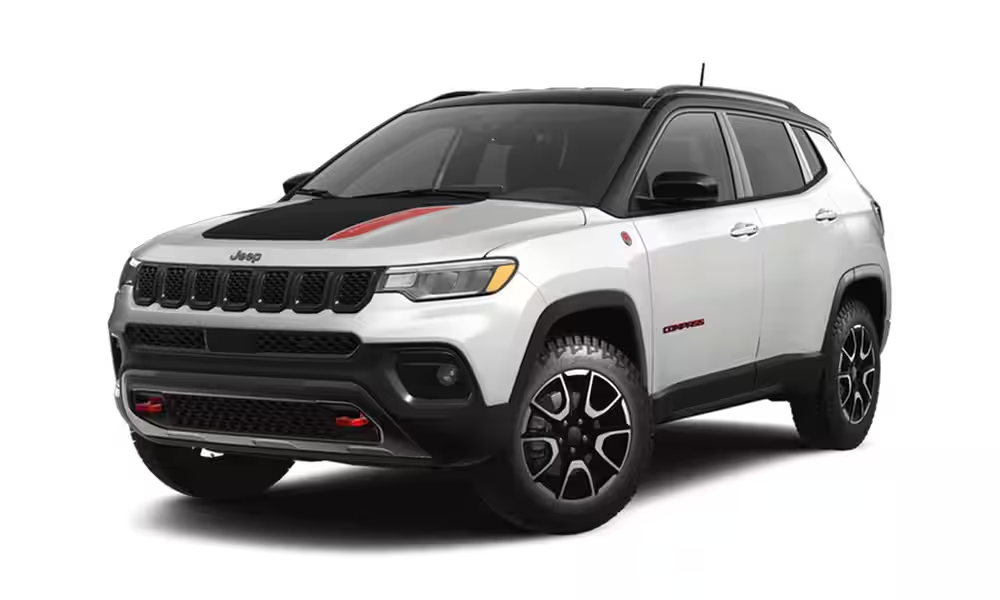
The model receives a unique lower front bumper designed specifically for off-road use. Jeep’s familiar red accents appear throughout the exterior, including the front and rear tow hooks as well as the badging.
A matte black hood decal is included to help reduce glare. Trail Rated badging remains part of the package, reinforcing the model’s focus on capability rather than appearance alone.
Inside, Jeep sticks with black Nappa leather seats accented by red details. Drivers also benefit from updates introduced across the refreshed Grand Cherokee range, including the larger 12.3-inch infotainment display.
The system includes Jeep’s Off-Road Pages feature, providing terrain-focused information that can be useful when navigating challenging trails.
The Overland Returns For Buyers Who Want Luxury
Not every Grand Cherokee customer wants to spend weekends crawling over rocks.
That’s where the Overland comes in.
While it borrows several features from the Trailhawk, the Overland is aimed at buyers looking for a more premium driving experience. It shares the unique front fascia and adjustable air suspension, though the styling is toned down with silver tow hooks replacing the Trailhawk’s red accents.
The Overland also receives semi-active damping and distinctive 21-inch machine-faced wheels. Exterior trim elements feature what Jeep calls a Silver Silk finish, while the roof remains body colored.
The cabin receives additional luxury touches. Heated and ventilated front seats come standard, and the Nappa leather upholstery features Overland branding embossed into the headrests.
Technology remains a priority as well. Along with the Off-Road Pages system, buyers receive a standard 360-degree camera setup complete with a washer system.
Why This Matters For Grand Cherokee Buyers
When the updated 2026 Grand Cherokee debuted earlier this year, the improvements were useful but not revolutionary. The missing Trailhawk left a noticeable hole in the lineup.
That gap is exactly what the returning Trailhawk fills.
The return of the Trailhawk gives Jeep a genuine flagship for buyers who care about off-road performance. More importantly, it does so without relying on the discontinued 4xe setup that previously defined the trim.
For enthusiasts, that could make the formula more appealing. The vehicle still delivers class-leading ground clearance, strong off-road geometry, dedicated hardware, and respectable towing capability. At the same time, it adopts a simpler turbocharged powertrain shared with much of the rest of the lineup.
The Overland’s return also fills an important gap. Buyers seeking premium features without stepping all the way up to the Summit once again have an option.
Pricing remains one of the biggest unanswered questions. Jeep says details will arrive closer to launch later this year. The last gas-powered Overland sat below the Summit in the pricing hierarchy, while the outgoing Trailhawk started near $70,000 because it included the 4xe powertrain.
If the new Trailhawk arrives with a lower price point while retaining its impressive capability figures, it could end up being one of the most compelling Grand Cherokee variants in years. For Jeep, bringing back these familiar nameplates is more than a nostalgia play. It’s an acknowledgment that buyers still want capable SUVs with clear identities, especially when those identities are backed up by real hardware instead of marketing slogans.
Source
Images Via: Jeep
About the Author