Most people look at a rusty, wrecked 1971 Datsun 240Z and see a restoration project. Something to bring back, clean up, keep original. That’s the safe route. That’s also the predictable one. This build didn’t go that way.
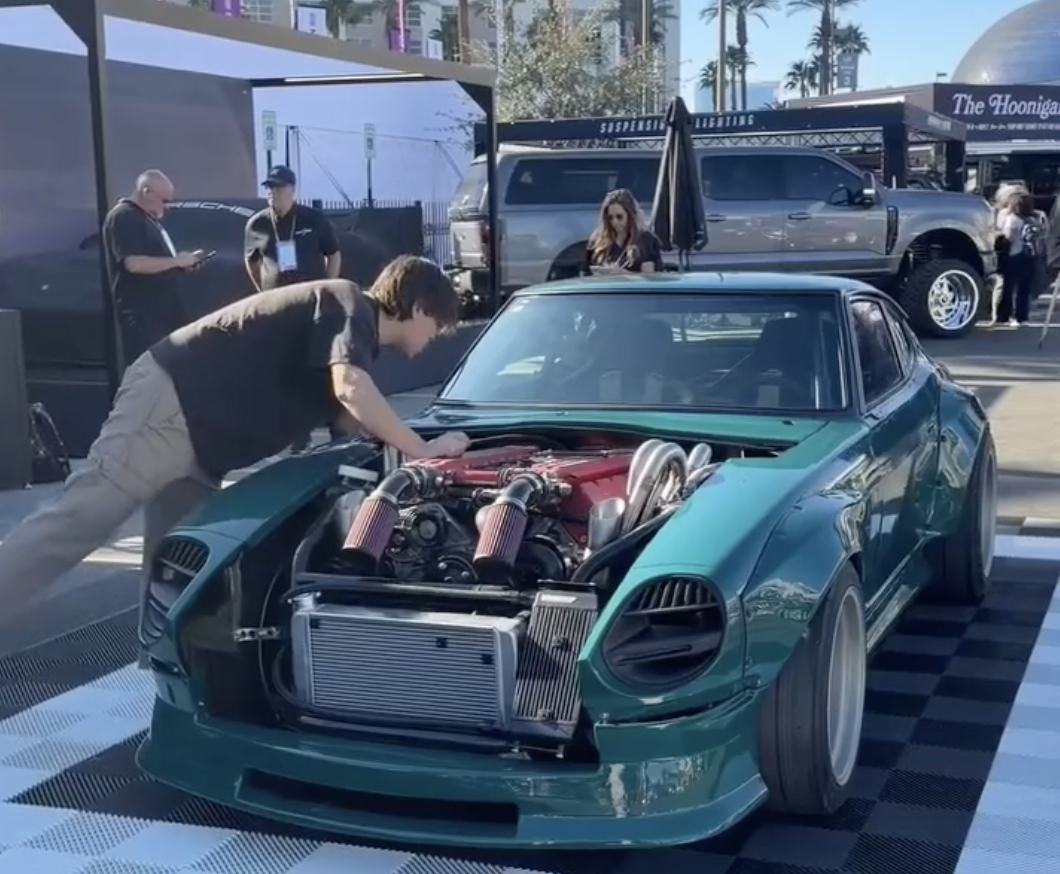
Instead, someone looked at that same shell and decided it needed an 8.0 liter Dodge Viper V10 shoved into it. Not adapted. Not gently fitted. Stuffed in. And the result is exactly what you’d expect when you mix one of the cleanest Japanese sports car designs ever made with one of the most aggressive American engines ever built. It’s chaos. Controlled, impressive chaos.
@bradbuilds_ 60 Days Later 🙂 #viper #datsun #engineswap #nissanz ♬ original sound – BradBuilds
The car started life as a salvage-title chassis pulled from Copart. The front end was destroyed, rust had taken hold, and it sat for years before anything serious happened. The owner, known as Brad Builds, spent a long stretch just getting the shell back into usable condition. Fixing rust, straightening things out, making it structurally sound again. That part alone could have been the whole story. But it wasn’t.
At some point, the direction changed. Restoration was out. Restomod was in. And not a mild one either. The goal became building what he described as the craziest 240Z possible. Here’s where things really shift.
@bradbuilds_ How-To 3d scan and produce custom car parts using a 3DeVOK MT #3dprinting #projectcar #datsun #240z #howto ♬ original sound – BradBuilds
Instead of hunting for a period-correct inline-six or something subtle, he went looking for the biggest engine he could realistically fit. That search ended with a second-generation Dodge Viper V10, pulled from an early 2000s car. He found it online, drove 15 hours from Texas to Alabama to get it, and brought it back knowing full well it was going to be a problem to install.
And it was.
Getting that V10 into the tight engine bay of a 240Z wasn’t a simple swap. It required serious fabrication. The engine had to go in from underneath the car. The firewall and transmission tunnel had to be cut and reshaped just to make space for the massive Viper transmission setup.
That’s where it gets complicated.
The build uses a Viper T-56 transmission, paired with a Ford Super 8.8 rear end and a modified Viper driveshaft. Nothing about that combination is small or easy to package. The steering system had to be reworked too, with the rack moved up and forward just to clear the oil pan. And even after all that, it still runs manual steering.
No shortcuts there.
Power-wise, the V10 delivers exactly what you’d expect. In stock form, it sits around 450 horsepower and 490 lb-ft of torque. With custom headers and a few changes, the estimate now lands somewhere between 400 and 500 horsepower. In a lightweight car like a 240Z, that’s more than enough to turn things into a handful.
And that’s the point.
@bradbuilds_ Interior Rundown on the Viper Datsun #v10 #datsun #engineswap ♬ original sound – BradBuilds
This wasn’t built to be easy to drive or comfortable. It was built to be extreme. A statement more than anything else. Something that forces people to stop and look, then try to figure out how it even works.
The car made its debut at SEMA 2025, and that part adds another layer to the story.
The entire build was pulled together in just 60 days. After years of sitting and slow progress, everything accelerated at once. Fabrication, assembly, problem solving, all happening under pressure. That kind of timeline usually leads to compromises, but here it pushed the build into something raw and immediate. Not perfect. Not overly polished. Just real.
What makes this even more interesting is how much of the work was done by Brad himself. He didn’t just oversee the project. He built it. Fabrication, roll cage, tubular front end, body design, even the headlights. Most of it came together in-house, with only a few pieces like the headers and wrap handled elsewhere. That hands-on approach shows in the details.
The headlights, for example, aren’t just for looks. They’re designed to channel air through the front and direct it toward the brakes. That’s not something you see on a casual build. It’s functional thinking layered into a project that already borders on excessive. Then there’s the overall design.
Despite everything going on underneath, the car still reads as a 240Z. The proportions are intact. The shape is recognizable. The wheels were chosen to keep a period-correct feel. Even the body kit avoids going too far, which is a rare move in builds like this. It could have easily turned into a caricature. It didn’t.
Right now, it’s still not fully finished. There’s no complete hood or grille, leaving the front end exposed. The engine, radiator, and oil cooler are all visible. The plan is to add a partial hood and a classic-style grille later, but keep enough of the V10 on display to remind everyone what’s hiding underneath. Because hiding it completely would miss the point. Then there’s the cost, which is where things get a little murky.
The builder hasn’t put a number on the total investment, and honestly, that makes sense. Projects like this don’t have clean budgets. Between the cost of the donor car, the engine, parts, tools, and countless hours of work, it adds up fast.
A typical 240Z might sit somewhere around the mid-$30,000 range depending on condition. A Viper V10 alone can run around $10,000. But those numbers barely scratch the surface here.
The real cost is in the time, the trial and error, and the willingness to push through problems most people would walk away from. That’s the bigger takeaway.
This car isn’t about resale value or market trends. It’s not trying to appeal to everyone. It exists because someone wanted to build something outrageous and followed through on it. And in a world full of polished builds that all start to look the same, that kind of approach stands out. Not because it’s perfect, but because it isn’t.
About the Author