There’s something oddly calming about watching a classic car get stripped down to nothing. Not torn apart, not wrecked, just slowly cleaned back to its raw form. And when the car in question is a 1972 DeTomaso Pantera, it hits a little different.
This wasn’t just any project car. It started as what appears to be a barn find, one of those forgotten machines that sat long enough to collect grime, wear, and a few mysteries. The Pantera itself has always been a bit of an oddball, part Italian exotic, part American muscle, and never fully fitting into either category. Even now, people don’t quite know where to place it, which is part of the appeal.
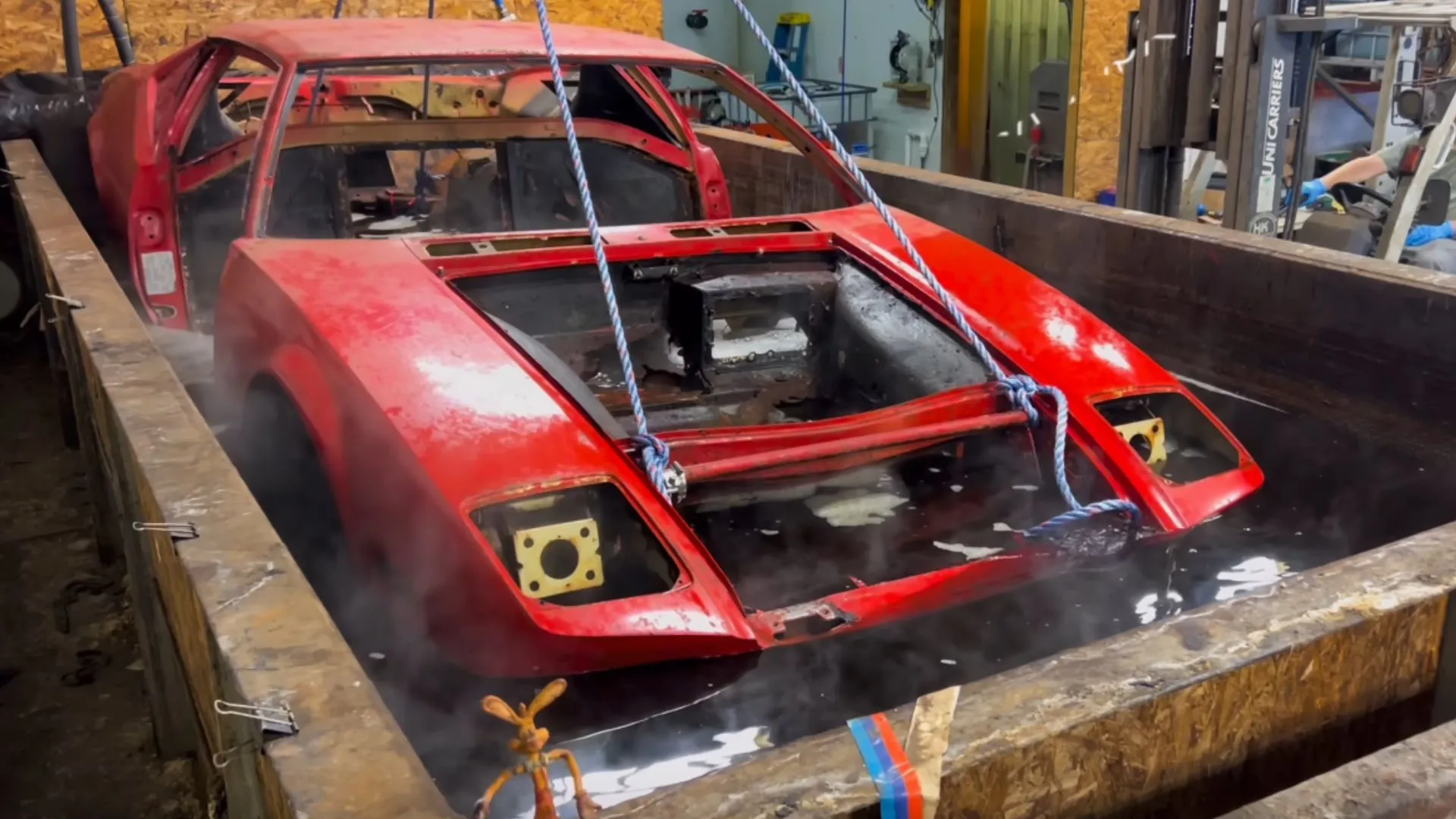
So instead of tearing into it piece by piece, the decision here was to go all in and drop the entire body into a chemical stripping process. That’s where things change.
The first step is an alkaline bath designed to remove paint. According to the process, the coating on this Pantera is believed to be original, which actually makes the job easier. Older paint tends to give up a little faster under chemical treatment, especially when it hasn’t been layered over multiple times.
At first glance, the car didn’t look terrible. A little worn, sure, but nothing shocking. That’s usually how these stories start. The real condition hides underneath.
After a few days soaking in the alkaline solution, the body comes out ready for pressure washing. And this is where it gets satisfying. Sheets of paint peel away under the force of water, exposing raw metal that hasn’t been seen in decades. It’s not perfect, not even close, but it’s honest. What you see is exactly what’s there.
Still, it’s not a one-and-done process.
The car goes back in for another round of alkaline dipping to chase down the remaining paint. That second pass clears out what the first couldn’t fully remove. By this point, the Pantera is starting to look less like a car you’d drive and more like a blank canvas waiting for answers.
Then comes the part that really matters.
The acid bath.
This is where everything left behind gets exposed, not just paint, but corrosion, scale, all the hidden damage that builds up over time. The body doesn’t just take a quick dip either. It goes through multiple rounds over about two weeks, with several immersions needed to fully strip away the rust.
And the results are a little shocking.
Areas that once looked solid start telling a different story. The front trunk section, for example, comes out looking like it’s been punched full of holes. Rust had eaten through sections of the metal, leaving behind what can only be described as a patchwork of gaps. But here’s the strange part. Even though the metal is clearly compromised, the corrosion itself is gone. Completely stripped away.
It almost looks wrong at first. Clean metal where there used to be decay, but now full of openings that weren’t obvious before.
That’s where it gets complicated.
Because this process doesn’t hide anything. It doesn’t smooth things over or make the car look better than it is. It forces the reality into the open. Every weak spot, every thin panel, every area that needs attention is right there in plain sight.
And honestly, that’s the whole point.
Once the Pantera comes out of the final stages, what’s left is a bare shell that tells the truth. No filler, no paint, no shortcuts. Just the structure as it exists today. And surprisingly, it’s not all bad news.
Despite the visible rust damage in certain areas, the overall body looks strong. The panels appear straight. The gaps line up better than you might expect from something that’s been sitting for years. It’s not perfect, but it’s far from a lost cause.
In fact, it’s the kind of starting point that restorers look for.
Here’s the part that matters. You can fix holes. You can replace sections. What’s harder to deal with is a twisted frame or poorly aligned structure. That doesn’t seem to be the case here. Underneath everything, the Pantera still holds its shape.
And that changes the entire outlook for the project.
Instead of being a questionable rebuild, it now looks like a solid restoration candidate. There’s work to do, no question. Metal repair, refinishing, reassembly, all of it takes time and effort. But the foundation is there.
That’s what makes this process so satisfying to watch.
It’s not just about cleaning a car. It’s about revealing what’s worth saving. In this case, the answer leans toward yes.
The DeTomaso Pantera has always been a unique machine. Mid-engine layout, Italian design, American V8 power. It never quite fit the mold, which is probably why it still stands out today. Seeing one brought back from this condition adds another layer to that story.
And it also says something about how these cars are treated now.
Years ago, something like this might have been overlooked or parted out. Too much work, too many unknowns. Now, there’s more interest in preserving these oddball classics, even when they come with issues.
That shift matters.
Because once a car like this disappears, it’s gone for good. There aren’t many Panteras left, and even fewer that still have a chance at a full restoration. Saving one, even in rough shape, keeps that history alive.
By the end of the process, the car doesn’t look finished. It doesn’t even look close. But it looks real. And sometimes, that’s more important than anything else.
You can’t fix what you can’t see.
Now, everything is visible. And that means the real work can finally begin.
About the Author