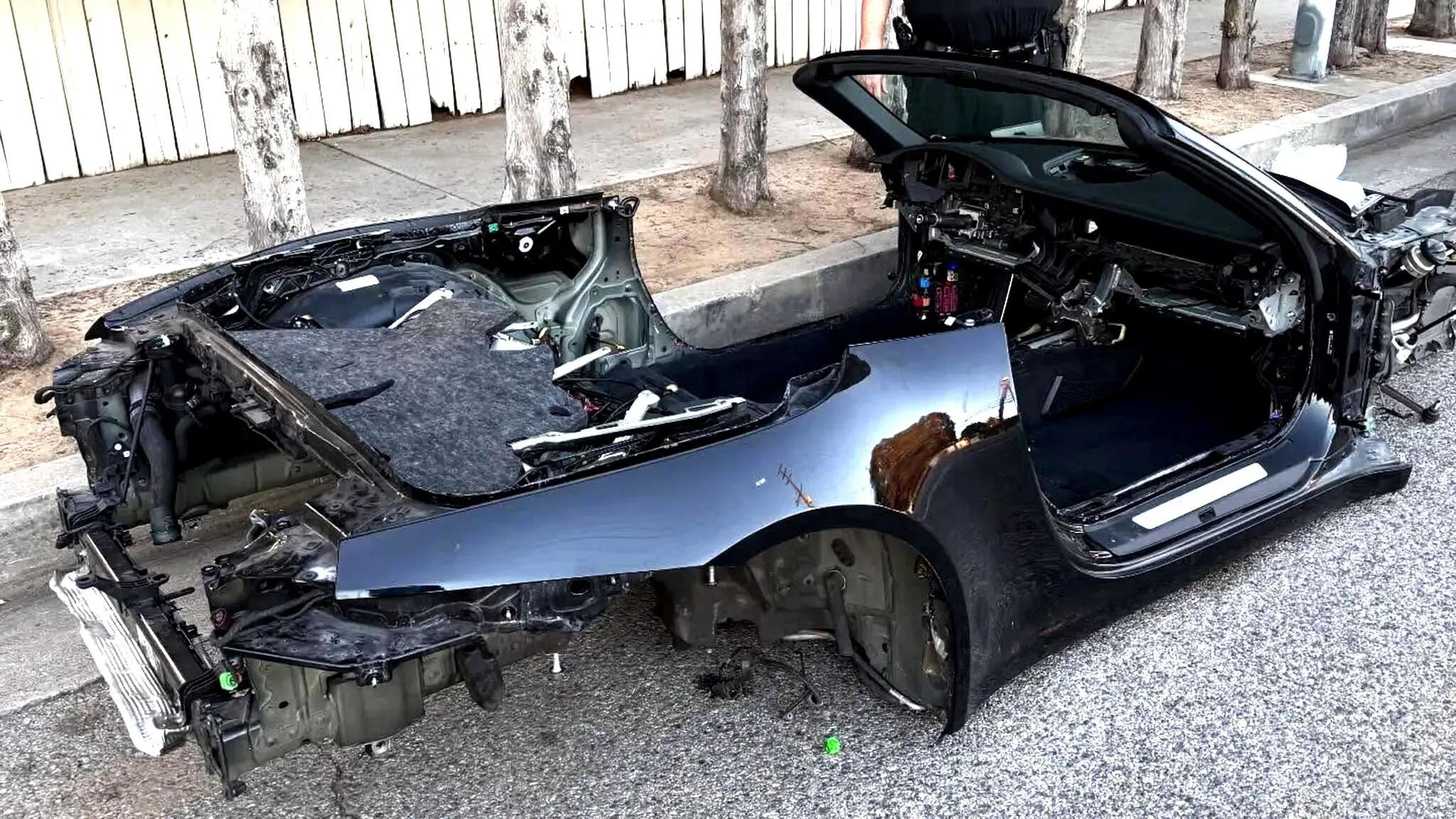
A Porsche 911 Cabriolet turning up without an engine is already bad. Finding it without doors, interior, or basically anything that makes it a car at all is something else entirely. That’s exactly what Los Angeles police were dealing with after recovering a stolen 911 that had been stripped so thoroughly it barely resembled what it once was.
What they recovered wasn’t really a car anymore. It was more like a skeleton. The convertible top was obviously gone, but so were the doors, the drivetrain, and the entire interior. Seats, trim, electronics, everything that could be removed had been taken. Even the engine had vanished, which tells you right away this wasn’t random.
This Was Surgical, Not a Joyride
Here’s the part that matters. You don’t strip a modern Porsche 911 down to that level unless you know exactly what you’re doing. This kind of teardown points straight at an organized operation. High-end cars like the 911 aren’t just stolen to be driven around or resold whole. They’re worth far more in pieces. Engines alone can fetch serious money. Same goes for transmissions, body panels, even small interior components. Someone out there is always looking for parts, and someone else is willing to supply them.
Modern 911s are not easy cars to steal. They come loaded with security features: immobilizers, tracking systems, encrypted keys, all of it designed to make theft difficult. But clearly, that’s not stopping anyone determined enough. If anything, it’s forcing thieves to get smarter, faster, and more organized. Because this wasn’t a smash-and-grab. This was planned.
Gone Before Anyone Knew to Look
Details about when and where the theft actually happened haven’t been fully laid out, which makes it harder to trace the timeline. But based on how stripped the car was, it likely didn’t take long once it was in the right hands. Professional crews can dismantle a vehicle like this in a matter of hours. Once the parts are separated, they disappear into different channels, and by the time the shell is found, the valuable pieces are already gone. That leaves the owner with what is essentially a total loss, even if the car is technically recovered.
The only clue left on this particular Porsche is the door sill marking that identifies it as a 911 Carrera. Beyond that, figuring out the exact model year or spec is almost impossible at a glance. Too much is missing. It’s a strange situation where one of the most recognizable sports cars in the world becomes almost anonymous once it’s taken apart.
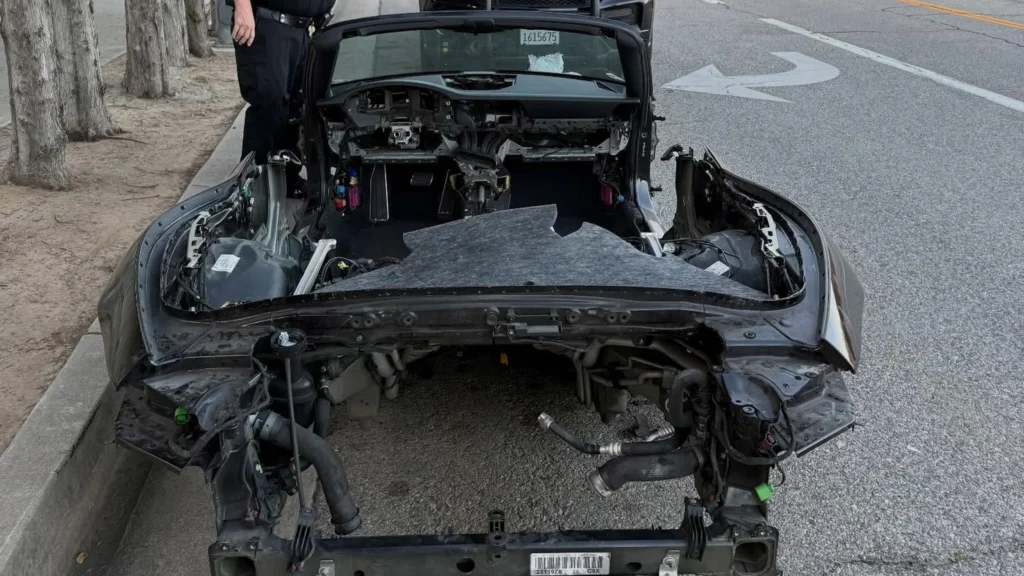
For enthusiasts, it’s tough to look at. The 911 Cabriolet is one of those cars that fits Los Angeles perfectly: open air, sharp performance, everyday usability. It’s the kind of car people work toward owning, and seeing one reduced to a bare frame hits differently if you know what it represents. But there’s a bigger issue here than just one car.
A Growing Market for Stolen Parts
This kind of theft isn’t isolated. It’s part of a pattern. High-end vehicles are increasingly being targeted not just for resale, but for parts, and the demand isn’t slowing down. If anything, it’s growing as repair costs rise and supply chains stay tight, which creates a market where stolen components can move quickly and quietly. And yes, owners are doing what they can: tracking devices, secure parking, updated security systems. It all helps. But when organized groups are involved, it becomes a different game entirely.
In the meantime, the owner is left dealing with the aftermath. Insurance will likely step in, but that doesn’t really replace what was lost. Anyone who’s owned a car like this knows it’s not just about the price tag. There’s time, effort, and a personal connection involved.
Still, there’s one hard truth sitting underneath all of this. If someone wants your car badly enough, especially a high-value one, they might not take the whole thing. They’ll just take it apart instead. And in some ways, that’s even worse.
Source
About the Author