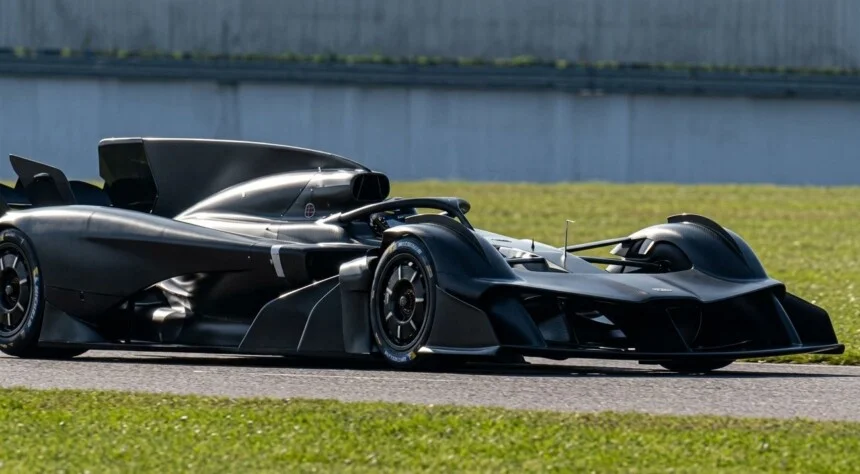
Something strange just rolled out onto an empty airfield, and it didn’t look like anything Aston Martin is supposed to be building right now. No camouflage overload, no attempt to hide what it is. Just a raw, single-seat machine that looks like it wandered straight out of a Formula 1 garage and took a wrong turn. And that’s where things change.
A One-Off Prototype With No Attempt to Hide Itself
A video started making the rounds online showing what appears to be a one-off Aston Martin prototype being put through its paces. It’s not subtle. One seat, center driving position, halo safety structure, exposed suspension. The kind of thing you don’t accidentally build unless you’re chasing something very specific.
The timing raises eyebrows too. Adrian Newey is already tied up with Aston Martin’s Formula 1 effort, working on the AMR26. That alone is a massive undertaking. But now there’s this. A completely separate machine, clearly influenced by top-tier motorsport, and it doesn’t look like a race car bound by regulations. It looks like something else entirely.
Exposed Suspension and an F1-Style Halo
From the footage, the proportions are extreme. Low, narrow, aggressively shaped. The nose is razor sharp, very much in line with modern F1 design language. Up front, you can see suspension components fully exposed, with wishbones and inboard dampers laid out in a way that screams race engineering rather than road car compromise. There’s no attempt to hide the mechanical bits. That’s intentional.
The cockpit sits right in the middle, single seat, surrounded by a halo structure just like you’d find in Formula 1. That alone tells you what direction this project is leaning. Safety hardware like that doesn’t show up unless the performance envelope demands it.

A Naturally Aspirated V12 in a Hybrid World
Then there’s the intake sitting directly above the driver’s head. Again, straight out of the F1 playbook. It feeds air into whatever is sitting behind the cockpit, and in this case, that’s where things get interesting. Because this isn’t electric. It’s not even hybrid. Everything points to a naturally aspirated V12.
And that’s where it gets complicated. Aston Martin has been leaning into hybrid systems with its newest performance cars. The Valhalla is a perfect example of that shift, combining a turbocharged V8 with multiple electric motors. That’s the future, at least on paper. Efficiency, power, all working together. This prototype goes in the opposite direction.
No visible signs of electrification. No packaging compromises for batteries. Just a tightly wrapped engine cover hugging what’s likely a large displacement V12. Old-school in the best way, but wrapped in cutting-edge aerodynamics. That contrast feels deliberate.
A Shark Fin, a Massive Wing, and Race-Car Floor
Moving toward the back of the car, the design tightens even more. The engine cover looks almost shrink-wrapped, hugging every contour underneath. A shark fin rises from the spine and stretches back into a massive rear wing that dominates the rear profile. It doesn’t look decorative. It looks necessary.
Down low, the floor and aero elements look straight out of a race car. There are bargeboards, aggressive shaping underneath, and surfaces designed to control airflow with precision. This isn’t about style points. It’s about grip, stability, and making the car stick at speeds most drivers will never see.

Not an F1 Car, Not an IndyCar, Not a Valkyrie
But here’s the part that matters. This thing doesn’t fit neatly into any existing category. It’s not a Formula 1 car. It’s not an IndyCar. It’s not a Valkyrie AMR Pro, even though that’s clearly part of its DNA. It’s sitting somewhere in between, borrowing from all of them without being restricted by any of them.
That usually means one of two things. Either it’s an experimental platform that never sees production, or it’s the early stage of something extremely limited and extremely expensive. Given Aston Martin’s recent direction, the second option feels more likely.
The Valkyrie already pushed boundaries, especially in AMR Pro form, where it leaned heavily into track-only performance. This new prototype looks like it takes that concept and strips it down even further. One seat. No compromises for passengers. No distractions. Just the driver and the machine.
The Newey Effect Raises the Stakes
That kind of focus isn’t for mass production. It’s for a very specific type of buyer. Someone who wants something closer to a race car than a road car, but without the restrictions that come with actual competition vehicles. And that’s where the stakes start to climb. If this turns into a real product, it won’t just be expensive. It’ll be exclusive in a way that makes even limited hypercars look accessible. There’s also the engineering challenge behind it. Building something this extreme, with this level of performance, and making it usable enough for private owners is not simple, especially without the safety nets of a racing series.
There’s also the Newey factor. His involvement changes how people look at this immediately. He’s known for pushing aerodynamic concepts to the edge, finding performance where others don’t. If he’s behind this, even partially, expectations jump. And expectations bring pressure.
No Confirmation, Just a Car That Shouldn’t Exist
Right now, all of this is based on what’s been seen and what can be inferred. There’s no official announcement, no confirmation, nothing tying it neatly into Aston Martin’s future lineup. Just a car on an airfield, moving fast, looking like it shouldn’t exist outside of a race weekend. Sometimes that’s how the most interesting projects start.
Here’s the hard truth. If this is what it looks like, a single-seat, V12-powered, race-inspired hypercar, it’s not going to stay quiet for long. Interest will build, speculation will grow, and if Aston Martin decides to move forward, demand will likely outrun supply before anyone even sees a final version.
For now, it’s a glimpse. But it’s the kind of glimpse that tells you something bigger is already in motion.
Source: @Scubachef1969 via Tiktok
About the Author